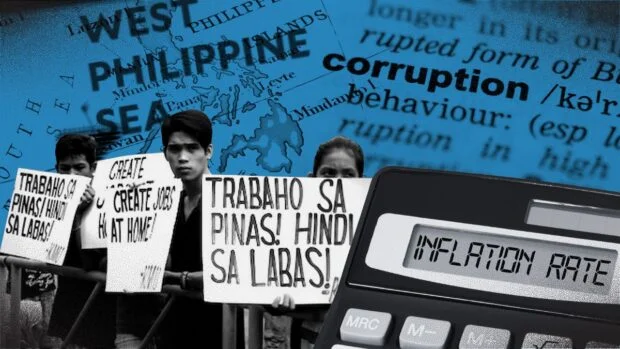
Inflation, jobs, corruption, WPS: Questions hanging over SONA 2026
MANILA, Philippines — As Malacañang described it, President Ferdinand Marcos Jr.’s fifth State of the Nation Address will be “simple, but dignified.”
But as the Philippines grapples with a growing list of challenges, a significant question remains: What will he tell millions of Filipinos when he stands at the Batasang Pambansa on Monday, July 27?
Based on the latest Pulse Asia survey, 57% of Filipinos are concerned about the need to control the rising cost of commodities, while 43% believe the government should fight corruption and hold erring officials accountable.
Article continues after this advertisement
Another 36% said increasing workers’ wages is an urgent concern.
More than 25% believe the government should do more to lift Filipinos out of poverty, while 15% said there should be more employment opportunities.
The number of jobless Filipinos rose slightly to 2.5 million in May from 2.4 million in April despite the broader labor market’s resilience amid the lingering effects of the Middle East war.
READ: Unemployment rate rose to 4.8% in May
Some 22% of Filipinos want the government to fight criminality, while 11% said the law should be enforced equally, whether a person is influential or not.
Article continues after this advertisement
More than 10% also identified the promotion of peace as an urgent national concern, but only 3% cited the defense of territorial integrity.
This comes despite China’s intensifying aggression against Filipino service members in the West Philippine Sea.
Article continues after this advertisement
The latest attack wounded two Philippine Navy sailors, one of whom was hit on the head with a wooden baton during a confrontation with China Coast Guard personnel. The Chinese personnel confronted Filipinos stationed aboard the BRP Sierra Madre at Ayungin Shoal, which is within the Philippines’ exclusive economic zone.
Malacañang has yet to provide details on what Marcos will discuss in his Sona, his second to last before his six-year presidency ends in 2028.
With some of the most critical issues confronting millions of Filipinos, here are points to consider when listening to the President’s speech:
Inflation
Last year, Marcos said the economy was doing well, pointing to easing inflation.
He immediately stressed, however, that “this means nothing when a lot of Filipinos are still struggling and burdened with their lives.”
He then said the government would strengthen the Department of Agriculture’s Kadiwa ng Pangulo program.
Less than a year later, the Middle East war broke out and sent inflation soaring to a three-year high of 7.2% as the spillover effects of the conflict persisted.
Last month, inflation eased to 6.4%, slower than the 6.8% recorded in May, bringing the year-to-date average to 4.8%.
Even before the inflation spike, the percentage of Filipino families that experienced involuntary hunger had already risen to 23.2% in March from 20.1% in November last year.
Involuntary hunger refers to being hungry and having nothing to eat at least once in the previous three months.
Employment
Marcos had said several government agencies would work together to find ways to provide employment opportunities to the remaining 4%, or 2.03 million people, in the labor force who were jobless.
In May, however, the unemployment rate rose to 4.8% from 4.7% a month earlier.
READ: Jobless Filipinos rise to 2.5M in May
Marcos did not mention wage increases in his Sona last year.
His economic managers had opposed a wage increase, saying it could have “dangerous repercussions” for the economy, such as higher inflation and joblessness.
The 19th Congress ended without passing a wage increase bill.
On July 14, the Department of Labor and Employment said more than 1 million workers in Metro Manila would receive the first tranche of the P85 minimum wage increase on Saturday, July 25.
Malacañang said Marcos would not defer the implementation of the minimum wage increase.
Outside Metro Manila, Marcos said some regions might have to wait until the last quarter of 2026 before their respective wage boards decide on proposed wage increases.
“That may take a while longer,” he said.
The wage increase in Metro Manila is expected to raise the minimum wage from P695 to P780.
Health
Last year, Marcos announced that the government would proceed with its “zero balance billing” policy, under which patients at Department of Health hospitals would not have to pay for basic accommodation.
“I will repeat: patients no longer need to pay anything at DOH hospitals because your bill has already been paid,” he said.
On Jan. 5, the DOH said its zero balance billing policy would be implemented in selected LGU-owned hospitals after Marcos announced that P1 billion of the department’s resources for 2026 would be allocated to the program.
Under the policy, which was implemented beginning May 18 last year, patients admitted to the basic wards of any of the 87 DOH-operated hospitals no longer have to pay out of pocket, regardless of their economic status.
Law enforcement
The Philippine National Police reported lower crime rates across the country after three months of implementing its “Safer Cities” initiative.
“The Philippines is safer now as compared to the previous periods,” the PNP said.
In May, the crime rate dropped by 25.77%, with the police recording 2,149 focus crime cases from May 1 to 30.
This was 746 fewer than the 2,895 focus crime incidents recorded during the same period last year.
READ: PNP: Crime rates in PH dropped by 25.77% in May 2026
In his 2025 Sona, however, Marcos’ remarks against corruption took center stage, particularly his disclosure that only 15 contractors had cornered P100 billion of the P545 billion allocated for flood control projects since 2022.
“Shame on you,” he said.
Almost a year later, several people linked to the scandal have been arrested and jailed, including former Sen. Bong Revilla, Sen. Jinggoy Estrada and contractor couple Curlee and Sarah Discaya.
Still, a lawyer interviewed by the Inquirer said, “The president has not done enough to back his promise to resolve corruption in his administration.”
The lawyer said the Ombudsman’s case filings should not be presented as an achievement because prosecuting corrupt officials is the office’s responsibility.
West Philippine Sea
Last year, Marcos said that despite threats to peace and sovereignty, the Philippines had intensified its preparedness, surveillance and defense while continuing to exercise patience in protecting the archipelago and its interests.
The Philippines, he said, could better defend itself because of its allies.
“Today, our confidence is even stronger because we now have more partners who will stand with us and support us in times of great need,” he said.
As of October last year, the government had lodged more than 200 diplomatic protests.
The actions of China Coast Guard and Chinese militia vessels that have been condemned as “harassment” continued, with Filipino fishermen facing water cannon blasts, dangerous blocking maneuvers and the cutting of anchor lines.
On Monday, July 20, the National Task Force for the West Philippine Sea condemned the CCG’s “violent and unlawful” activities inside the Philippines’ EEZ.
The Armed Forces of the Philippines said a CCG rigid-hull inflatable boat carrying eight personnel from the vessel CCGV 21560 illegally approached the BRP Sierra Madre at close range.
The World War II-era warship was intentionally grounded to serve as a Filipino outpost in the West Philippine Sea.
Marcos denounced the incident, with Malacañang saying, “The President condemns these kinds of incidents.”
Less than a year after Marcos took office, the government marked a sharp departure from the previous administration’s appeasement policy toward China, which has consistently rejected the landmark 2016 arbitral award.
The ruling found that none of the features claimed by China were capable of generating an EEZ.
When Rodrigo Duterte became president in 2016, his administration adopted an appeasement policy that sought closer relations with Beijing while distancing the Philippines from the United States, its long-standing treaty ally. /dm
Visit our Sona 2026 live coverage to stay updated with the latest #SONA2026 news and stories.