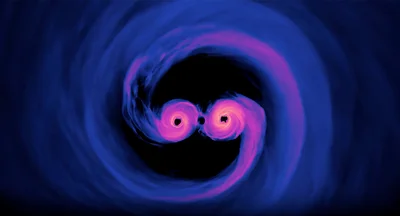
Supermassive black holes are believed to be at the heart of every galaxy, but how did they get so big? Likely by gobbling up other black holes, astronomers say.
Unfortunately, supermassive black holes in close proximity to each other have proved difficult to find—until now. New research from the Max Planck Institute accepted for publication in Monthly Notices of the Royal Astronomical Society describes a pair of these behemoths orbiting one another on a cosmic collision course.
The team analyzed high-resolution observations of the galaxy Markarian 501 recorded over a period of 23 years and discovered not just one jet of matter screaming into space, but two—there was a second black hole inside the galaxy. “We searched for it for so long, and then it came as a complete surprise that we could not only see a second jet, but even track its movement,” Britzen said in a statement.
Read more: “Why It’s Hard for Black Holes to Get Together”
The jet from the first black hole points toward Earth, making it considerably bright to radio telescopes. The second jet starts behind the first black hole, moving counterclockwise around it. Because of the gravitational lensing of the first black hole, the radiation emitted by the second reaches us on a warped path.
“Evaluating the data felt like being on a ship,” said Britzen. “The entire jet system is in motion. A system of two black holes can explain this: The orbital plane sways.”
SIGNS OF BLACK HOLES: This illustration shows the central region of the galaxy Mrk 501 on three different days. The previously known jet pointing toward Earth is marked with an orange line. The newly discovered second jet (highlighted in blue) changed its appearance within a few weeks. Both particle streams originate close to each other in the core of the galaxy. Illustration by S. Britzen.
Their analysis revealed that the two black holes orbit each other once every 121 days and are roughly 250 to 540 times farther apart than the distance between Earth and the sun, which is pretty close considering their gargantuan masses. Depending on how big they are, the pair could collide at some point in the next century.
Unfortunately, they’re so far from Earth—at least tens and maybe even hundreds of millions of light-years away—that we won’t be able to directly observe their cosmic collision. So how will we know? The system should emit low-frequency gravitational waves as the duo merge, which astrophysicists will be able to detect with pulsar timing arrays.
By measuring discrepancies in the timing of flashes from an array of well-known pulsars, astronomers can discern the minute effects of these waves. “If gravitational waves are detected, we may even see their frequency steadily rise as the two giants spiral toward collision, offering a rare chance to watch a supermassive black hole merger unfold,” study co-author Héctor Olivares said.
Of course, on a galactic scale these mergers are happening all the time, so it’s possible we’ll get to see one sooner. Until then, mark your calendars for (at most) 100 years in the future.
Enjoying Nautilus? Subscribe to our free newsletter.
Lead image: NASA's Goddard Space Flight Center/Scott Noble; simulation data, d'Ascoli et al. 2018