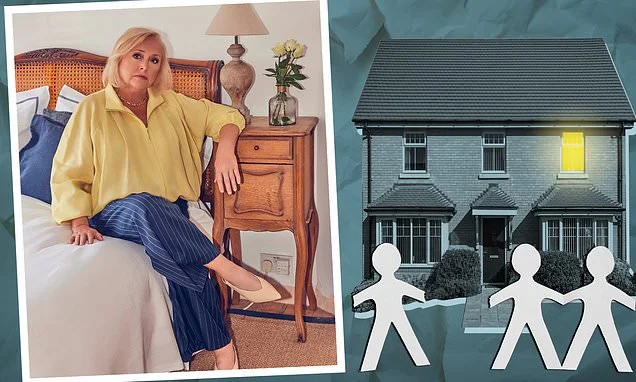
The sound I remember most isn’t the laughter as they climbed the stairs. It’s the electric toothbrush.
At 60, I never imagined that I’d be standing shoulder to shoulder with my daughter in the bathroom, brushing our teeth with unnecessary enthusiasm, silently willing the buzzing to drown out the unmistakable squeaks coming from the bedroom next door.
The bed that’s creaking beneath them isn’t just any old bed either. I bought it with my very first wage packet when I was working in Liverpool on This Morning and Richard & Judy. It’s old enough to tell a thousand stories. Right now, though, it feels as though it doesn’t belong to me any more.
My daughter catches my eye in the mirror. Neither of us says a word. We don’t need to. We simply brush our teeth a little louder.
Most people imagine a break-up ends with someone packing a suitcase, slamming the front door and disappearing into a new life.
Increasingly, though, couples are stuck together.
Research commissioned by the property website Zoopla found that around a third of homeowners who separate are forced to continue living together, often for more than a year because they simply can’t afford to live apart.
I was one of them.
Nicky Taylor's ex-partner was a 61-year-old eccentric teacher with a dry sense of humour
While living with him and his new love, she felt her own home was no longer entirely hers
No one prepares you for what comes next. Not the rows. It’s the tiny indignities. The gradual feeling that your own home is no longer entirely yours.
The strange thing is, when we first got together in 2016, I didn’t think I’d met the love of my life. I’d spent years bringing up my three children on my own.
They had been just three, two and one when I left their father, to whom I’d been married for five years. I was 36.
By then I’d got rather used to being the only adult in the house and had stopped expecting anyone to come riding over the hill on a white horse. I wasn’t actively looking for another relationship. But he intrigued me.
We met online. His username was Bloodaxe. Not exactly the sort of name that whispers, ‘Marry me’.
He was 61, an eccentric teacher and poet with a wonderfully dry sense of humour. All ska music, quirky hats and cool shades. I, meanwhile, was The Sound Of Music, Andrew Lloyd Webber and Heart Radio. On paper, we probably shouldn’t have worked.
But somehow . . . we did.
We’d lived only a few streets apart in Brighton without ever meeting. Our children already knew each other from school. He made me laugh. It felt worth taking a chance.
The hardest part for Nicky was discovering that she no longer felt like sharing with others
We’d only been together for about a year when we bought a house together. Thinking about it now, it was an enormous leap for two people aged 51 and 61 who barely knew each other. But we were sensible. If it all went wrong, we’d both be financially protected.
And for the first four years it went wonderfully right.
I’d always dreamed of creating one of those gloriously chaotic blended families where everyone somehow finds their place. For a while, it felt as though we had. My son, then in his teens suddenly had another football fanatic to disappear off with for hours discussing VAR, transfers and every match under the sun while the girls and I rolled our eyes.
I created a gallery wall in the hallway with matching frames, carefully filling them with photographs of his family, my family and, slowly, our family together. Different histories and surnames. Somehow becoming one.
It all sounds slightly nauseating now. In fact, if you’d met me back then, you’d probably have wanted to give me a gentle shake. I embraced this blended family lark with embarrassing enthusiasm. And, yes, we even sent Christmas cards with photographs of us all in them.
It all seems almost absurdly optimistic in retrospect. But that’s the thing about hope.
Then life quietly changed the script.
The children did exactly what they are supposed to do. They grew up. One by one the bedrooms emptied, the football conversations stopped and the beautifully chaotic family life that had filled every corner of the house disappeared.
For the first time it was just the two of us. Without all that glorious noise and distraction, we were left facing something we’d probably ignored for years. We really were very different people.
The differences that had once made us smile became the places we each retreated to for comfort when life became difficult.
She and her daughter found themselves brushing their teeth together to drown out the noise (posed by models)
Meanwhile, I was desperately trying to keep my television production company afloat. The industry was shrinking and every commission felt harder to win than the last.
Life became heavier. Money became tighter. The fun started to drain away. And I slowly became someone I didn’t much like. I was anxious. Short-tempered. I didn’t recognise myself.
I’d always imagined that if one of us hit hard times, the other would instinctively say: ‘Don’t worry. We’ll get through this together.’
Instead, when we talked about it, the conversation became about money. What each of us could afford. Who should pay for what. It wasn’t unkind. It wasn’t even an argument. It was simply practical.
Perhaps we’d been speaking different languages all along. Back then, I thought it was just ska and show tunes. Now I realised it ran much deeper than that.
He spoke practicality. I spoke reassurance. He was trying to solve a financial problem. I needed to hear: ‘Don’t worry. We’ll get through this together.’
That’s when something shifted.
It wasn’t really about the money. In that moment, I realised we’d been measuring love by completely different yardsticks.
And one day in 2023 I found myself saying something I never imagined I’d say: ‘I don’t think I want to be in this relationship any more.’
Not because we’d had some spectacular row. Not because either of us had done anything unforgivable. Simply because I’d realised we had completely different ideas about what being partners meant. No slammed doors. No dramatic scenes. Just the sad acceptance that after seven years we’d reached the end of our story.
What happened next was, in many ways, entirely understandable. He started looking forwards. I was desperately trying to stay afloat.
People often ask why we didn’t simply sell the house and move on. If only it had been that simple.
I’d lost my job. And without a regular income there was no chance of getting another mortgage. The one I already had was fixed at just over 1 per cent. In today’s world, that felt almost mythical. Walking away from it just as my career had collapsed seemed impossible.
But it was more than that. The house had stopped being bricks and mortar. It had become my anchor. Everything else felt uncertain. My career. My confidence. My future. The house was the last thing in my life that still felt solid. I clung to it with both hands.
He wanted a fresh start. I wanted somewhere safe to land. Neither of us was wrong. We were simply trying to survive in completely different ways.
So, while I was trying to work out how to rebuild my life, he applied to appear in a newspaper dating feature entitled Over 60 And Still Got It. He actually told me after he’d done it.
I don’t think there was any attempt to hurt me. Quite the opposite. I think he genuinely believed we’d both moved on. Perhaps he couldn’t understand why it mattered. At the time, I couldn’t understand why it didn’t.
A few weeks later he met someone he really liked through the feature, and before long she was staying at the house. Because neither of us could afford to untangle our lives overnight, there we all were, trying to live under the same roof for completely different reasons. That’s when my house stopped feeling like home.
People imagine the hardest part is the arguments. It wasn’t. The hardest part was discovering I no longer liked sharing – which came as something of a shock because I’d always considered myself a bona fide sharer.
One morning I heard the two of them chatting over breakfast downstairs and realised I’d become the sort of woman who now kept her porcini mushrooms next to her winter coats. My bedroom looked less like somewhere to sleep and more like the Waitrose World Foods aisle. Forget knickers and shoes, my wardrobe was full of pickles and booze. Well, smoked Maldon sea salt, Dijon mustard and elderflower liqueur to be precise.
Who hides condiments in a wardrobe? Apparently I did.
Ridiculous? Entirely.
Necessary? It felt like it.
Because this wasn’t really about food. It was about trying to preserve the last little corners of a life that still felt like mine.
Eventually I’d take a deep breath and make myself go downstairs for breakfast. I’d tell myself: ‘Come on, Nicky. Be a grown-up.’ And there she’d be. Sitting at my table. Not an expensive table. Not some priceless antique. Just an old pine table I’d bought 35 years earlier when I was a young television researcher living my best life in a tiny flat in the Manchester suburb of Didsbury.
That table had quietly witnessed almost every chapter of my adult life: my first marriage, feeding my three children their first spoonfuls of real food, and, years later, this unexpected second act.
Every dent. Every scratch. Every ring left by a coffee mug carried a memory. And now someone I’d never invited into that story was eating her breakfast from the little egg cup my daughter had bought me.
I smiled politely. Inside my head I was thinking: ‘Who are you? I didn’t invite you into my life.’
It wasn’t really about the crockery. Or the pine table. It was the feeling that somebody had wandered into my memories and made themselves at home.
Outside in the garden stood my hammock chair. Every morning I’d curl up in it with a cup of tea for ten peaceful minutes before the day began. Then, one morning I looked outside. She was sitting in it. Swinging gently. My ex was playing flamenco guitar. I remember thinking, rather childishly: ‘Get off! That’s my chair.’
Now I can smile. At the time, it didn’t feel funny at all.
Then there was the Jo Malone bath oil. We’d always loved sitting at opposite ends of the bath chatting about life. Now he was recreating that moment with somebody else – using my favourite bath oil. I know it sounds ridiculous. But grief has a habit of attaching itself to the smallest things.
Friends kept telling me I should start dating, too. I remember thinking: ‘Are you kidding?’ I was still trying to save the roof over my head. Finding another man was the last thing on my mind.
What surprises me most isn’t the anger. It’s how diminished I felt. I’d spent years building a home. Raising children. Creating traditions. Then, suddenly, it felt as though somebody had picked up an eraser and started rubbing it out.
For a long time I thought nobody was standing up for me. I wanted somebody to march into the house and say: ‘Don’t you dare treat her like that.’
I now know that people did stand beside me. Just without the confrontation I’d secretly hoped for. When the dating article appeared, my friend Gina wrote to him asking him how on earth he could be so hurtful. Other friends let him know exactly what they thought, too. They didn’t fight my battles. They simply reminded me that I wasn’t invisible.
The truth is, I’m far from unique. Across Britain, thousands of separated couples are still sharing homes because they simply can’t afford to leave. Mortgages don’t disappear because relationships do. Neither do interest rates.
Of course, people move on. They should. Nobody owns another person for ever. But when you’re still sharing the same front door, there is something uniquely painful about watching somebody else’s new beginning before you’ve even had the chance to finish your own ending.
This isn’t really a story about my ex. Or even about his girlfriend. It’s about what happens when one life hasn’t quite been packed up before somebody else starts unpacking their new one.
If you’d told me back then, while my daughter and I stood brushing our teeth just a little louder to drown out the squeaky bed next door, that one day I’d look back on that period as the beginning of a happier life, I’d have laughed. But life has a funny way of surprising you.
Eventually when it got too much, I realised it wasn’t just the house that was changing, I was. I found myself thinking thoughts I didn’t recognise and behaving in ways that simply weren’t me. My children gently suggested I speak to someone.
I went to my GP convinced I needed antidepressants. Instead, after listening quietly, she looked at me and said: ‘I’m not surprised you’re struggling. I’m amazed you’ve managed for as long as you have.’
Hearing that was oddly reassuring. It wasn’t that I was broken – I was living through an extraordinarily difficult situation.
It wasn’t really about him. Or his new partner. I just couldn’t bear feeling permanently on edge in the place that had once made me feel safest.
In the end, my mum helped me find a house to rent while ours was on the market. Walking out of the front door wasn’t admitting defeat. It was the first step towards becoming myself again.
We had been together for seven years. After the split, we endured one excruciating year living under the same roof while our house slowly made its way onto the market. I then rented for a year before finally buying my own tumbledown house that I’m now restoring one room at a time. In many ways it’s been restoring me, too.
Most importantly, I like this version of me. Because home, I’ve realised, isn’t really the bricks and mortar I clung to. It’s the life you build inside them.
Sometimes one chapter ends before you’re ready. Sometimes another begins before you’ve even packed the first one away. And somehow, without even noticing – you discover you’re home.