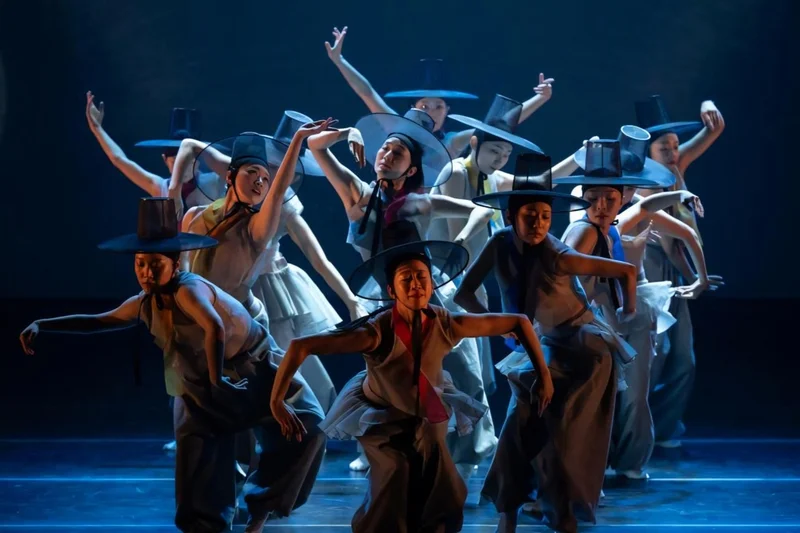
BUSAN — Inspired by the 22nd hexagram of the I Ching — symbolizing "refined beauty resting upon true essence" — the performance "Sanhwabi: HEXAGRAM 22," a special congratulatory show for Korea's hosting of the 48th session of the UNESCO World Heritage Committee here, transformed the stage into a vibrant intersection of past and present.
Held "in search of the core strength and new frontiers of intangible cultural heritage," the production presented a sweeping reinterpretation of Korea's centuries-old artistic traditions, fusing classical masterworks with striking contemporary elements.
Organized into seven thematic movements — breath, sound, line, light, pan (communal space), rite and harmony — the showcase demonstrated how living heritage can evolve while honoring its roots.
The performance opened with a grand entrance from behind the audience as members of "Daechwita" (traditional Korean military music), dressed in traditional yellow robes with blue sashes, marched in to recreate the royal processionals of the Joseon Dynasty (1392-1910).
The stately opening transitioned into "Seodo Sori," the folk vocal tradition from the Hwanghae Province and Pyeongan Province regions, located in present-day North Korea. National Intangible Cultural Heritage holder Kim Kwang-suk, accompanied by Oh Cho-rong on the "piri" (a traditional bamboo oboe), delivered a primordial vocal performance that conveyed the historical joys, sorrows and hopes of the Korean people.
Visual arts quickly took center stage during a movement highlighting the "gat" (traditional Korean horsehair hat). Set against dynamic media art backdrops, dancers wearing gat traced graceful lines and balanced curves across the stage, channeling the precision of traditional craft artisans into physical motion.
The musical peak of the evening arrived during a duet featuring the "haegeum" (a two-stringed vertical fiddle) and the "ulla" (a percussion instrument consisting of ten small tuned gongs).
Moving seamlessly between mournful melodies and rapid rhythmic passages, the haegeum filled the hall without needing vocal accompaniment. As the sorrowful string tones built toward a thunderous percussion climax before fading away, the entire audience remained spellbound in total silence. This poignant moment gave way to "Taepyeongmu," a regal dance traditionally performed to pray for national peace and prosperity.
Audience enthusiasm reached a high point during the communal celebration phase, which drew from Korean shamanic rituals "gut" and folk festivities. Against a backdrop of psychedelic media visuals and modern electronic music, Park Jeong-wook, an initiate of the "Pyeongsan Sonoreumgut" (shamanic ox performance of Pyeongsan), executed ceremonial rites that included drawing a sacred flag to extend blessings to the crowd.
The energy remained high as performers delivered the Lion Mask Dance of Bukcheong. Wearing intricate lion masks traditionally used to ward off evil spirits on the first full moon of the lunar year, the dancers delighted attendees with dynamic stunts, tail spins and humorous movements.
Adding a modern edge to the shamanic motifs, 64ksana — an alternative electronic band that fuses techno beats, traditional percussion and vocals — transformed the auditorium into a shared, high-energy space where past and present merged.
The classical program concluded with the majestic "Ilmu" (the ceremonial line dance associated with Jongmyo Jeryeak, the Royal Ancestral Ritual Music enshrined as a UNESCO Intangible Cultural Heritage of Humanity).
For international audience members, the blend of discipline and modernization left a lasting impression.
"I liked it from the beginning; it was actually very touching," said Ira, a Ukrainian resident of Busan, noting that a female soloist singing the Korean traditional folk song "Arirang" beneath a illuminated moon was both beautiful and sad.
Layne, an attendee from South Africa who had previously encountered Korean marching bands in her home country, praised the performance's balance.
"The mixing of modern and traditional elements showed how far Koreans have come, but how they should still remember where they come from," she said, highlighting the mesmerizing movement of the hat dance and the overall performance.
The performance concluded with the cast and audience joining in a collective rendition of "Arirang." Singing lines that say, "Arirang, arirang, arariyo... countless stars shine in the clear blue sky, countless hopes live within our hearts," the crowd closed the night with a unified message of peace, well-being and global harmony.