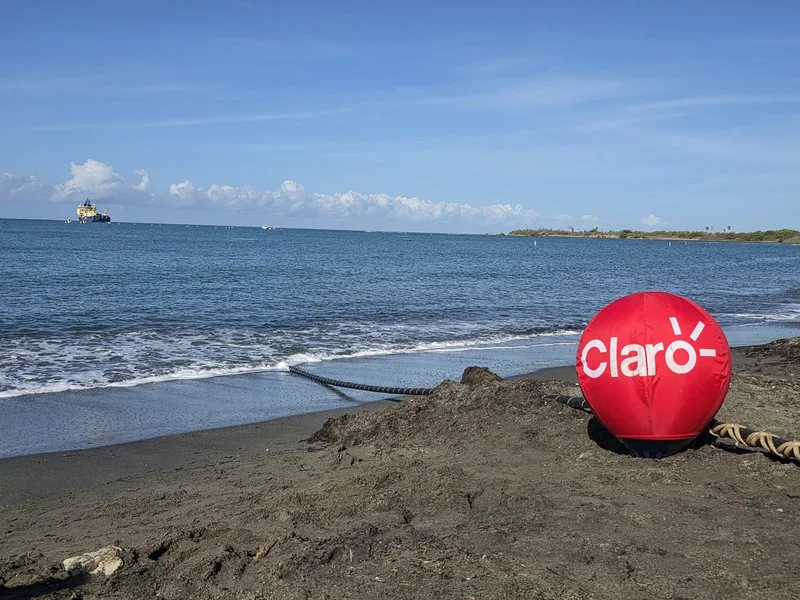
Claro Lands US$35M Submarine Cable in Ponce, Puerto Rico
Puerto Rico · Companies
Claro Puerto Rico has completed a Puerto Rico submarine cable landing in the southern city of Ponce, investing US$35 million to create the island’s first redundant international internet connection point outside the northern corridor. The project, an extension of the América Móvil-owned AMX-1 system, aims to fortify connectivity and disaster resilience in a territory where hurricanes have repeatedly devastated critical infrastructure.
The AMX-1 System and Its New Southern Route
The AMX-1 submarine cable is a vast fiber-optic system owned by Mexican telecommunications group América Móvil, the parent company of Claro. Built by Alcatel Submarine Networks, the cable stretches approximately 19,300 kilometers and links the United States, Mexico, Colombia, Brazil, the Dominican Republic, Costa Rica, Guatemala, and Puerto Rico.
It features 15 landing points across eight jurisdictions. Until now, Puerto Rico’s connection to this network entered exclusively through the island’s northern coast. The new Ponce landing adds a critical southern entry point, diversifying the physical routes through which data reaches the island.
The underwater connection was completed on June 17, according to local daily El Nuevo Día. América Móvil initiated the project in 2023, and the deployment in the south was publicly announced in July 2026 with the cable already physically landed.
The connection point is located on the beach in Ponce, adjacent to the Ponce Hilton area. This makes Ponce the first and only submarine cable connection point for data transmission in Puerto Rico’s southern region.
Capacity and Technical Specifications
The AMX-1 cable is designed for high-capacity data transmission. It supports speeds of 100 gigabits per second, with a total system capacity reaching up to 90 terabits per second. This bandwidth is essential for handling growing demand from businesses, consumers, and government services.
For context, one terabit per second can transmit roughly 250 high-definition movies in a single second. The cable’s design ensures that Puerto Rico can access a meaningful share of this capacity, supporting everything from cloud computing to streaming and remote work.
The system’s scale reflects América Móvil’s broader strategy to connect major markets across the Americas. Puerto Rico, as a U.S. territory with a developed digital economy, benefits from being integrated into this high-capacity backbone.
Resilience and Redundancy in a Hurricane-Prone Island
Puerto Rico’s telecommunications infrastructure has long been concentrated in the northern part of the island. This geographic concentration creates a single point of failure. When hurricanes strike, as they did with Maria in 2017 and Fiona in 2022, damage to northern landing stations or terrestrial networks can sever international connectivity for millions.
The Ponce landing directly addresses this vulnerability. By creating a redundant southern path, internet traffic can be rerouted if northern cable routes are disrupted. Claro states the project is meant to strengthen network resilience, expand bandwidth, and diversify Puerto Rico’s international communication routes.
This redundancy is not merely a technical upgrade. It is a matter of public safety and economic continuity. Emergency services, financial transactions, and remote work all depend on stable internet connections. A diversified cable network reduces the risk of a total communications blackout after a natural disaster.
Puerto Rican officials and federal reports have repeatedly emphasized the need for more robust, diversified subsea routes. The island’s post-hurricane recovery efforts have included significant federal funding for broadband resilience, making private investments like Claro’s complementary to public goals.
Puerto Rico’s Telecom Infrastructure Context
For foreign investors and expats, understanding Puerto Rico’s connectivity landscape is essential. The island has long relied on submarine cables landing in the north, including systems like Americas-II and others connecting to the U.S. mainland and the broader Caribbean.
The territory’s broadband plan, once branded as the ‘Gigabit Island Plan,’ has aimed to position Puerto Rico as a competitive digital hub. However, progress has been uneven, and the concentration of international links in one corridor remained a recognized weakness.
The government has separately pursued a new submarine cable project through a bidding process, with one proposal citing 275 direct and 600 indirect jobs. That initiative is distinct from Claro’s AMX-1 extension. Claro has not released a formal job-creation estimate specific to the Ponce landing.
What Claro’s investment signals is confidence in Puerto Rico’s long-term demand for data. The US$35 million deployment adds physical infrastructure that can serve data centers, call centers, and the growing population of remote workers who have relocated to the island in recent years.
What the Ponce Landing Means for Business and Daily Life
For the average internet user in Puerto Rico, the new cable may not produce an immediate, noticeable speed boost. Its primary value lies in reliability and future capacity. Businesses that require uninterrupted connectivity, such as financial services firms and customer support centers, stand to benefit most directly.
The southern city of Ponce, Puerto Rico’s second-largest urban area, gains a strategic asset. The presence of a submarine cable landing station can attract technology investment and support local economic development. It positions Ponce as a digital gateway, not just a cultural and industrial hub.
Expats and investors considering Puerto Rico under its tax incentive programs, including Acts 20 and 22, often cite internet reliability as a key factor. The existence of a redundant southern cable route strengthens the island’s value proposition as a remote work destination.
The project also underscores a broader trend in Latin America and the Caribbean: the push to build resilient digital infrastructure that can withstand extreme weather. As climate patterns intensify, investments in diversified subsea networks become less of a luxury and more of a necessity.
Looking Ahead
With the physical landing complete, the focus will shift to integrating the Ponce connection into Claro’s broader network and making capacity available to customers. The company has not disclosed a specific commercial launch date for services riding the new route.
The AMX-1 extension arrives as Puerto Rico continues to rebuild and modernize its infrastructure with a mix of federal recovery funds and private capital. The island’s telecom sector is seeing increased attention from both incumbent operators and new entrants seeking to close connectivity gaps.
For now, the Ponce landing represents a concrete step toward a more resilient Puerto Rico. It adds a layer of protection that was missing during past hurricanes, when the island’s dependence on northern connections left it dangerously exposed.
Frequently Asked Questions
What is the AMX-1 submarine cable?
The AMX-1 is a 19,300-kilometer fiber-optic submarine cable owned by América Móvil and built by Alcatel Submarine Networks. It connects the United States, Mexico, Colombia, Brazil, the Dominican Republic, Costa Rica, Guatemala, and Puerto Rico with 15 landing points.
Why did Claro land the cable in Ponce instead of San Juan?
All of Puerto Rico‘s previous international submarine cable connections landed in the north. The Ponce landing creates a redundant southern entry point, ensuring internet traffic can be rerouted if northern cables are damaged by hurricanes or other disruptions.
How much did the Ponce submarine cable project cost?
Claro Puerto Rico announced an investment of US$35 million to deploy the AMX-1 submarine cable extension to Ponce.