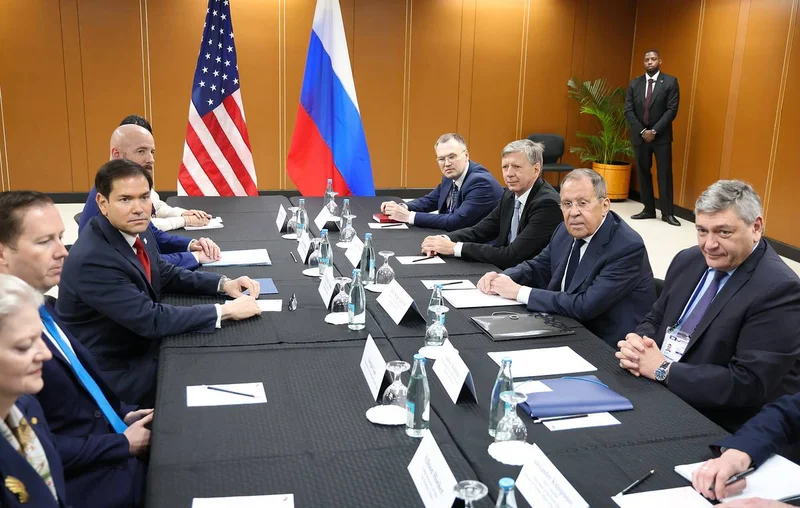
MOSCOW, July 24. /TASS/. Moscow and Washington appear to be keeping diplomatic channels open as the US searches for a new approach to resolving the Ukraine conflict; the EU’s latest sanctions package reflects a compromise between tightening pressure on Russia and protecting the bloc’s own economic interests; and Germany’s approval of Russian-designed nuclear fuel production underscores Europe’s continued reliance on Russian nuclear technology. These stories topped Friday’s newspaper headlines across Russia.
New ideas are needed to resolve the conflict in Ukraine, US Secretary of State Marco Rubio said on July 23 following a 35-minute meeting with his Russian counterpart, Foreign Minister Sergey Lavrov, held on the sidelines of ASEAN ministerial events in Manila. On its official website, the Russian Foreign Ministry described the meeting with Rubio as "a substantive exchange of views on a broad range of bilateral and international issues." Experts interviewed by Vedomosti believe that while the Lavrov-Rubio meeting shows that both sides are still committed to diplomacy, Washington is pivoting to a new approach to negotiations, given the failure of previous efforts.
One of the main topics of discussion was the normalization of the operating conditions for the two countries’ diplomatic missions. Regarding Ukraine, the Russian Foreign Ministry’s statement emphasized that Lavrov had briefed his US counterpart on the actual situation along the line of combat engagement and stressed the inadmissibility of continued arms supplies to the Kiev government, as well as what Moscow described as the broader destabilizing policies of European countries.
Russia’s top diplomat also reaffirmed Moscow’s readiness to settle the conflict and its "commitment to the proposals put forward by the American side" at last year’s bilateral summit in Anchorage.
The United States is trying to take a new approach in the Russia-Ukraine conflict, Pavel Koshkin, a senior research fellow at the Institute for US and Canadian Studies of the Russian Academy of Sciences, told Vedomosti. According to him, Moscow and Washington regarded the Alaska summit as a way to find common ground rather than reach a final settlement. "From the outset, both sides viewed the prospects for resolving the conflict between Moscow and Kiev with very cautious optimism. However, that does not mean diplomacy has been abandoned. It continues. One approach has failed, so they will look for another. The question is when they will find it and at what cost," Koshkin said.
The Lavrov-Rubio meeting undoubtedly reflects both sides’ interest in negotiations, although that interest is driven by different objectives, political analyst Alexey Naumov told the newspaper. He explained that Russia views the preliminary agreements reached in Anchorage as carrying a lot of weight, while "the United States under Trump approaches those negotiations with far less reverence," the expert noted. At the same time, Naumov believes that genuine negotiations are not yet possible and are not needed by either side, as developments are currently being decided on the battlefield.
The European Union has approved the main provisions of its new 21st sanctions package against Russia, which include a one-year freeze of the price cap for EU-compliant buyers of Russian oil at its current level of $44.1 per barrel. In addition, the European Commission approved sanctions against another group of Russian banks and cryptocurrency exchanges, new sanctions targeting the Moscow Exchange, and Russia’s defense industry enterprises. Experts interviewed by Vedomosti believe that the EU’s new sanctions package will have only a limited impact on Russian oil exports because European carriers are no longer central to Urals shipments, while Greece is expected to continue resisting EU efforts to curb Russian LNG shipping due to its own economic interests.
The nearly six-month conflict in the Middle East drove global oil prices higher, creating pressure to raise the price cap in a way that would contradict its original purpose, Igor Yushkov, expert at the Financial University under the Russian Government, told the newspaper. "The freeze is designed for the moment when Urals prices decline, so that the cap can then be lowered further," he said. According to energy expert Kirill Rodionov, such a decline in oil prices may occur after the Iranian conflict is settled in the fall, around the time of the Knesset elections in Israel and the US midterm congressional elections.
EU companies are not the key carriers of Urals crude, so the 21st sanctions package is unlikely to have a significant impact on oil trade, Rodionov believes. Any European price cap has little effect on the physical ability to deliver oil to buyers in India, Turkey, and China. What is being lost is freight capacity provided by companies from Greece, Cyprus, and Malta, Alexander Belogoryev, Research Director at the Institute of Energy and Finance, told Vedomosti. However, when benchmark oil prices are high and selling Urals crude at $44.1 per barrel becomes economically irrational, the loss of European shipping narrows freight availability and drives up transportation costs, Belogoryev said. "It is European shipowners, primarily Greek ones, who suffer from the price cap. When oil prices rise, the cap begins to work, but not in the way EU politicians imagine," he added.
The attempt to ban European companies from transporting Russian liquefied natural gas (LNG) to third countries encountered resistance from Greece and shipping company Dynagas, which is owned by Greek shipowners. Dynagas is a partner in the Yamal LNG project, Russia’s only supplier of liquefied natural gas to Europe. The company owns a 49% stake in the tanker consortium transporting Yamal LNG cargoes, alongside China’s China LNG Shipping and Sinotrans Shipping. A ban on providing maritime services to Russia is economically unacceptable for Greece, and the country will likely continue clashing with the European Commission over the issue once the current exemption expires, Belogoryev believes.
Germany has authorized the French company Framatome to produce nuclear fuel based on Russian technology at its plant in Lingen, in coordination with Rosatom. The authorities of Lower Saxony approved the production of fuel for VVER (water-water energetic reactors) at Framatome’s facility. Experts pointed out to Izvestia that Europe cannot simply abandon Russian technology overnight.
The plant is owned by Advanced Nuclear Fuels (ANF), a subsidiary of Framatome. To launch the new production line in Lingen, part of the equipment will be modernized and additional machinery for fuel assembly and inspection will be installed. According to German media reports, the Russian-licensed equipment has already been delivered to Germany and placed in a separate building adjacent to the main production site. ANF employees have also completed training to operate the equipment.
Russia is positioned well as more than just a supplier of fuel for VVER reactors. European Union countries continue to purchase Russian enriched uranium or related services, Izvestia writes. During the first four months of this year alone, the EU imported eight times more enriched uranium than during the same period last year. France remains the largest buyer, importing €141.2 mln worth of products. Germany ranks second with €13.8 mln, followed by the Netherlands with nearly €8.6 mln.
Despite the EU’s political course, Europe is still unable to quickly abandon Russian nuclear technologies, Vice President of the Association of Exporters and Importers Irina Zasedatel told Izvestia.
"The appropriate instrument for limiting such cooperation should not be national legislation, but EU-wide sanctions covering the nuclear sector. However, the necessary consensus on this issue does not currently exist within the European Union. Despite Berlin’s critical stance toward cooperation with Russia, it is forced to take this into account," she said.
"Europe simply cannot abandon Russian technologies in this field overnight. This is not only a matter of politics, but also of the stable and safe operation of existing nuclear power plants," the expert added.
The project also has technological and strategic significance for Russia, Olga Veretennikova, Vice President of analytical company Borsell, told the newspaper. In her view, it confirms the continued demand for Russian expertise and helps preserve Russia’s presence in the European nuclear market.
Russia’s trade with the countries of the Asia-Pacific region is now conducted almost entirely in rubles and the national currencies of friendly countries, according to Russia’s Ambassador-at-Large at the Foreign Ministry Marat Berdyev. Total trade between Russia and the countries of the region has reached approximately $500 bln. Experts polled by Izvestia believe that switching to settlements in national currencies is a necessary response to sanctions and shields Russia’s foreign trade from dollar-related external pressure.
This approach is especially stark in trade with China - more than 99% of mutual payments are now made in rubles and yuan, while the use of the US dollar and the euro has virtually ceased, the newspaper writes.
The shift to settlements in national currencies was precipitated by sanctions, including secondary sanctions, PhD in Economics and Associate Professor at the Department of International Business of the Plekhanov Russian University of Economics Anastasia Prikladova told Izvestia. However, if there are no currency swap agreements between the countries, or if a foreign partner acts as an intermediary or payment agent, two separate currency conversion transactions are required, resulting in higher banking fees.
Expanding settlements in national currencies better protects foreign trade from external pressure, the Russian Finance Ministry’s press service told Izvestia. The ministry said this is an important factor supporting further growth in trade turnover, while the scale of that growth will also depend on the development of economic cooperation and mutual demand.
The transition to settlements in rubles and the currencies of friendly countries strengthens the resilience of Russia’s foreign economic activity, promotes the development of the national financial infrastructure, and reduces the impact of external restrictions on cross-border payments.
"For businesses, this means greater predictability and reliability in processing payments. The main challenges in further expanding the use of national currencies in international trade are the need to continue developing payment infrastructure, increase the liquidity of certain currencies, and coordinate financial mechanisms with foreign partners," the ministry said.
Revenue and EBITDA of Russian gold mining companies are expected to continue growing in 2026, albeit at a more moderate pace due to pressure on prices, analysts predict. However, the industry’s main risks may come from costs rising faster than initially forecast, as well as the prospect of a new windfall profit tax, Kommersant writes.
According to a report by Expert RA, the conflict in the Middle East triggered an increase in oil prices and intensified inflationary pressures, leading to a correction in gold prices. Gold prices have fallen from their record highs reached earlier this year ($5,620 per ounce) to around $4,000 per ounce by mid-July. According to Comex data as of July 23, gold was trading at $4,040 per ounce, down 3.5% month-on-month.
According to Alfa-Bank, under its baseline scenario, gold will continue trading in the $4,000-5,000 per ounce range over the next 12 to 18 months. Expert RA noted that, over the long term, prices will be supported by steady demand from central banks around the world and ongoing geopolitical uncertainty.
Since global gold production is increasing only slowly, any significant rise in demand could push prices higher, Director of the Foreign Exchange and Precious Metals Market at the Moscow Exchange Arina Kostryukova told Kommersant.
According to Expert RA, alongside rising gold prices, companies have also faced an increase in unit production costs. "The situation with costs remains unfavorable," Managing Director at the NKR rating agency Dmitry Orekhov told the newspaper. According to him, production costs are being driven higher by inflation in the prices of materials and services, rising wages, a heavier tax burden, and declining metal content in ore.
Alexander Khrushch, President of the Seligdar holding company, said that when preparing its 2026 budget, the company assumed a gold price of approximately $3,900 per ounce. According to him, gold prices are currently being influenced by too many variables, but over the long term the company expects prices to rise, supported in part by continued interest in gold from central banks, including those in Asia, as well as by rising production costs for gold miners.
TASS is not responsible for the material quoted in these press reviews