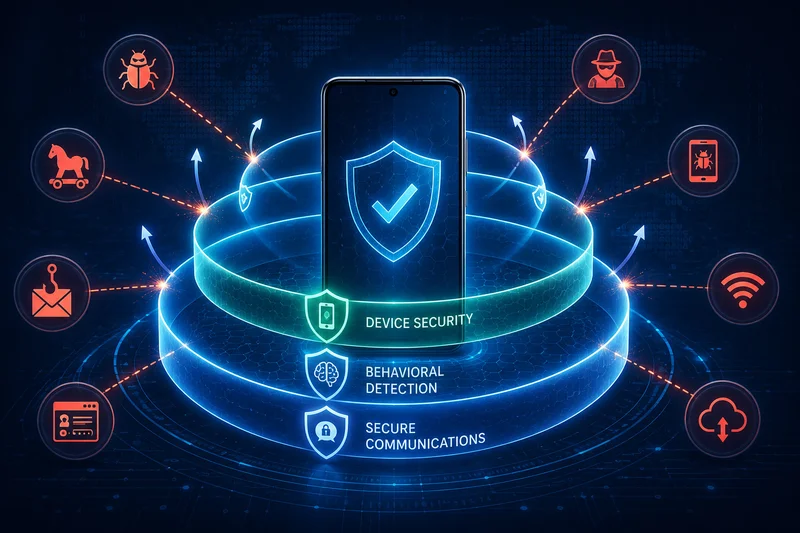
Mobile threats have evolved beyond traditional viruses. Modern phone security requires behavioral detection, spyware protection, secure communications, and continuous monitoring rather than relying solely on signature-based antivirus software.
If you've searched for virus protection for phone, you're not alone. Every month, hundreds of thousands of users look for ways to protect their smartphones from malware, hackers, spyware, and other digital threats. Most of them expect to find a simple solution—a traditional phone antivirus application capable of detecting and removing malicious software with a single scan.
That expectation, however, no longer reflects the reality of today's mobile threat landscape.
Android powers billions of active devices worldwide, making smartphones the primary computing platform for both personal and professional activities. They now store financial information, corporate documents, authentication tokens, personal conversations, location history, medical records, photographs and access credentials for dozens of online services.
Modern attacks rarely resemble the computer viruses that many users still imagine. Instead of spreading by infecting files, today's mobile malware relies on social engineering, privilege escalation, malicious Accessibility Services, rogue Mobile Device Management (MDM) profiles, phishing campaigns, fake applications, supply-chain attacks, and even zero-click exploits capable of compromising a device without any user interaction.
The objective is no longer simply to damage a device. Attackers want persistent access to sensitive information. They seek banking credentials, one-time passwords, corporate emails, confidential documents, encrypted messaging metadata, authentication cookies, and cryptocurrency wallets. Some campaigns focus on financial fraud, while others perform long-term surveillance, silently collecting information for weeks or even months before being discovered.
This evolution has significantly changed what virus protection for phone actually means. Detecting a malicious application is only one part of the equation. Effective phone security now requires understanding how applications behave, monitoring unusual system activity, identifying privilege abuse, detecting suspicious network communications, and recognizing indicators that may reveal an ongoing compromise even when no known malware signature exists.
Security researchers increasingly describe mobile protection as a layered process rather than a single product. Signature-based antivirus engines remain useful for identifying known threats, but they are no longer sufficient on their own. Behavioral analysis, anomaly detection, application reputation, permission auditing, secure communications, and continuous monitoring have become essential components of modern mobile defense strategies.
The same evolution is reflected in recommendations published by organizations such as CISA, ENISA, Google's Android Security team and the OWASP Mobile Application Security Verification Standard (MASVS). Their guidance consistently emphasizes reducing attack surfaces, monitoring device behavior, applying security updates promptly and protecting sensitive communications in addition to detecting malware. In other words, preventing compromise has become just as important as removing malicious software after infection.
Users also face a growing challenge in distinguishing legitimate security software from applications that merely promise protection. Hundreds of mobile security products advertise themselves as complete solutions, yet their capabilities vary considerably. Some focus almost exclusively on malware signatures, while others incorporate behavioral detection, anti spyware software capabilities, network monitoring, phishing protection, and anomaly analysis designed to identify emerging threats before they become widespread.
Choosing effective protection therefore requires understanding how modern attacks operate. A smartphone infected with spyware may never display obvious symptoms. A banking trojan can abuse legitimate Android features without exploiting a software vulnerability. Data exfiltration malware may quietly transmit sensitive information while remaining almost invisible to the user. These scenarios demonstrate why security professionals increasingly evaluate the overall security posture of a device instead of asking a single question: "Does this phone have a virus?"
This article explores how mobile threats have evolved, why traditional phone antivirus solutions are no longer enough on their own, and which technologies now play the most important role in delivering effective virus protection for phone. Along the way, we'll examine spyware, banking trojans, behavioral detection, secure communications, and the practical security measures that individuals and organizations should adopt to reduce the risk of compromise in an increasingly hostile mobile environment.
Why Phone Antivirus Is No Longer Enough
For years, installing a phone antivirus application was considered one of the best ways to protect an Android device. The approach worked reasonably well when mobile malware consisted mainly of known malicious applications that could be identified through signature databases. Today, however, attackers rarely rely on techniques that are so easy to detect.
Modern virus protection for phone must deal with threats that constantly evolve. Malware authors frequently modify their code, automate the creation of new variants and use legitimate Android features to hide malicious activity. As a result, a malicious application may look completely different from previous samples while performing exactly the same attack.
Traditional antivirus software remains an essential first layer of defense because it can rapidly identify known malware families using signature-based detection. However, modern mobile attacks increasingly rely on techniques specifically designed to evade these signatures. Newly developed banking trojans, previously unseen spyware variants and malware delivered through sophisticated phishing campaigns may remain undetected until security researchers analyze the threat and security vendors distribute updated detection rules.
This delay creates a critical window of opportunity for attackers. During that time, compromised devices may continue leaking sensitive information, recording user activity or intercepting authentication codes without triggering any warning. Google Play Protect provides an important first layer of defense by continuously scanning applications distributed through Google Play and periodically checking installed apps for known threats. While this significantly improves baseline security for most users, Play Protect is primarily designed to detect known malicious applications. Advanced spyware, targeted attacks and sophisticated banking trojans may still require behavioral analysis capable of identifying suspicious activity even when no known malware signature exists.
Modern phone security therefore focuses on detecting suspicious behavior instead of waiting for malware to become known. Security solutions increasingly analyze how applications interact with the operating system, which permissions they request, how they communicate with external servers and whether they attempt to perform actions that are inconsistent with their intended functionality.
For example, a calculator application requesting Accessibility permissions, attempting to become a device administrator and continuously communicating with unknown remote servers should immediately raise suspicion, even if no antivirus vendor has yet classified it as malicious.
Behavioral analysis also helps detect attacks that do not rely on traditional malware. Rogue Mobile Device Management profiles, malicious configuration changes, abuse of Android Accessibility Services and privilege escalation attempts may all represent serious security risks despite leaving no recognizable malware signature.
This is why cybersecurity professionals increasingly recommend combining multiple layers of protection. Signature-based detection should work alongside behavioral monitoring, permission auditing, anomaly detection and continuous system analysis. Together, these technologies significantly reduce the time required to identify suspicious activity and improve the overall resilience of Android devices against both known and emerging threats.
Ultimately, effective virus protection for phone is no longer defined by how many malware signatures an antivirus database contains. It depends on how quickly suspicious behavior can be identified, analyzed and contained before sensitive information is exposed or attackers establish long-term persistence on the device.
The New Generation of Mobile Malware
When most people think about malware, they imagine a virus that infects a device, slows it down and displays obvious warning signs. Modern mobile attacks are very different. Today's malware is designed to remain invisible for as long as possible, silently collecting information, stealing credentials or creating remote access channels without disrupting the normal operation of the smartphone.
This evolution has fundamentally changed the role of virus protection for phone. Instead of looking only for known malicious files, modern security solutions must identify suspicious behavior across the entire operating system.
One of the fastest-growing threats is commercial spyware. Platforms such as Pegasus, Predator and Graphite have shown that modern surveillance software can compromise smartphones, collect sensitive information and remain undetected for extended periods, even when users follow common security practices. Unlike traditional malware, spyware focuses on surveillance rather than destruction. It can monitor messages, emails, contact lists, location history, browser activity, photos, microphone input and, in some cases, even camera access. Because its objective is to remain undetected, spyware often consumes minimal resources and avoids generating noticeable symptoms. This is why understanding Android spyware detection techniques and using effective anti spyware software has become an essential part of modern mobile security.
Another major category is the banking trojan. Malware families such as Anatsa, TeaBot, SharkBot and the more recent Crocodilus have demonstrated how sophisticated Android banking malware has become. These threats abuse Android Accessibility Services, display convincing fake login screens, intercept one-time passwords and automate fraudulent transactions. In many cases, victims believe they are interacting with their legitimate banking application while malware silently captures credentials and performs unauthorized actions in the background. Several of these malware families have specifically targeted customers of financial institutions across Europe, demonstrating how rapidly Android banking threats continue to evolve.
OTP stealers represent another rapidly growing threat. Rather than attacking banking applications directly, they intercept SMS verification codes, notification content or authentication tokens generated by dedicated authenticator apps. Once these credentials are stolen, attackers can bypass multi-factor authentication and gain unauthorized access to online accounts.
Dropper malware presents a different challenge. Instead of containing the final malicious payload, droppers act as delivery mechanisms. They appear harmless during installation, allowing them to evade traditional antivirus scans before downloading additional malware from remote servers after the device has already been compromised.
Cybercriminals also increasingly rely on persistent malware capable of surviving device reboots, restoring disabled services and maintaining long-term access to infected smartphones. Persistence techniques make incident response significantly more difficult because removing one malicious component may not eliminate the entire infection.
Perhaps the most dangerous attacks combine several of these techniques into a single campaign. A phishing message installs a dropper, which downloads spyware, steals authentication tokens and eventually deploys a banking trojan. Each stage appears relatively harmless on its own, but together they create a highly effective attack chain capable of compromising both personal and corporate data.
For this reason, modern phone security can no longer focus on detecting a single type of malware. Security solutions must continuously monitor applications, processes, permissions and network activity to recognize suspicious patterns before attackers achieve their objectives. Detecting individual malware samples is important, but understanding how different threats interact has become equally essential for protecting today's Android devices.
Behavioral Detection: The Next Generation of Phone Security
One of the biggest changes in mobile cybersecurity is the shift from signature-based detection to behavioral analysis. Instead of asking whether an application matches a known malware signature, modern security solutions evaluate how software behaves once it is installed on the device.
This approach dramatically improves virus protection for phone because many modern attacks are specifically designed to evade traditional phone antivirus products. Malware developers frequently modify their code, encrypt payloads or download malicious components only after installation, making static analysis far less effective than it was a few years ago.
Behavioral detection continuously monitors applications and the operating system for suspicious activities. Rather than relying exclusively on malware signatures, it evaluates how applications interact with sensitive Android components, whether they request unusual privileges and whether their behavior deviates from what would normally be expected for their stated functionality. Examples include unexpected requests for Accessibility Services, attempts to obtain Device Administrator privileges, unusual background activity, excessive permission requests, hidden foreground services, or unexplained communications with remote servers.
A security platform may also detect anomalies such as an application repeatedly trying to restart after being terminated, disabling security features, or accessing sensitive information unrelated to its advertised functionality. These behaviors often reveal an ongoing compromise even when no known malware signature exists.
This type of continuous monitoring is particularly valuable because many users only realize something is wrong after searching for signs that their phone is under surveillance. By that stage, spyware or other forms of malware may already have been active for weeks, silently collecting messages, contacts, authentication tokens and location data.
Behavioral analysis reduces this risk by identifying suspicious activity as it develops rather than waiting for researchers to classify a specific malware sample. Combined with reputation analysis, permission auditing and network monitoring, it provides a far more resilient approach to modern phone security than traditional signature-based scanning alone.
The future of mobile protection will depend less on identifying known malware families and more on recognizing abnormal behavior before attackers achieve persistence or begin exfiltrating sensitive information. That proactive approach is rapidly becoming the foundation of effective smartphone defense.
Why a Privacy Phone Offers Better Protection Against Modern Threats
Many users believe that installing a security application is enough to protect their smartphone. While security software remains an important layer of defense, the overall architecture of the device plays an equally important role. A privacy phone is designed with security as a fundamental principle rather than an optional feature added after the operating system has been installed.
Traditional smartphones are optimized for convenience, compatibility and user experience. They often contain dozens of pre-installed applications, cloud services and background processes that increase the attack surface. Every additional component represents another potential entry point for attackers.
By contrast, an encrypted phone is typically designed with security as a primary objective. Depending on its security architecture, it may minimize unnecessary background services, strengthen application isolation, enforce stricter operating system policies, protect sensitive communications and provide administrators with greater control over the device's security configuration. These measures cannot eliminate cyber threats entirely, but they significantly reduce the attack surface and make successful compromises considerably more difficult.
This approach is particularly valuable against spyware and advanced persistent threats. Even when malware successfully reaches a device, limiting privileges, restricting unnecessary services and protecting sensitive data can reduce the impact of a successful compromise.
A secure architecture also complements modern virus protection for phone strategies. Behavioral detection, permission auditing and continuous monitoring become more effective when they operate on a system that has already been designed to minimize risk rather than simply reacting to attacks after they occur.
For organizations handling confidential information, journalists working with sensitive sources, legal professionals and executives responsible for strategic decisions, combining a privacy phone with layered security controls provides a stronger defense than relying exclusively on a traditional phone antivirus application.
As mobile attacks continue to evolve, security is increasingly determined by the design of the entire ecosystem rather than by any single protective application. The operating system, hardware configuration, communication infrastructure and user behavior all contribute to building a resilient mobile security posture.
Secure Communications Are an Essential Part of Phone Security
When discussing smartphone protection, most people immediately think about malware. However, protecting a device is only one aspect of mobile cybersecurity. Equally important is protecting the information that travels through it. Even a smartphone free from malware can expose sensitive data if communications are intercepted, improperly stored or transmitted through insecure channels.
This is why cybersecurity professionals increasingly view a secure messaging platform as a critical component of modern phone security. While encryption protects messages during transmission, it secures only the communication channel. If the endpoint itself has already been compromised by spyware or a remote access trojan, attackers may capture messages before they are encrypted or immediately after they are decrypted. For this reason, organizations increasingly rely on secure communications platforms that combine strong encryption with robust endpoint protection while also safeguarding metadata, authentication mechanisms, user identities and stored conversations.
Choosing a secure communication app is therefore about much more than end-to-end encryption. The application should receive regular security updates, implement strong authentication, protect data stored on the device and minimize the amount of information that can be collected by third parties. Features such as encrypted file sharing, secure voice calls, message expiration and controlled data retention further strengthen the overall security of mobile communications.
Organizations face additional challenges because employees regularly exchange confidential documents, customer information, strategic plans and operational data using smartphones. If these communications are compromised, the consequences may include financial losses, regulatory violations and reputational damage. For this reason, many organizations adopt dedicated communication platforms instead of relying exclusively on consumer messaging applications.
The importance of secure instant messaging has grown even further as remote work and mobile collaboration have become standard practice. Attackers increasingly target communication channels to distribute malware, conduct phishing campaigns or capture sensitive information that can later be used for extortion, espionage or credential theft.
A comprehensive mobile security strategy should therefore protect both the device and the information it handles. Combining behavioral threat detection with a secure communication app significantly reduces the opportunities available to attackers, helping organizations and individuals maintain confidentiality even when facing increasingly sophisticated cyber threats.
What Modern Virus Protection for Phone Should Actually Do
The effectiveness of virus protection for phone should no longer be measured solely by the number of malware signatures stored in a database. Modern mobile security requires continuous analysis of device behavior, application activity and potential indicators of compromise throughout the entire lifecycle of the smartphone.
A comprehensive security solution should begin by identifying known malware families, but it must also recognize suspicious activity that has never been seen before. This includes monitoring unusual permission requests, unauthorized attempts to obtain administrative privileges, abnormal network communications, excessive background activity and signs that an application is attempting to establish persistence within the operating system.
An effective anti spyware app for android should also detect behaviors commonly associated with surveillance software. Spyware rarely announces its presence. Instead, it quietly accesses sensitive resources such as messages, contacts, location data, microphones or cameras while attempting to remain invisible to the user. Detecting these activities requires behavioral analysis rather than simple file scanning.
The same principle applies to anti spyware software used in enterprise environments. Organizations need visibility into how devices behave over time, allowing security teams to identify anomalies before attackers can steal confidential information or expand their access within the corporate infrastructure.
Modern protection should also evaluate applications after installation rather than only during the installation process. A seemingly harmless application may download additional components days or weeks later, activate hidden services or begin communicating with command-and-control servers only after specific conditions have been met. Continuous monitoring is therefore essential for identifying delayed attacks that would otherwise bypass traditional antivirus products.
Many advanced mobile security platforms are now capable of identifying suspicious patterns that indicate ongoing attacks and help organizations detect and neutralize spyware and trojans before significant damage occurs. These capabilities typically combine behavioral analytics, reputation services, permission auditing, anomaly detection and threat intelligence to create multiple layers of defense against both known and previously unseen attacks.
Ultimately, effective phone security is not defined by a single technology. It results from combining malware detection, behavioral monitoring, secure communications, timely updates and informed user behavior into a comprehensive security strategy capable of adapting to an evolving threat landscape.
Mobile Security Is No Longer Just About the Smartphone
Protecting a smartphone no longer depends exclusively on what happens inside the device. Every modern mobile application communicates with cloud services, APIs, authentication systems and remote infrastructures that process, store and exchange sensitive information. As a result, phone security now extends far beyond the operating system itself.
A malicious actor who cannot compromise the smartphone directly may instead target the servers supporting mobile applications, intercept insecure communications or exploit weaknesses in backend services. Even the most advanced virus protection for phone cannot compensate for insecure infrastructure or poorly protected communication channels.
This is particularly important for organizations that rely on mobile devices to exchange confidential information. Even the most secure communication platform is only as trustworthy as the infrastructure that manages encryption keys, authentication, message delivery and user identities. If backend systems are compromised, attackers may gain valuable information even without installing malware on the endpoint.
For this reason, cybersecurity architects increasingly design mobile ecosystems using a defense-in-depth approach. Secure devices, encrypted communications, identity management, continuous monitoring and a secure server infrastructure work together to reduce the likelihood of successful attacks. Each security layer compensates for the potential failure of another, making the overall system significantly more resilient.
This architecture also improves incident response. Centralized logging, anomaly detection and infrastructure monitoring help security teams identify suspicious activity quickly, limiting the impact of attacks before they spread across multiple users or systems.
As smartphones continue to replace laptops for business communications, financial operations and access to critical services, protecting the surrounding infrastructure becomes just as important as protecting the device itself. Effective mobile security is no longer a collection of isolated technologies but an integrated ecosystem where endpoints, networks and servers continuously reinforce one another.
Best Practices for Protecting Your Smartphone in 2026
No security solution can guarantee complete protection against every cyber threat. Attack techniques continue to evolve, and even the most advanced technologies require informed user behavior to remain effective. The goal of modern virus protection for phone is therefore to reduce risk by combining multiple defensive layers rather than relying on a single application.
Keeping Android, security patches and installed applications updated should always be the first priority. Security updates frequently address vulnerabilities that attackers actively exploit, and delaying their installation unnecessarily increases the attack surface.
Users should also install applications only from trusted sources and carefully review the permissions they request. An application asking for access to features unrelated to its functionality should always raise concerns. Excessive permissions remain one of the most common indicators of malicious or potentially unwanted software.
A modern phone antivirus remains an important component of mobile protection, but it should be complemented by behavioral monitoring, permission auditing and continuous analysis of system activity. These additional layers help identify suspicious behavior even when malware has not yet been classified by security researchers.
Anyone handling confidential information should also consider adopting a privacy phone that minimizes unnecessary services, strengthens security controls and reduces the opportunities available to attackers. Combined with secure communication practices, this approach provides significantly greater resilience against both criminal and targeted attacks.
It is equally important to recognize the warning signs of a possible compromise. Unexpected battery drain, unusual network activity, unexplained permission changes, persistent background services or suspicious administrator privileges should never be ignored. Understanding the principles of smartphone interception protection allows users and organizations to respond more quickly before attackers gain long-term access to sensitive information.
Ultimately, effective phone security is built on multiple complementary layers rather than a single defensive technology. Secure software, resilient infrastructure, responsible user behavior and continuous monitoring work together to protect one of the most valuable digital assets we carry every day.
Conclusion
The concept of virus protection for phone has changed dramatically over the past few years. Modern cyber threats are no longer limited to traditional viruses that can be detected through signature databases. Spyware, banking trojans, phishing campaigns, malicious Accessibility Services, rogue MDM configurations and sophisticated persistence techniques have transformed the smartphone into one of the most attractive targets for cybercriminals.
While a phone antivirus remains an important component of mobile defense, it should be viewed as only one layer within a broader security strategy. Behavioral analysis, anomaly detection, permission auditing, secure infrastructure and continuous monitoring now play an equally important role in identifying threats before they can compromise sensitive information.
Protecting communications has become just as critical as protecting the device itself. Choosing a reliable secure communication app and adopting a trustworthy secure messaging platform significantly reduces the risk of exposing confidential conversations, business information and personal data to unauthorized parties.
Likewise, selecting a privacy phone designed with security in mind can reduce the attack surface and provide stronger protection against increasingly sophisticated threats. Combined with responsible user behavior, timely software updates and modern detection technologies, these measures create multiple layers of defense capable of adapting to an ever-changing threat landscape.
Cybersecurity is no longer about finding a single application that solves every problem. Effective phone security results from combining secure devices, resilient infrastructure, intelligent threat detection and informed decision-making. As attackers continue to evolve their techniques, organizations and individuals who adopt a layered approach will be far better prepared to protect their data, communications and digital identities.
Understanding how today's threats operate is the first step toward building effective protection. The second is recognizing that modern virus protection for phone is no longer defined by the size of an antivirus signature database, but by its ability to understand behavior, detect anomalies and stop attacks before they become successful compromises.