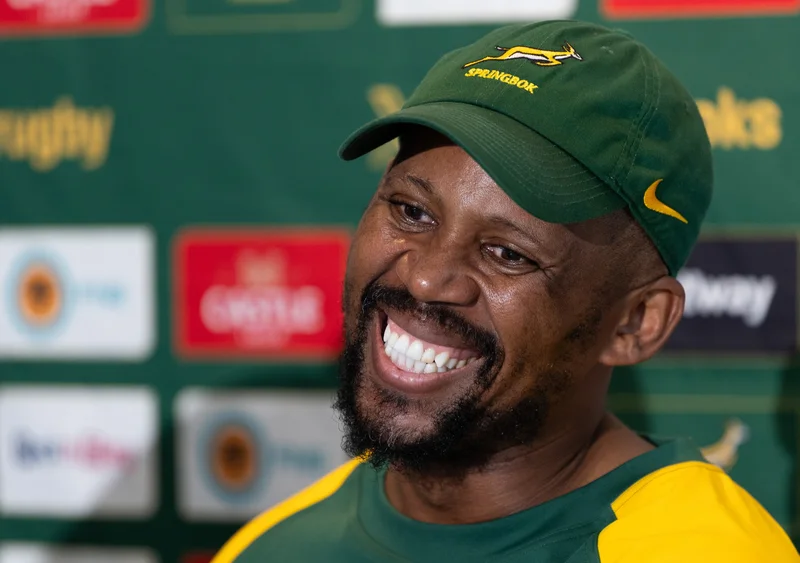
Mzwandile Stick became acquainted with rugby when he was still in primary school in the township of New Brighton in the Eastern Cape. Rugby was not his first choice, but one of his teachers â Mavuso Mafu â steered him towards the sport. Now Stick is one of the most respected names, not just in South African rugby, but globally.
Stick has two Rugby World Cup titles behind him as part of the Springbok coaching staff: one in 2019, another in 2023. Raised by a single mother who worked tirelessly to make ends meet in a hostile township environment, Stick could not have imagined his life taking this direction.
âIn the townships, we didnât have distinct sports seasons. So, if cricket, rugby and soccer were all played on a Wednesday, the teachers would battle over which sport you should play. Mafu chose rugby for me and I will always be grateful because he really understood the game,â Stick told Roc Nation as part of the brandâs International Insider Series.
With that seed planted by Mafu, Stick grew and created a name for himself in South African rugby as a player. He dabbled in fifteens, but the sevens format was where Stick was particularly effective.
He operated as a fullback and wing. But his leadership always shone through even when he was a player. His standout achievement was captaining the Blitzboks to a first-ever World Rugby Sevens Series title in 2009.
Stick continued to grow as a player from there, but his leadership skills were evident to the people close to him. He transitioned into coaching shortly after retiring in 2013. By his own admission, the transition from player to coach was not something he had mapped out while he was playing.
âIâd be lying if I said it was always the plan to go straight from playing into coaching. However, I started playing at a young age, and rugby has essentially been my entire life. Even during holidays, my friends and I would organise touch rugby games on the beach or in the parks of New Brighton. I was fortunate to have friends who were on the same page and kept me focused,â said Stick.
âAs for the transition itself, it came naturally through the leadership roles I held. Itâs funny, but back in the township schools, youâd sometimes have a coach who loved the game but didnât fully understand it â they were mostly there to manage the school budget,â Stick recalled.
âEven in high school, I felt I had a solid grasp of the game. So, I became the one running around organising the team for matches. The teachers used to make fun of me because during the last period of class, I wasnât focusing; I was already calculating numbers and planning the afternoon training session,â said Stick.
âThat hands-on experience built my leadership skills. Later, when Paul Treu appointed me captain of the Sevens team, there was initially some negativity around my appointment.
âBut we turned things around. Credit goes to my teammates who believed in me. We were a tight-knit family. We might have been small in stature, but we had massive hearts and worked incredibly hard for each other,â Stick stated.
The coach
His transition from the pitch to the sidelines was seamless due to this natural knack for leadership. âBefore I retired from playing, I captained the Southern Kings under Alan Solomons. Playing as a flyhalf and fullback meant I was already a game-driver, one of the primary voices giving direction on the field. That naturally eased my transition into coaching.â
The evidence of this flawless transition came in the form of him leading the Eastern Province U19 side to a historic provincial title in 2015 â just two years after hanging up his playing boots.
That achievement saw him fast-tracked into Allister Coetzeeâs Springbok technical team setup in 2016, as a backline coach. But Stick was dealt a reality check about the difficulties of being a coach and about leadership during this period.
That year the Springboks were atrocious, winning just four of their 12 Tests. Coetzee was heavily criticised for his role in the Bok slump, but people such as Stick were not spared either. In 2017, Stick was demoted to the U20 coaching role as a result of the backlash faced by the technical team at the time.
The Rassie influence
When Rassie Erasmus succeeded Coetzee as Springbok coach in 2018, ahead of a major assignment at the 2019 World Cup, he roped Stick back into the senior sideâs coaching setup. Erasmus felt that Stickâs experience, particularly his contributions in the sevens format, would be valuable in the Bok rebuild he was administering.
Hence Stick never misses an opportunity to praise Erasmus for his contribution towards the former Blitzboks skipper becoming not just a better coach, but a better human being.
âWe all know he (Erasmus) has a brilliant mind for rugby and works incredibly hard, but thereâs one specific thing I always tell people about him: he is one of the best managers of people Iâve ever seen. Even when things start to get out of control, Rassie has a unique way of bringing everything back together,â Stick said.
âAs a human being, that is something I deeply respect about him. He always finds a funny, effective way to get the best out of people.
âWhen I was given the opportunity to return to the national team, there were some who believed I didnât have what it takes anymore. Rassie brought me back into the system, and weâve never looked back since,â the Bok lieutenant added.
âAs a leader, he is someone who has always encouraged me to be at my absolute best. He knows exactly when Iâm not in a good space â and it takes a truly special manager to look at the people around them and recognise when they are struggling. That is easily one of his greatest skills as a coach; he understands his people and genuinely cares about everything he does,â said Stick.
As they build up to attempting a third World Cup win in a row in 2027, the Springboks have a number of major assignments during 2026. This includes clashes in the ongoing inaugural Nations Championship. Of course, they also have four mouthwatering battles against old foes New Zealand between late August and mid-September.
Stickâs experience, expertise and humility will be vital towards any Bok success. DM