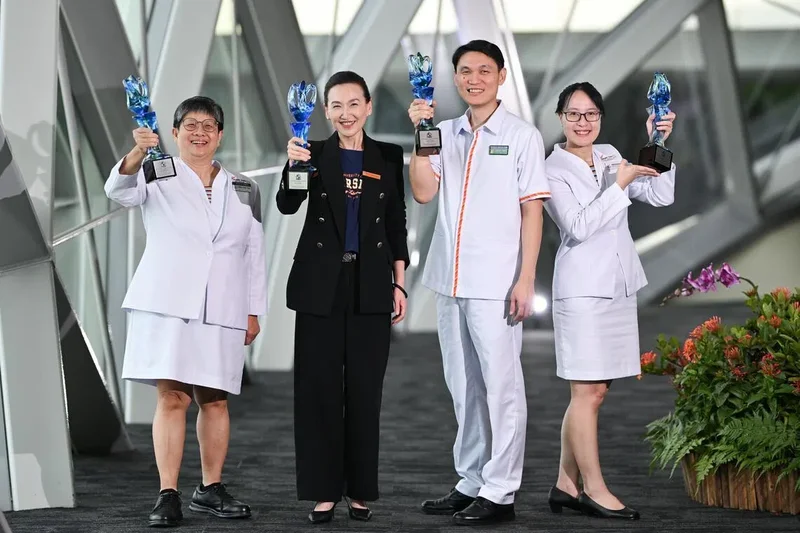
4 trailblazers receive President’s Award for Nurses
AI generated
SINGAPORE - Four nurses have been awarded the 2026 President’s Award for Nurses - Singapore’s highest accolade for the profession.
Each is a trailblazer in his or her own right.
Jordan Hwang, 46, initiated Singapore’s first free annual screening programme for fellow nurses in the chemotherapy unit.
Pham Thi Ngoc Anh, 42, is the nation’s first paediatric Advanced Practice Nurse (APN). She has a Master’s degree and specialises in stem cell transplants.
Wong Yoke Ping, 59, is from the first batch of mid-career professionals who made the switch to nursing. She led the establishment of palliative care services at Changi General Hospital (CGH).
Zhou Wentao, 53, established the first local Doctor of Nursing Practice programme to advance experienced nurses’ capabilities in delivering high-quality and evidence-based care.
They received their award from President Tharman Shanmugaratnam at Gardens by the Bay on July 24, for their continuous outstanding performance and contributions to provide better patient care and elevate the profession.
Each recipient was given a trophy, a certificate signed by the President, and a $10,000 cash prize which can be used for their professional and personal development.
Minister for Health and Coordinating Minister for Social Policies Ong Ye Kung was also present.
Ninth male recipient since 2000
Hwang, who is the assistant director of nursing at Singapore General Hospital, has advocated for workplace safety for fellow nurses at the hospital’s chemotherapy unit.
He said that while the chances are slim, nurses face the possibility of exposure to aerosols of the chemotherapy drugs from the patients’ body waste after chemotherapy, even if they have taken steps to protect themselves, such as donning personal protective equipment (PPE).
Exposure to chemotherapy drugs carries health risks ranging from rashes to organ damage, according to the US Centers for Disease Control and Prevention. This can affect those who handle the medications or come into contact with residual drugs or bodily fluids, including healthcare workers.
In 2019, he worked on a proposal to institute free annual blood tests, which included checking on liver function, which could also help assess if staff are fit to continue their work in the unit.
The initiative was successfully implemented and now benefits around 500 nurses each year.
A protocol was also established to spell out the specific protective gear for specific tasks such as preparing the drugs or clearing of waste.
Hwang said that when he was in his second year of studies, he was posted to KK Women’s & Children’s Hospital (KKH). He was exposed to and contracted measles, and his first-hand experience as a patient receiving attentive care also strengthened his conviction to provide good care.
“As my bosses say, we treat people the way you want people to treat you”, he said.
Hwang is also actively involved in research and has co-authored seven peer-reviewed publications, with topics ranging from the psychosocial needs of adolescents with acute leukaemia, to the experiences of stem cell transplant survivors.
Hwang is the ninth male recipient of the nation’s top nursing accolade to date, and the first male recipient since 2022. There have been 105 such awards given out since 2000.
One of only seven men in his batch of almost 300 nursing students, he said he is glad that more men are joining the ranks.
Tapping virtual reality to help patients and their families
Pham, a senior nurse clinician at KKH focussing on paediatric oncology nursing practice, has led the redesign of the hospital’s transplant nursing programme since 2019. This was to adapt to new medical developments such as more complex transplants and more sources of stem cells beyond the bone marrow.
She is also keenly involved in research, and has leveraged augmented reality as part of the orientation for patients and their families. The tool aims to help them understand the processes in a virtual transplant environment, before the child’s admission.
She said that when the care team engages the family, the young patient is usually included too, to help the child understand what he or she would be going through.
“We have made the process fun for the children by including elements of gamification, asking them to catch bad germs like how they would catch Pokemons. They can also earn rewards by building up their army of immune cells.”
Following a one-year development phase, this prototype is likely to be deployed at end-2026 and could benefit up to 10 transplant patients each year.
Pham is now pursuing a two-year Doctor of Nursing Practice at Duke University, after getting a Master of Nursing from the National University of Singapore (NUS).
Looking back to when she first arrived in Singapore from Vietnam when she was 18 - 24 years ago - and started nursing training at Nanyang Polytechnic, she described her career as very fulfilling and meaningful.
“My first posting was for paediatric care, and the patient encounters were very special and close to my heart. Even for children who unfortunately passed on, these memories stay with me as they have taught me lessons that adults might not be able to”, said Pham.
For instance, she cared for a young boy who recorded voice messages for his parents to tell him he loved them before he died.
“That changed the way I look at life, because as adults, sometimes we tend to forget to send a love message to our loved ones”.
Business administrator became palliative care nurse following mum’s death
CGH’s senior nurse manager Wong used to work in their family business as an administrator but when Wong was 19, her mother was diagnosed with late-stage pancreatic cancer and the subsequent experiences with caregiving and dealing with the impending death cemented her decision to switch to nursing when she was 36, in 2003.
Wong joined the pioneering batch of mid-career professionals switching to nursing through what is now known as the career conversion programme for nurses.
Keenly interested in palliative care, she became a key member of the pioneering team which established palliative care services at CGH.
She has also led the expansion of community nursing services for geriatric and end-of-life care to 10 nursing homes, with plans to scale to 16 homes by 2029.
“Receiving this award is a privilege and great honour. This award is not just for myself but also for the palliative care community”, Wong said, adding that she hopes to inspire other nurses to perform at the top of their game.
Taking nursing education to the next level
Zhou, an associate professor with NUS’ Alice Lee Centre for Nursing Studies and its deputy head for postgraduate programmes, is the fifth award recipient from the education sector to date.
Zhou, who arrived from China to take up a nursing scholarship in Singapore in 1993, later pivoted to an educator role in 2011.
Her main focus in the past decade has been in preparing Advanced Practice Nurse (APNs) to meet the country’s growing healthcare needs, such as standardising the competency standards of APNs across all public hospitals, ensuring more consistent training.
One of the reforms she pushed through was shortening the 24-month full-time programme to 18 months. While nurses received the same high training standards, they were able to return to their caring roles sooner.
“There are multiple career tracks that nurses can possibly have... which is very meaningful, to not only recruit new nurses, but also keep them in our workforce”, Zhou said.
She also said Singapore’s healthcare system is widely recognised and well respected by other jurisdictions, and that she had worked with universities and hospitals in China and Japan to learn more about enhancing the profession.