The government on Friday (July 24, 2026) announced a new ₹3,030-crore scheme for setting up three large chemical parks, each spreading across at least 2,000 acres, an initiative aimed at making India self-reliant in the sector.
**Also Read | Centre to establish chemical parks in Andhra Pradesh **
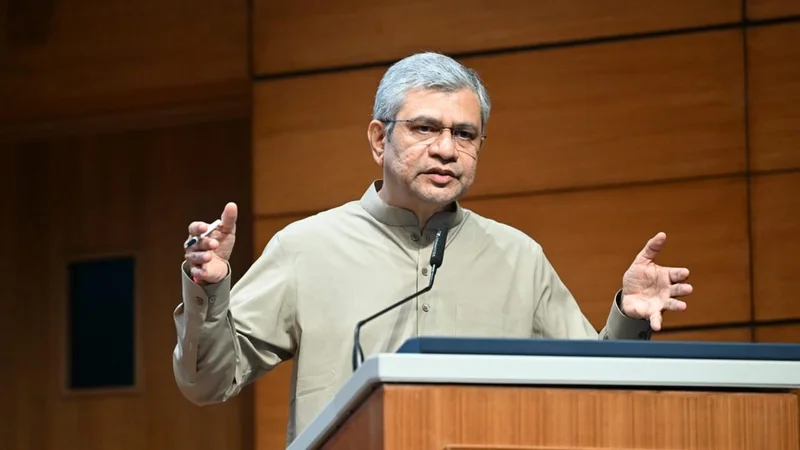
Announcing the Cabinet decision, Information & Broadcasting Minister Ashwini Vaishnaw said each park could see investments in the range of ₹20,000 crore to ₹50,000 crore and the scheme will act as a "multiplier".
The Cabinet, chaired by Prime Minister Narendra Modi, has approved Bharat Audyogik Vikas Yojana Rasayan, or BHAVYA-Rasayan Scheme, to establish three dedicated chemical parks in the country.
The scheme, announced in the Union Budget of the 2026-27 fiscal, will have a total financial outlay of ₹3,030 crore.
According to an official statement, Rs 3,000 crore would be towards the cost of establishing the common infrastructure facilities and basic utilities inside the parks. The remaining Rs 30 crore will be for the administrative expenditure.
The scheme would run for a period of 5 years from the current fiscal to 2030-31.
In response to a question, Mr. Vaishnaw said that the total investment for the the establishment of these three parks will be significantly higher than this. The outlay (₹3,030 crore) is only for common infrastructure."
The investments on each park could be to the tune of ₹20,000 crore to ₹50,000 crore, he said, adding that the scheme would act as a "multiplier" in attracting investments.
"The Centre will facilitate development of three dedicated chemical parks by the state governments under challenge route. Each such park will have a minimum contiguous area of 8 sq km (minimum 2,000 acres) of encumbrance-free land," the statement said.
The chemical parks could be greenfield or brownfield, depending on the state governments' selection based on the challenge route, Mr. Vaishnaw said.
The Minister said that many sectors in the economy are "foundational", and the chemical sector is one of them, as it provides basic raw materials for many other industries.
The Centre would provide a grant of up to ₹1,000 crore per park. However, this will be subject to the minimum contribution of ₹500 crore by the concerned state government, the statement said.
About the benefits, the government said the introduction of the scheme would facilitate "development of the sector by attracting domestic and foreign investments, enhancing domestic production capacity and generating employment."
It will boost the global competitiveness of the sector, thereby promoting Atmanirbharta, the statement said.
The scheme will promote development of the chemical industry along the whole value chains, including upstream, downstream and ancillary industries.
Giving details, the government said the proposed three parks will provide plug-and-play infrastructure in the form of common facilities and basic utilities for the chemical industry.
The facilities include a common effluent treatment plant (CETP); treatment, storage, and disposal facility (TSDF), water supply and distribution systems; solvent recovery and distillation facilities; steam generation and distribution network; interconnected pipeline network; and logistics and warehousing facilities.
The government noted that the establishment of three parks would make the Indian chemical industry globally competitive.
"It will promote development of Indian chemical industry in a sustainable way by creating an environment-friendly ecosystem which will consist of centralized facilities..." The growth of the chemical sector will lead to a cascading effect through enhanced development of downstream sectors of the economy as well, thereby leading to higher employment generation and greater development of the economy.
The sector produces chemicals and petrochemicals that are used in various downstream sectors such as agriculture, textiles, pharma, nutraceuticals, construction, automobile and electronics.
Published - July 24, 2026 05:41 pm IST