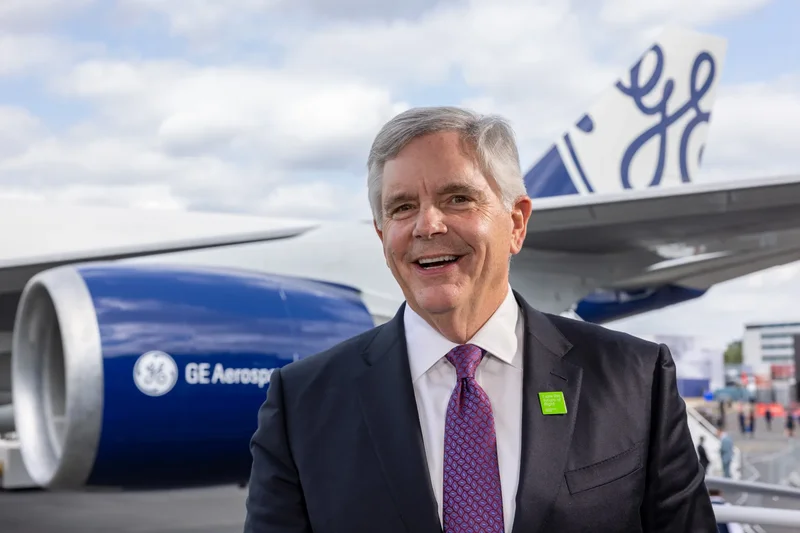
Good morning. Larry Culp’s overhaul of General Electric is emerging as a modern benchmark in balance-sheet repair, operating discipline, and value creation, turning a near-distressed industrial icon into three focused, high-performing public companies.
“How GE CEO Larry Culp pulled off the turnaround of the century,” a new Fortune feature by my colleague Shawn Tully, offers an in-depth account of how Culp joined GE to steer the transformation of the conglomerate into three public companies now worth nearly $700 billion in aggregate—roughly double the S&P 500’s annualized return over his tenure.
When Culp arrived in 2018, GE’s market cap had collapsed to about $96 billion—down more than 80% from its 2000 peak—and the company was weighed down by roughly $150 billion of debt and chronic cash flow underperformance, Tully writes. His first moves prioritized deleveraging and simplification such as cutting central overhead and dismantling GE’s bloated headquarters infrastructure.
That groundwork enabled GE’s breakup into GE HealthCare, GE Vernova, and GE Aerospace across 2023–2024, a structural shift that has helped drive a combined equity value approaching $700 billion, far outpacing the S&P 500 over Culp’s tenure. The operating engine behind that outcome is lean management, heavily influenced by the Toyota Production System and Culp’s Danaher experience, according to Tully. To explore Culp’s playbook in more detail, you can read the full article here.
For investors, the most compelling cash-flow story now sits at jet-engine giant GE Aerospace, which Culp has led since it became a separate company in 2022. In its Q2 2026 earnings reported July 16, GE Aerospace generated $3 billion in free cash flow, up 43% year-over-year, driven by higher earnings and a reduction in working capital. Adjusted earnings per share of $2.02 beat the consensus estimate of $1.86, while adjusted revenue rose 24% year-over-year to $12.63 billion, surpassing forecasts of about $11.86 billion and marking the fifth consecutive quarter of at least 20% revenue growth.
Morningstar raised its fair value estimate for GE Aerospace to $347 per share from $307, citing stronger profit growth in its aftermarket business. The stock now trades close to Morningstar’s estimate of its value. The firm also expects GE Aerospace to keep increasing its dividend and buying back shares. Analyst Nicolas Owens said the company’s strong market position and disciplined execution continue to support its long-term outlook, even in an uncertain environment.
When you tie together fixing the balance sheet, running lean, and spending capital wisely, even a struggling company can turn into a steady growth story.
Have a good weekend. Sheryl Estrada
Sheryl.Estrada@fortune.com
Leaderboard
Fortune 500 Power Moves
Sharon McCollam, president and CFO of
Albertsons(No. 57), has announced that she plans to retire later this year. McCollam will remain in her role until a successor is named. Then, McCollam will remain with the company in an advisory capacity until the end of the fiscal year, Feb. 27. The company is conducting a search to identify "a transformational leader who combines exceptional financial acumen with the strategic vision to drive sustainable growth and long-term value," according to the announcement.
The weekly Fortune 500 Power Moves column tracks Fortune 500 company C-suite shifts—see the most recent edition.
More notable moves this week:
Fred Graffam was appointed CFO of Lightwave Logic, Inc. (Nasdaq: LWLG), a technology platform company, effective immediately. Graffam brings more than 20 years of experience. Snizhana "Ana" Quan, who has served as the company's principal financial officer and principal accounting officer since January 2026, will remain with the company as VP of finance and corporate controller. Most recently, Graffam served as CFO of Fidium, formerly Consolidated Communications. He previously served as CFO of Ascent Capital Group and its wholly owned subsidiary, Monitronics International, dba Brinks Home Security.
Kieran Kelliher was appointed CFO of the NBA's Dallas Mavericks. Kelliher joins the Mavericks as CFO after 12 years at the Chicago Bulls and Chicago Bulls Charities in similar roles. During his tenure, he led the Bulls’ efforts to host the NBA All-Star Game in 2020 and spearheaded the launch of its G League franchise (Windy City Bulls) in 2016. With the move to Dallas, Kelliher will continue to serve on the NBA G League’s Leadership and Labor Relations Committees and the NBA's Risk Management Advisory Council.
Jennifer Simon was appointed CFO of Upland Software, Inc. (Nasdaq: UPLD), a provider of enterprise intelligence, effective Aug. 17. Simon brings more than 20 years of finance leadership. She joins Upland from NextGen Healthcare, where she served as SVP of finance. Immediately prior, she spent more than three years at Quest Software, a private equity-backed global software company, rising from VP of finance to interim CFO. She also previously served as CFO of Community Impact Newspaper.
Jamie Schroeder was appointed CFO of Premium Guard Inc. (PGI), a filter manufacturer and supplier. Schroeder joins PGI with more than 30 years of executive finance and operational leadership experience. Most recently, Schroeder served in executive finance leadership roles in the retail space, including Big Lots. Prior to that, he spent more than 16 years at Scotts Miracle-Gro. He began his career at Ford Motor Company.
Wes Gilbreath was appointed CFO of Daybright Financial, effective July 20. Gilbreath will lead Daybright's finance organization. Matt Riordan, who has served as Daybright's CFO for the past 18 years, will continue with the company as operating CFO, where he will focus on ensuring continuity across the finance organization and supporting Gilbreath's transition. Gilbreath joins Daybright from Integrity Wealth and brings nearly 20 years of experience.
Andrew "Andy" Aberdale was appointed president and CFO of AiM Medical Robotics, a developer of advanced robotic systems for MRI-guided neurosurgery. Aberdale brings more than 30 years of experience. He has spent the past 20 years exclusively within the entrepreneurial ecosystem, specializing in taking early-stage startups through commercialization.
Big Deal
AI-hub economies—the U.S., mainland China, Japan, Taiwan, South Korea, and the Netherlands—are outpacing global manufacturing growth in output, new orders, and employment, with the gap widening in recent months, according to a S&P Global Market Intelligence report released on Tuesday. Taiwan and the Netherlands lead export gains via semiconductor and chip-equipment supply chains, while Technology Equipment and Software & Services are the fastest-growing sectors globally, both boosted by AI demand. Strong chip demand has also pushed semiconductor input costs to their highest since the 2022 supply-chain crisis, even as capex confidence—especially in the U.S.—hits multi-year highs.
Going deeper
Here are four Fortune weekend reads:
"AI is forcing Big Tech to do something it’s never done: Spend more than it earns, and Wall Street hates it" —Eva Roytburg
"Amazon’s Jeff Bezos could be the latest American billionaire to buy into European soccer clubs—he’s eyeing up a stake in Liverpool FC" —Emma Burleigh
"Wall Street is finally starting to buy ServiceNow CEO Bill McDermott’s story as the company beats Q2 earnings forecasts" —Jeremy Kahn
"The millennial generation has split, new Fed research shows: Those over 35 are edging toward boomer-style wealth, while everyone else falls behind" —Nick Lichtenberg
Overheard
"Agentic AI activity is driving a lot of the browser activity you’re seeing."
—Rudy Yang, Pitchbook’s enterprise and retail fintech analyst who wrote the firm’s July report about agentic AI traffic, told Fortune.