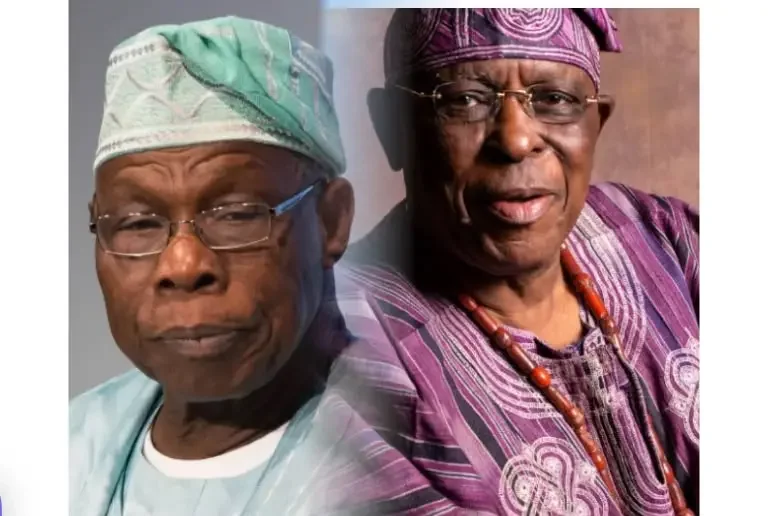
Former President Olusegun Obasanjo has dismissed allegations by former Ogun State Governor Olusegun Osoba that he deceived Alliance for Democracy (AD) leaders during the 2003 political realignments.
Mr Obasanjo, in a letter on Thursday addressed to Mr Osoba, described Mr Osoba’s article, “How Obasanjo Deceived Us in 2003,” as inaccurate, insisting he never deceived anyone in his political career.
He said several events surrounding his emergence as president and subsequent political engagements were either unknown to Mr Osoba or omitted from the publication.
The former president said his return to politics followed consultations after repeated appeals from leaders across the country following his release from prison.
| | |
|---|
According to him, he consulted prominent leaders from the South-west, the North and the South-east before joining the Peoples Democratic Party (PDP) and contesting the presidency.
Mr Obasanjo said his philosophy had always been to promote dialogue, friendship and national unity rather than bitterness, tribal politics or political exclusion.
He maintained that his decision to form a broad-based government after the 1999 election was driven by national interest and not political weakness.
The AD, promoted by the then-highly influential Yoruba socio-cultural group, dominated South-west politics when Nigeria returned to democratic rule in 1999. The party won the governorships of all six South-west states – Ogun, Ondo, Ekiti, Osun, Lagos and Oyo – in the elections that ushered in democracy after decades of military rule.
Just four years later, however, the party lost its political standing in the region, losing five of the six states to the Peoples Democratic Party in the 2003 governorship elections. Mr Osoba, who sought a second term, lost in Ogun. Other AD governors who lost were the now-deceased Adebayo Adefarati of Ondo, the late Lam Adesina of Oyo, Bisi Akande of Osun, and Adeniyi Adebayo of Ekiti. Only Bola Tinubu, a future Nigerian president, won his second term election as Lagos governor in the region.
Fabled accounts attributed the AD’s loss to the flawed agreement they had with Mr Obasanjo in the build-up to the 2003 general elections. Under the unwritten agreement, as the account goes, the AD governors would support Mr Obasanjo, a Yoruba man from Ogun State, for a second term as president, and he would return the gesture by supporting the governors to return for a second term on the AD platform.
Mr Tinubu reportedly opted out of the agreement, running a campaign for the outright rejection of Mr Obasanjo and his party, the PDP. He asked supporters to vote for the AD across all elections in his state.
The five AD governors reportedly kept their part of the deal while Obasanjo reneged on his. The five governors lost, paving the way for the PDP to take control of their states. Only Mr Tinubu, who was not part of the agreement, emerged victorious among the AD governors and completed his second term.
But Mr Obasanjo, in his rebuttal, Mr Obasanjo denied claims that he sought the support of six AD governors to survive political challenges, describing such assertions as unrealistic considering the PDP’s numerical strength.
He said allegations that he accepted political conditions allegedly presented by Afenifere leaders before assuming office were false, stressing that no group dictated government policies to him.
Mr Obasanjo defended the outcome of the 2003 elections, insisting the defeats suffered by most AD governors reflected political realities and campaign shortcomings rather than manipulation.
He criticised Afenifere for what he described as narrow ethnic politics, arguing that national leadership required broader political accommodation beyond regional interests.
“I sympathise with some Afenifere leaders who died with regret as they expressed to me before they died – Chief Gani Daudu, Chief Abraham Adesanya, and Chief Ayo Adebanjo.
“I was close to some of them before they died. What they cherished, taught, believed and practised were not what their proteges accepted, believed and practised.
“There are many things you got wrong and many things you omitted advertently or inadvertently in your write-up carried in The Legal Observer of July 20, 2026.
“Your presentation in your write-up was farfetched to put it mildly.
“But Before I go further, I take strong and serious objection to your calling me a deceit because I deceived nobody.
“I always presented my case and all issues as I had them and as I understood them no matter whose ox is gored,” he said.
Despite their disagreements, Obasanjo acknowledged Osoba’s contributions to Ogun State, particularly allocating land for the Olusegun Obasanjo Presidential Library in Abeokuta.
He urged political leaders to embrace humility, dialogue and enduring relationships, saying politics should never destroy personal friendships or commitment to national development.
NAN reports that one of the issues highlighted by Mr Osoba in the article was the AD’s endorsement of Mr Obasanjo for the 2003 presidential election.
He insisted Mr Obasanjo knew he would not contest under the AD but played along, deceiving the party that had endorsed him as its presidential candidate.
“We decided not to present a presidential candidate for the AD, in spite of resistance from some Afenifere leaders.
“We later realised that we had been fooled. Obasanjo merely played along with us and ended up deceiving us by telling our leaders what he knew they wanted to hear but which didn’t come from his heart,” he said.
(NAN)