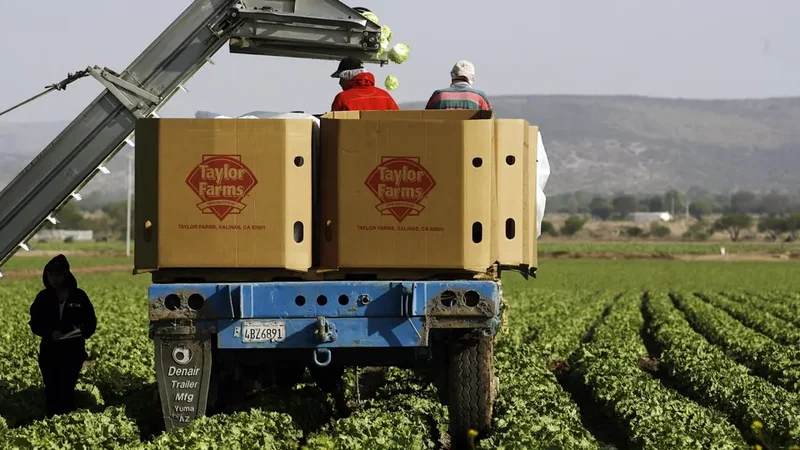
Late last week Bruce Taylor, the founder and CEO of Taylor Farms, dispatched a lobbyist to the White House for an emergency meeting to discuss the__ cyclosporiasis outbreak__ that has been linked to his business and to express “frustration with being excluded from the outbreak investigation process.” The meeting came after the Food and Drug Administration reported that the brand’s lettuce was being investigated for the parasite—which has so far caused “explosive diarrhea” in more than 7,000 people and nearly 150 hospitalizations. His company, the largest salad producer in America, had issued a __voluntary recall____ __of its iceberg lettuce from Central Mexico in response.
On Sunday, the FDA acknowledged that a sample test actually yielded a false positive. Taylor Farms then issued a statement__ stating__ the FDA had apologized. By Monday, the FDA__ clarified__ that the agency’s investigation still indicated that the parasite was linked to Taylor Farms with “overwhelming epidemiological data.” In response to the “significant confusion,” Taylor Farms released another statement, this time promising not to source any of its iceberg from growers in Central Mexico for the rest of this season, and that, in addition to working “closely” with federal health officials, it had “deployed” its own specialists to Central Mexico “to probe every possible origin of the parasitic contamination.” (The FDA still says it has no positive test results to date.)
As the outbreak continues, Taylor contends the company welcomes more FDA scrutiny, and cautions against letting the outbreak frighten consumers away from eating fresh fruits and vegetables, noting that they are healthier for consumers than frozen or processed foods. "Americans are afraid and avoiding healthy fresh food to their own detriment,” Taylor told Forbes on Thursday over email in what appears to be the first time he’s responded to questions about his farm’s potential role in the outbreak.
Taylor had been co-chairman of the produce giant Fresh International Corp., the produce giant his father Ted founded along with Fresh Express, from 1981 to 1994. His father died in 1991, and a reported rift between him and his brother Steve, who was also working for the family business by then, over management styles and the future of the company apparently led Bruce Taylor to resign. He soon founded Taylor Farms with several partners in California's Salinas Valley in 1995. His brother, Steve (d. 2022), took over the family produce firm, and later led its sale to publicly traded Performance Food Group in 2001 for some $300 million.
Taylor Farms has since grown into a $7 billion (estimated annual revenue) produce powerhouse and is one of the world’s largest salad and fresh produce operations. The majority of the estimated $15 billion market for salad in North America is controlled by Taylor Farms, Fresh Express (which was acquired by Chiquita from Performance Food Group in 2005 for $855 million), and private equity owned salad brand Organic Girl.
In addition to Taco Bell and Walmart, both of which have been identified in the voluntary recall linked to the parasite outbreak, Taylor Farms has sold salad bags to Whole Foods, shredded lettuce to McDonald’s and Chipotle, and iceberg to Olive Garden. It also cuts, packs and sells other vegetables like brussel sprouts, cauliflower and onions.
The Salinas, California-based business is no stranger to recalls. Taylor Farms has been linked to several major outbreaks over the past two decades, including five different recalls in 2013 alone and a 2024 recall of raw onions served at McDonald’s due to e.Coli contamination that sickened over 100 and led to one death. “We strive to stop any risk identified quickly and learn from each one,” Taylor noted.
“Americans are afraid and avoiding healthy fresh food to their own detriment.”
The company, which describes the voluntary recall as being “out of an abundance of caution,” issued another statement that discussed its safety procedures: “We maintain best-in-class Cyclospora prevention protocols and invest more than $200 million annually into our independently audited and verified food safety protocols.”
Taylor has kept a low-profile over the past three decades, all while the company has rapidly grown.
According to Forbes estimates,Taylor Farms’s annual EBITDA margins could be as high as 6%. Publicly held Dole, the largest produce company in the world, currently trades at 0.15 times sales. At that multiple, Taylor Farms would be worth about $1 billion.
Nearly a decade ago, Taylor told Forbes he owned an estimated 51% majority of the business; if he’d held onto that stake, it would now be worth about a half billion. But his stake now is just 13% as he had been giving some stock to his adult children, top employees and a charitable foundation over the past several years. That 13% stake is worth roughly $130 million, according to Forbes estimates. Including his children’ s stakes, the family is possibly worth quite a bit more. Taylor declined to comment further on the valuation.
“A more interesting story is how a Cyclospora outbreak attributed to our shredded iceberg lettuce in Michigan can lead to a 10% drop in all produce sales across the country…including grapes and berries…and a 40% drop in leafy green products,” Taylor told Forbes, insisting that the fresh foods are still the healthy choice amid concerns. Taylor added that “science shows packaged salads are cleaner than whole head raw vegetables.”
Taylor is a third-generation produce grower. His grandfather was a farmer in the early 1900s when the Salinas Valley was best known for its depiction in John Steinbeck’s 1939 novel The Grapes of Wrath, and not for what it would become with better irrigation—the Salad Bowl of the World.
As the salad bowl has grown, so too has Taylor’s business ventures. In addition to his stake in the farm, Taylor owns 8.35% of publicly traded Mission Produce, the global avocado and mango grower and distributor, worth about $75 million, bringing his individual net worth up to at least $200 million.
In February 2025, through Taylor Farms, he also bought a 16% stake worth about $10 million in the publicly traded Pacific Valley Bank, which has served the region and Monterey County for two decades.
The next month, and within a week of the FDA announcing that it would delay what’s known as the “Food Traceability Rule” which puts more scrutiny on food manufacturers, Taylor Farms gave $1 million to the president Donald Trump’ s political action committee Make America Great Again Inc.
Taylor says the business “wholeheartedly” supports the Food Traceability Rule “as we already comply” and did not make the donation because of the ruling. He says the donation “earned me a seat at a dinner to discuss the ramifications of the tariff” that Trump announced in March 2025 on food imported from Mexico and Canada that would have increased “the cost of salads and healthy fresh food to Americans by over $500 million per year.” He did not specify if the dinner was with Trump or White House officials.
Taylor Farms is not the only salad producer that has faced several recalls as fresh lettuce and raw cut fruits and vegetables can be especially susceptible to bacteria and parasites. The Emmy-award-winning 2023 Netflix documentary Poisoned, for example, singled out the lettuce industry and quoted several former food safety regulators and experts as saying they personally never eat romaine or bagged lettuce due to the food safety risks inherent to production.
One way bacterias and parasites often spreads is due to large-scale beef, pork and chicken operations, which can be breeding grounds for bacteria like salmonella or e.Coli. The bacteria survive in manure and then can get into the water supply through rainfall and runoff. That water then may get irrigated on other farms that grow produce like lettuce, without knowing the water has been contaminated.
But, in this case, cyclosporiasis is only spread to humans through parasite-contaminated human feces, and it is not yet clear how the parasite got potentially onto the fields or into the irrigation supply.
Taylor and the company have previously responded that they invest in high food safety standards and take any issue seriously. Fresh supply chains are riskier than other foods that get cooked, which kills off bacteria and parasites.
Taylor says he has wanted the FDA to involve the business more in the investigation. “For the sake of the industry, producer information can most likely help the FDA to understand any risk faster and companies can respond accordingly,” Taylor says. “For 30 years, we have been urging the FDA to be more transparent with the produce industry.”
Taylor Farms has also been investing in growing lettuce inside greenhouses in Indiana and Virginia through Earthbound Farms, the organic brand they acquired in 2019. Greenhouses are less at risk of outbreaks because they are fully enclosed systems which do not come into contact with the soil, manure and livestock runoff that can get mixed with irrigation water. Greenhouses are also more traceable if there’s a problem, whereas one bag of salad may come from several different lettuce farms.
Those benefits help to explain part of why greenhouse-grown lettuce has been growing at grocery stores, while field-grown lettuces were declining before the parasite outbreak. Gotham Greens, for example, does a lot of additional testing of that water compared to field irrigation and uses municipal water to irrigate. “What we’re using is what you brush your teeth with,” Gotham Greens founder and chairman Viraj Puri says.
But Puri says even though greenhouse-grown lettuce has grown to about 10% share of the total salad sold in America, up from 0.1% two decades ago, the scale is still not even close to on par with what can be grown in fields. “We would not be able to consume lettuce in this country if it was not coming from the fields. It’s an important piece of the puzzle,” Puri says. “Taylor Farms is a behemoth in the industry. They’ve reached a tremendous size and scale.”
Only time will tell whether this crisis turns out to be the tip of the iceberg for Taylor Farms.
MORE FROM FORBES