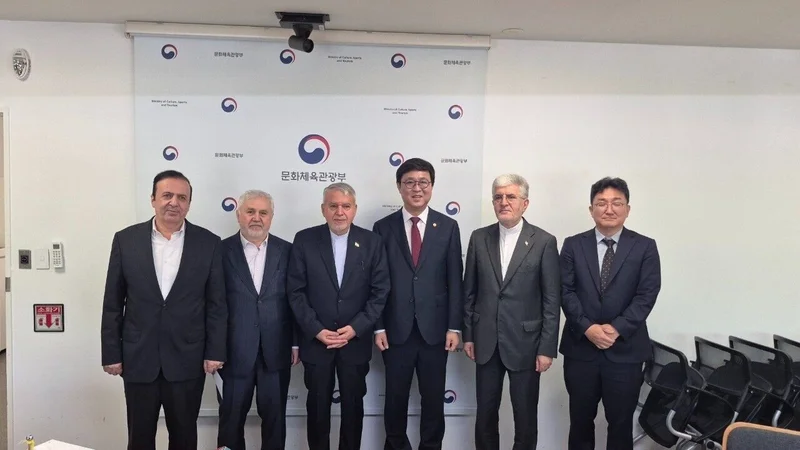
Tehran, Seoul discuss roadmap for cultural, tourism cooperation at UNESCO meeting
TEHRAN - Iran's Minister of Cultural Heritage, Tourism and Handicrafts Seyyed Reza Salehi-Amiri and South Korea's Minister of Culture, Sports and Tourism Choi Hwi-young agreed on Friday to pursue closer cooperation in cultural heritage, tourism, handicrafts and creative industries during a meeting held on the sidelines of the 48th session of UNESCO's World Heritage Committee in Busan.
The two ministers discussed expanding bilateral cooperation through a comprehensive framework covering cultural heritage, tourism, handicrafts, digital museums, smart tourism, creative industries and new technologies, IRAN reported.
Salehi-Amiri said South Korea's hosting of the UNESCO World Heritage Committee reflected its role in cultural heritage protection and cultural management.
He also expressed hope that Iran's nomination of the Cultural Landscape of Alamut would be inscribed on UNESCO's World Heritage List during the committee's current session, becoming the country's 30th World Heritage site.
The Iranian minister said Iran had identified more than one million historical sites, with more than 43,000 registered nationally, alongside dozens of UNESCO World Heritage properties and 58 sites on UNESCO's Tentative List.
Salehi-Amiri added that the Islamic Republic sought to develop a joint roadmap with South Korea to strengthen cooperation in cultural heritage preservation, tourism, handicrafts, digital technologies, electronic archives and smart tourism.
He said Iran also wanted to expand cooperation in creative industries and benefit from South Korea's experience in fields including cinema, music, animation, video games, digital content production and artificial intelligence.
Salehi-Amiri then underlined that the recent military attacks by the United States and Israeli regime had caused damage to a number of Iran's historical sites, adding that Iran would continue conservation and restoration efforts by relying on its scientific and technical capabilities.
On tourism, he said recent regional developments had temporarily affected Iran's tourism sector but expressed confidence that the industry would resume its growth. He then invited South Korean citizens to visit Iran and called for greater people-to-people exchanges.
Salehi-Amiri also invited Choi to visit Tehran and proposed signing a comprehensive memorandum of understanding covering cultural heritage, tourism, handicrafts and broader cultural cooperation. He also invited South Korea to participate in Tehran's international tourism exhibition and said Iran was ready to take part in specialized exhibitions in South Korea.
Choi, for his part, welcomed the Iranian proposals and said the two countries should deepen cooperation in culture, tourism, handicrafts, creative industries and people-to-people exchanges.
He said Iran and South Korea had long possessed the foundations for cultural cooperation and that further planning could strengthen bilateral ties.
Choi described Iran's civilization and history as part of humanity's shared heritage and said protecting historical and cultural sites was a common responsibility of the international community.
He also expressed regret over damage sustained by some Iranian historical sites during the recent conflict and said he hoped conservation, restoration and public presentation of the sites would continue as stability returned, IRNA reported.
Choi added that joint handicraft exhibitions, cultural programs and artistic events could strengthen bilateral cultural relations and added that Seoul was ready to expand cooperation in tourism, sports and cultural exchanges.
He also thanked the Iranian delegation for visiting South Korea and called for continued dialogue between the two governments and practical follow-up on the proposals discussed during the meeting.
AM