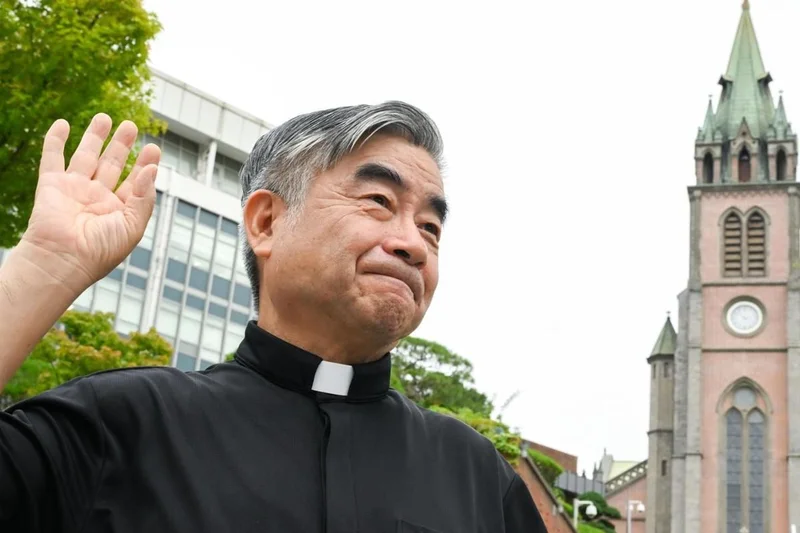
Fr. Matthew Hong Sung-nam, director of the Catholic Psycho-Spiritual Counseling Center in Seoul, says he is "more interested in people than in God."
"I asked, 'God, what should I do?' and the answer that came back was, 'Make people happy,'" Hong said. "Since then, I have lived worrying about people instead of worrying about God."
Born in 1953, Hong followed an unconventional path to his calling. He struggled with anxiety during his youth, describing himself as an "obnoxious Catholic fanatic." As a young adult seeking financial security, he apprenticed under a Korean shaman — a traditional folk spiritualist — before abandoning the training. After seeing Jesus in a dream, he entered a seminary and was ordained as a priest in 1987. Yet ordination did not bring him peace.
The demands of parish ministry soon overwhelmed him. Hong began drinking heavily as his mental health deteriorated to the point of contemplating suicide. Professional therapy from a Jesuit priest helped him overcome the crisis.
Reinvigorated, Hong earned a master's degree in psychological counseling and launched a new ministry centered on emotional well-being. For more than a decade, he counseled both Catholics and non-Catholics. Today, he primarily counsels fellow priests struggling with their own mental health.
While traditional religion often frames suffering as a divine test that requires complete reliance on God, Hong believes people must find healing within themselves and through human relationships.
"Just as parents want nothing more than for their children to be happy, God must want us to live happily today," Hong said during an interview at the Myeongdong Catholic Center in central Seoul. "God loves everyone unconditionally."
The Hankook Ilbo interviewed Fr. Hong, asking him what defines a happy life, how to find inner peace, and what lies beyond death.
‘Teaching people they are sinners amounts to gaslighting’
Q: The idea of religion helping people through psychological counseling may seem unfamiliar to many. How does spirituality connect with therapy?
A: The society I have observed as a priest is dark and highly transactional. The fundamental solution is for people to change. For that to happen, we need religion that nurtures internal goodness. Spirituality ultimately comes down to character. My work involves using counseling to help people grow into better human beings.
Religion sometimes tells people, "You were born sinners, and you will continue committing the same sins." It instills guilt and a sense of inferiority. In some ways, that is violence. It is gaslighting. I spent years wandering while hating myself. Psychology led me to a different answer — that I had to treat myself with compassion.
There is an inner voice that scolds you, saying, "You are no good. You do not deserve to be happy." In psychospiritual counseling, we call that voice a snake or an evil spirit. It causes depression and anxiety. Some religious figures claim that voice comes from God and try to keep believers under psychological control. My work also involves helping believers resist that kind of control.
Q: Is seeking answers through counseling rather than traditional religious devotion considered a betrayal of faith?
A: The human mind is like muddy water. There are only brief moments when the water becomes clear. If you cherish and care for that muddy water, a lotus may occasionally bloom. Some religious figures demand that people turn muddy water into pure water, but that is impossible. To say, "I have attained enlightenment, and you can do it, too," is spiritual deception. When religious leaders tell people to follow God's will, that should mean, "Trust yourself and live your life."
Most religions instead claim the power to choose rests solely with God. They tell people, "Obey and you will go to heaven. Disobey and you will go to hell." If parents threatened their children that way, wouldn't we call it abuse? Would God behave like that? Would parents save the children they like and throw the others into a pit of fire? The same principle applies to God. We are tiny beings gathered on a tiny point called Earth. God wants us to live happily and harmoniously with one another. That is what religion originally taught.
Faith does not erase fear, grief
The building currently housing the Myeongdong Catholic Center served as St. Mary’s Hospital until it relocated to Yeouido in July 1986. Hong said the former hospital’s basement mortuary still sometimes gives him chills.
Hong recently suffered a severe illness and found himself thinking, "I might die like this. It would be a shame to die now." Shouldn’t a religious figure remain detached from life and death?
Q: Are priests and other clergy also afraid of death? Some devout believers even rejoice after a passing, saying the deceased is now with God.
A: That is merely a show of spiritual arrogance. People must not suppress their grief that way. Doing so can make them ill or cause them to collapse completely. They need time and space to grieve fully. I believe people need at least six months to mourn.
I sometimes lose contact with parents whose child has died and meet them again several years later. When I ask, "Are you feeling any better now?" they answer, "Do I look all right to you? I'm not." I am skeptical of religious people who say they have overcome their fear of death. Human beings are not that strong.
Death and religion
Q: You have celebrated hundreds of funeral Masses. What has death looked like from such close range?
A: After encountering death in so many forms, I find myself thinking, "I really must live well." I often remember the funeral of an elderly woman I met while serving in a parish in a low-income hillside neighborhood. She was impoverished and completely paralyzed. Whenever I visited her home to pray, a landline telephone beside her bed kept ringing. I wondered why a person who could barely move received so many calls.
Her funeral answered that question. So many mourners arrived that the church was packed. She had counseled people by telephone while lying in bed. Everyone who had found deep comfort in her words came to pay their respects. Her compassion brought all those people together.
The resurrection described by religion does not simply mean a physical return to life. To me, true resurrection — being remembered and deeply missed by many people after death — occurs through others. You learn what a person's life meant by how people remember them after death. Those left behind determine whether someone lived well.
The best life belongs to someone whom many people cannot bear to let go of and wish could return. Below that comes a life whose end leaves people saying, "What a loss that the person died." Below that comes the kind of life that makes people ask, "Is that person still alive?"
What is the worst life? One that makes everyone say, "That person must never come back." That is why people refuse to allow graves to be built for despots, or perform traditional rituals like throwing salt on dictators' graves — a Korean custom of purification used to banish bad luck and show absolute rejection.
Q: Do you often think about death? People whose work brings them close to it frequently say everyone should prepare for death.
A: I am too busy caring for the mental well-being of the living to have time for that. Catholicism encourages people to reflect on their existence by contemplating death. But little good comes from thinking about death too often. It makes people impatient and leads them to take actions they do not need to take.
Nothing matters more than protecting daily routines. Do not write a will merely as an exercise. Make a happiness list instead. A good death is one without lingering regrets. People burdened by regrets cannot find peace easily. Regrets stem from the happiness a person never experienced.
Tell yourself, "I will buy this for you" or "I will let you do that." Become someone who helps resolve your own lingering regrets. That will allow you to rebuild your relationship with yourself and move closer to a peaceful death.
Q: Does believing in the afterlife help us live better? Does faith make death less frightening?
A: No one can die with you. Death is a path each of us ultimately has to travel alone. Religion should keep you company along that path. You could call it a buffer against anxiety.
Religious teachings about the afterlife often come with the warning, "If you do not believe, you will go to hell." Much of that is about frightening believers into not leaving religion. Some religious leaders say, "Your life today is about earning a ticket to heaven," and, "You have to give money to get that ticket." That makes me angry.
The real role of religion is to welcome anyone, without judging who they are or demanding a tally of their sins, and give them a place where they can feel at ease. People often think a good believer should never have doubts. That is not true. Question what you are told, and stay alert.
Q: Suicide is considered a grave sin in many religions. The Catholic Church, among others, has made extensive efforts to prevent suicide, yet the problem persists.
A: What people need most to prevent suicide is other people. In Japan, they plant bamboo around houses to prepare for earthquakes. The tightly intertwined roots help hold the houses in place. People need to do for one another what those roots do for the bamboo. When your heart begins to waver, having people you are connected to can help you endure. The people who break down after struggling alone, with no one to lean on and no community where they can open up, are the ones who grieve me the most. People need other people. There is no better medicine for a person than another person, but too few realize that.
Q: Public calls are growing to give people more control over their own deaths, including by legalizing assisted dying. Opposition from religious groups remains a major obstacle.
A: If religion insists that people must live to the very end, then it also has to take responsibility for that position. Religious groups should pay the costs and take on the caregiving burden needed to help the elderly and sick live to the end. They could use their own money to build free hospitals or care facilities. Why do they only pay lip service?
For now, assisted dying is mostly a concern of the well-off. Why does religion stay silent when poor workers die in major workplace accidents? What about innocent people dying in wars?
If opposition to assisted dying or abortion really comes from a desire to protect life, religious groups should speak out just as consistently about those tragedies. Religious leaders would have no answer if people made to suffer needlessly because of that opposition held them responsible.
Q: Everyone wants to choose a dignified, pain-free death. But people still worry about burdening their families or being judged for failing to meet their obligations.
A: You should get to make your own decisions until the moment you die. What matters is that you can leave this world peacefully and comfortably.
Poet Cheon Sang-byeong famously compared life to a picnic. Leaving the world with that frame of mind is what a dignified death truly means.
Where is the dignity in lying there with needles all over your body just to make money for the hospital or help your family save face? If you want a good life and a good death, comfort people while you are alive and share what you have. That does not cost money. Like the woman from the low-income hillside neighborhood I mentioned earlier, sometimes all it takes is a phone call.
Why God is absent from Hong's happiness list
Hong says God wants people to live happily, outlining five key components for a happy life.
Human connection
Hong said human connection matters most. He cited the famous Roseto effect in Pennsylvania, where many residents were once obese but remarkably free of heart disease.
"They got along well and saw one another often," he said. "Redevelopment brought wealth into the neighborhood, people started fighting, and they stopped seeing one another. After that, people started getting sick."
Physical health
"Once you lose your health, nothing else matters," Hong said. "People spend money taking great care of their cars. So why do they keep introducing harmful substances like alcohol and tobacco into their own bodies? We are the caretakers of our bodies, not their owners. Take care of your health. Think of your body as something you should use well for a long time before giving it back."
Financial security
Hong said money itself does not bring happiness, but how you use it is what matters.
"Money is like blood. You need money to go about your life and get things done. Sometimes money can even save a life," he said. "Money is just money. What matters is how you use it. People who say, 'We shouldn’t talk about money,' are often the ones who want it most."
Continuous learning
Hong said people must remain humble in the face of their own ignorance.
"Studying should do more than add to our knowledge. It should confront prejudice and ignorance. We must keep asking what life is, what society is, and how the human mind works — and keep looking for answers," he said. "It is dangerous and arrogant to say, 'I know everything.' Do people who say that think they are God? Stay humble enough to say, 'I still don’t know very much.'"
Rest and play
"I went through a terrible time while serving at a parish in an area undergoing redevelopment. What got me through was setting aside time to have fun every day and release the tension in my body and mind," he said. "Play gives your brain a break after working hard all day. Do not feel guilty about having fun."
Neither God nor faith appeared on Hong’s list of essentials for a happy life, and he explained why.
"If I make people happy, they will wonder, 'Who is this person, and why is he doing this for us?' Then they will naturally see God through me, even if I say nothing," he said. "That’s the real thing."
This article from the Hankook Ilbo, the sister publication of The Korea Times, is translated by a generative AI system and edited by The Korea Times.