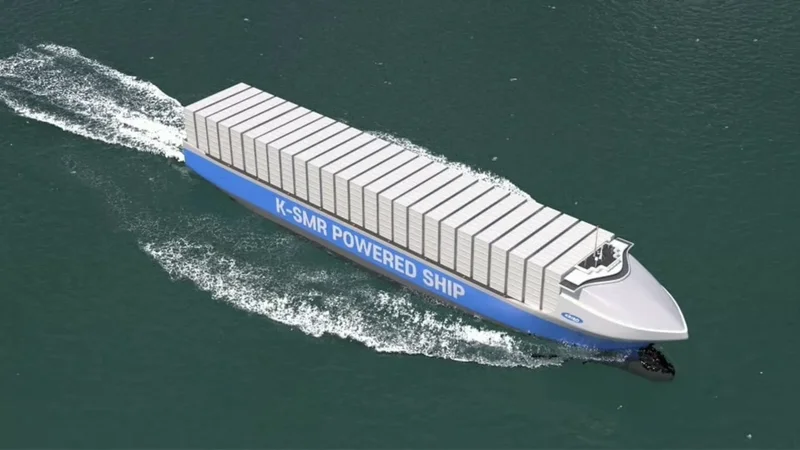
Massive artificial intelligence data centers and their extreme energy damages are fuelling renewed interest in nuclear power. But it turns out one of the more impactful uses of this atomic-age technology may not come from Three Mile Island or the American heartland. Instead, the hulls of giant cargo ships trudging their way across the world’s oceans may be ready to meet the world’s growing energy needs.
Several shipping giants have been toying with the idea of outfitting future vessels with smaller, more advanced nuclear reactors. Earlier this month, the American Bureau of Shipping, a global maritime classification society that establishes technical standards for ships, granted an important Approval in Principle (AIP) to a South Korean consortium interested in building an advanced vessel powered by a pair of molten salt nuclear reactors. The AIP is essentially a regulatory seal of approval and is an essential step in the ship’s progression from idea to reality.
If realized, the groups behind it believe the relatively small nuclear reactor onboard could let the vessel travel at 25 knots (roughly 28 miles per hour) across the ocean, carrying up to 15,000 20-foot cargo containers. It’s a major test for the technology, which supporters say might be the best way that the shipping industry could cut back on its notoriously high and stubbornly persistent fossil fuel emissions.
The ship design and molten salt reactor integration are being jointly pursued by the Korea Research Institute of Ships & Ocean Engineering (KRISO), Samsung Heavy Industries, and the Korea Atomic Energy Research Institute (KAERI).
“Nuclear has the potential to fundamentally alter commercial shipping in vessel design, operating range and energy economics. ABS is focused on building the technical and safety framework needed to support that, and this AIP with KRISO and KAERI is a concrete part of that work,” ABS Senior Vice President and Chief Technology Officer Patrick Ryan said in a statement.
New nuclear reactors are getting salty
Nuclear-powered ships, as a general concept, aren’t all that new. After World War II, the United States military began using pressurized water-cooled reactors on warships and submarines. The first nuclear-powered merchant ship, the NS Savannah, was built in the late 1950s and cost roughly $500 million in today’s dollars. Currently, the U.S. has a fleet of around 70 active nuclear-powered submarines. However, cargo ships powered by conventional nuclear power are far rarer, partly because the technology has not matured and because the sheer size of the reactors limits the space left for cargo. Only one of these nuclear cargo ships, Russia’s Sevmorput, remains in service to this day, after being commissioned in 1988.
The newer nuclear-powered ships currently under consideration, like the massive Korean vessel are taking a different approach. Rather than rely on old, massive, water-cooled reactors, they are aiming to utilize a new, developing class of much smaller molten salt reactors. As the name suggests, these reactors use molten salt as a carrier for liquid nuclear fuel, in place of solid fuel rods. In practice, molten salt combines with fissile material like uranium or thorium, which then creates a chain reaction. Heat generated by the process transfers directly to the salt, which then passes through a boiler that creates steam to drive a turbine. The engineers designing the Korean ship say that they plan to place the reactor near the middle of the hull to minimize impact from rough ocean waves and mitigate damage to the reactor that may occur during a potential collision. They also plan to build a hefty radiation shield to protect the crew onboard.
Though still relatively early in development, proponents of molten salt reactors (MSRs) say they offer multiple upsides over conventional nuclear power. For starters, they use far less water since salt is used as the primary coolant. That potentially decreases how much nuclear waste is created and reduces intensive water demand. That reduction in water could become even more important in light of notoriously thirsty AI data centers. MSRs are also, in theory at least, much safer. That’s because, as Wired notes, they are basically self-regulating.
If a chain reaction in the core occurs too fast and the reactor gets concerningly hot, the salt should expand out of the core, which in turn should cool the whole thing down. The salt that leaks out then can no longer cause a fission reaction. The International Atomic Energy Agency describes these as passive safety features that regulate the reactor without the need for direct human intervention.
MSRs are also potentially cheaper. A previous analysis highlighted by IEEE Spectrum showed that an MSR-powered cargo ship would save about $70 million over the course of a ship’s lifetime simply by not using heavy diesel. A separate, more recent study published in the International Journal of Naval Architecture and Ocean Engineering found that the ship being designed by the Korean consortium would similarly offer “significant long-term cost advantages” over an alternative running on fossil fuels.
The shipping industry’s race to get green
Still, there’s a larger elephant in the room when it comes to the shipping industry broadly. More than safety or hypothetical fuel-cost savings, proponents are hoping this foray into MSR-based hulls could work as a kind of silver bullet to meet climate goals. For now at least, these ambitious goals look incredibly unlikely to succeed. Even as cars have embraced electrification and solar and wind power have been on the rise, shipping has remained stubbornly tied to fossil fuels. The industry is estimated to consume around 350 million tons of fossil fuels annually, which amounts to around 3 percent of the world’s total carbon emissions. A single container ship making the journey from Amsterdam to Shanghai reportedly requires 4,000 tonnes of fuel. And it’s not just any fuel: cargo ships rely primarily on a cheaper, less heavily refined diesel called heavy fuel oil, which produces much higher levels of environmentally harmful black carbon and sulfur dioxide than standard car gasoline.
The International Maritime Organization, the United Nations body that governs the industry, previously set a goal of a 50 percent reduction in emissions by 2050. That already sounded wildly ambitious, and then they moved the goalpost even further in 2025. The new goal aims to achieve net zero emissions by 2050 as well. To do that, companies are exploring battery power and alternative fuel sources like ammonia. Some companies like DHL, have even explored a new breed of cargo ship powered by wind—essentially a massive, modern take on sailing.
All of those options will help on the margins, but making massive reduction in carbon emissions in a short period of time will require something more radical—government cooperation and commitment.
While molten salt reactor-powered ships are an exciting option, they still have a long way to go. Just this week, the U.S. Department of Energy granted Texas-based firm Natura Resources a Nuclear Safety Design Agreement for its experimental molten salt reactor, making it the closest to actually breaking ground. China, meanwhile, already has one 2-megawatt reactor up and running with others in development.
In other words, the technology is advancing, but not exactly at what anyone would call breakneck speeds.