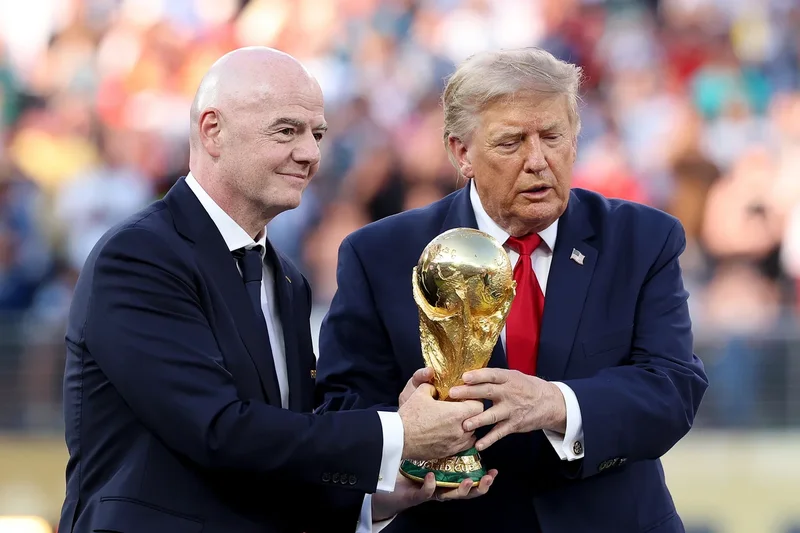
The International Olympic Committee (IOC) will not investigate claims that Fifa president Gianni Infantino violated Olympic neutrality rules through his interactions with United States President Donald Trump.
Human rights organisation FairSquare lodged a complaint with the IOC earlier this month, highlighting Fifa’s decision to postpone a World Cup suspension for US striker Folarin Balogun.
This deferral reportedly followed a personal request from President Trump to Infantino to review the red card.
Despite Infantino holding a position as an IOC member, a spokesperson for the committee stated that its ethics commission concluded it lacked jurisdiction, as the complaint primarily concerned Fifa's internal decisions and governance.
“The IOC ethics commission thoroughly analysed the complaint by FairSquare,” a spokesperson said.
“The commission noticed that, pursuant to the Olympic Charter, each international federation (IF) maintains its independence and autonomy in its governance. The IOC Code of Ethics’ scope of application vis-a-vis the international federations and their officials is specifically limited to their relations with the IOC.
“The IOC ethics commission noted that the current complaint, including with regard to the Fifa president, refers only to the IF’s decisions on its governance and its management, including its relations with government, and to the IF’s implementation of the rules of its sport, which are both outside the scope of application of the IOC code of ethics.
“Consequently, the complaint falls outside the IOC ethics commission’s jurisdiction. FairSquare has been informed accordingly.
“Separately from this complaint, as reaffirmed at the recent IOC Session, the IOC will continue its efforts to strengthen good governance across the Olympic Movement and to promote greater clarity regarding the respective roles, responsibilities and accountability of its constituent organisations.”
A FairSquare statement described the decision as “absurd”, adding: “The IOC’s commitment to political neutrality is as rigorous as FIFA’s.
“This will only add impetus to the calls for wholesale regulation of sports governing bodies since they demonstrate no ability to enforce their own rules with either consistency or impartiality.”
FairSquare separately made a complaint about Infantino to the investigatory chamber of Fifa’s ethics committee last December.
That complaint addressed four instances in which FairSquare alleged Infantino expressed his public support for the actions and policies of President Trump.
It also requested that the ethics committee investigate Infantino’s role in the decision to introduce a Fifa Peace Prize and the decision to award it to President Trump at the draw for the 2026 World Cup, and the conformity of those processes with FIFA’s procedural rules.
FairSquare said earlier this month that it had received an acknowledgement of its complaint from Fifa’s ethics committee, but no further information since.
That complaint was filed before the furore surrounding the Balogun affair.
Fifa’s disciplinary committee announced on July 5 that the automatic one-match ban for the Monaco forward had been suspended. President Trump revealed the following day he had personally lobbied Infantino to review the decision.
Infantino insisted Fifa’s committees acted independently, but no explanation has been provided by the disciplinary committee regarding the specific circumstances which prompted the deferral of the ban.
The Times has reported that the committee chair, Mohammad Al Kamali, took the decision alone.
UEFA issued a statement describing the Balogun decision as “unprecedented, incomprehensible and unjustifiable”, with its president Aleksander Ceferin understood to have stayed away from last Sunday’s final in protest over that issue, and a number of other serious misgivings over Fifa’s governance.
Balogun himself admitted he anticipated significant backlash following Trump’s intervention, saying he knew it would "cause a lot of controversy”.
Speaking to CBS, Balogun reflected on the immediate aftermath: "My initial reaction was I was happy to be back in the team, but when I kind of started to reflect, I knew it was going to cause a lot of controversy, and I could almost see within my team-mates a bit of nerves, because it’s something that is so unique."
He added: "But the closer we got to the game I tried to just focus as best as I could, but it was difficult. A lot of outside noise, and that’s hard to avoid."