I will openly admit that I'm not usually a fighting game person. I enjoy playing Mortal Kombat with my equally bad friends, but as soon as I'm up against someone who knows their shit, I'm fumbling over the controls. Unsurprisingly, it's not all too fun getting your ass whooped and feeling like there's little you can do to stop the pain.
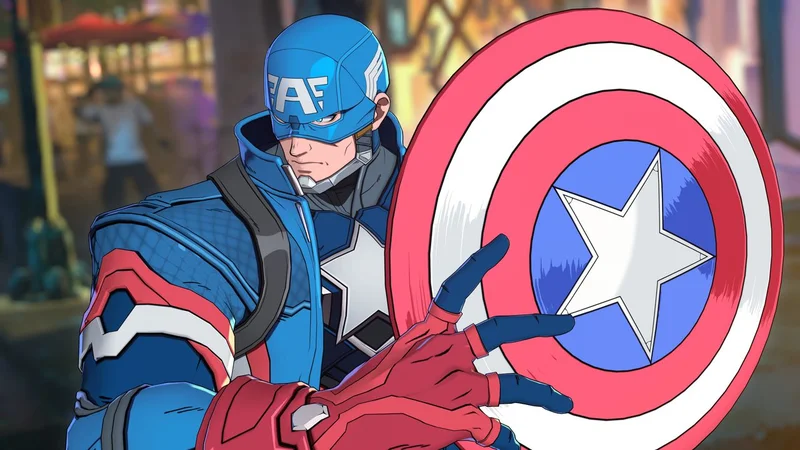
But as soon as I laid eyes on Marvel Tōkon: Fighting Souls during Sony's 2025 State of Play, I knew I needed to at least try it—just look at the graphic design work on display. And now that the Marvel Tōkon beta has arrived, I've done just that.
Marvel Tōkon's main selling point for a fighting game flump like me—besides the cool cast and art style—is the universal controls and automated combos. Basically, every superhero shares the same combo inputs, unlike, say, Mortal Kombat, where each character has unique chains. It's all standardised.
Light, medium, and heavy attacks while standing, crouched, or aerial will always perform the same actions and automatically lead to specific chains no matter who you're playing. For example, the following chain is a few basic attacks that'll launch your enemy into an aerial combo, then knock them down to earth again: L → M → H → Down → H → M → H → Down → H.
Similarly, the right bumper is dedicated to your character's unique attacks, while the right trigger handles your skills. Pressing triangle/Y and circle/B will grab your opponent. The X/A button, along with the left trigger, are mapped to your team swapping moves.
It's intuitive, it's quick, and it's much easier to remember than Mortal Kombat's fighter-specific inputs and combos that typically also have you pressing buttons like you're entering the Konami code. I can comfortably bounce from Wolverine to Captain America without having to rewire my brain.
Marvel Tōkon's approach might sound restrictive, as if each character would feel the same given they share the same basic combos, but that couldn't be further from the truth. Mastery here comes more from how you utilise your character's specific superhero skills, and how you weave that into a four-hero tag-team format.
Keep up to date with the most important stories and the best deals, as picked by the PC Gamer team.
Captain America, for example, can throw his shield for a nice bouncing ranged attack, but time the move correctly, and you can quickly kick the shield back for a second pass. Spider-Man can websling for easy mobility and can even hang from the ceiling. Wolverine can become Berserk from certain moves to deal bonus damage. Green Goblin can launch his glider out and, just like his fate in Sam Raimi's Spider-Man, it'll return shortly after.
And once you've mastered your chosen fighter, it's then time to pin down the other three in your team. Your other heroes will automatically poke their heads in for follow-up attacks after certain combos, so long as you've got charge, but you can also swap to them at any moment. It's far beyond my current abilities, but I can already foresee some pros rotating through their team, seamlessly executing combos that use each hero's unique powers.
It helps that, just like its marketing material, it's stylish as hell. You feel cool even if you're still making it up as you go along. I've long wanted to get into a fighting game, and perhaps Marvel Tōkon's lower barrier to entry through universal combat is my Trojan horse.
Rory has made the fatal error of playing way too many live service games at once, and somehow still finding time for everything in between. Sure, he’s an expert at Destiny 2, Call of Duty, and more, but at what cost? He’s even sunk 1,000 hours into The Elder Scrolls Online over the years. At least he put all those hours spent grinding challenges to good use over the years as a freelancer and guides editor. In his spare time, he’s also an avid video creator, often breaking down the environmental design of his favourite games. If you can’t track him down, he’s probably lost in a cave with a bunch of dwarves shouting “rock and stone” to no end.