U.S. President Donald Trump said Friday that the original deal on the disbursement of revenues from the Gordie Howe International Bridge “no longer stands” after his administration struck a new agreement, raising more questions about Prime Minister Mark Carney’s own claims about the arrangement.
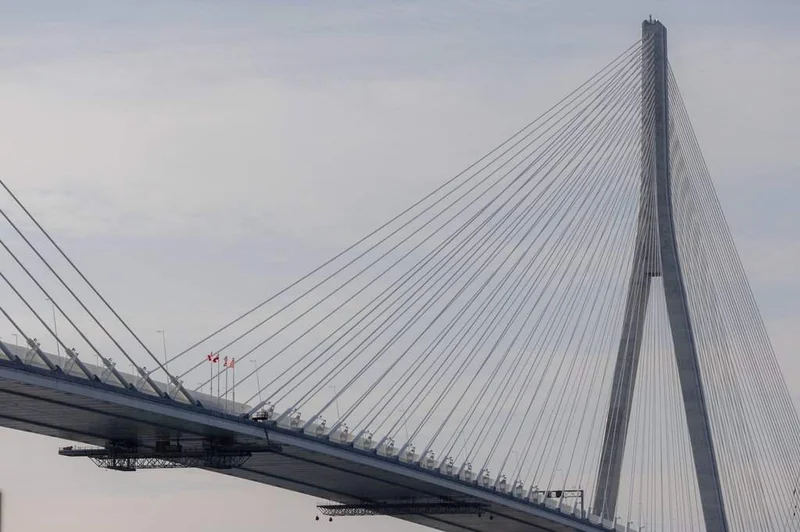
Trump’s post on Truth Social came during a ribbon-cutting ceremony being held by Canadian officials in Windsor to mark the opening of the new bridge to Detroit, which is officially set for Monday.
“Canada disinvited the United States of America to the opening of the Gordie Howe Bridge, which is fine, considering they are paying substantial TARIFFS to the United States,” Trump wrote.
“The original Deal on the Bridge, which was terribly negotiated by a previous Administration, no longer stands. We changed the terms of the Deal so that the United States of America now gets 50% of the Profit.”
A day earlier, Carney said the opposite.
Get daily National news
“The underlying agreement between Canada and Michigan remains in place,” Carney told reporters in Prince Edward Island where he was meeting with Canada’s premiers.
That original agreement, signed in 2012 and later approved by Trump during his first term, envisioned that Canada would collect the full toll revenues until the debt accrued from shouldering the full $6.4 billion cost of building the bridge is paid off, plus interest. After that, revenues would be split evenly between Canada and the U.S.
- ‘Today was one of the worst days,’ friend says of inquest into death of Boden Umpherville
- Does Canada have leverage in Trump trade war? What premiers, experts say
- Quebec obstetricians and gynecologists association head to court over pay gap
- Saskatchewan Roughrider fans pay tribute to player and man killed in crash
However, the text of the new agreement in principle states that Canada will make payments to the U.S. totalling 50 per cent of “net bridge and crossing related revenues” for the first 15 years, and doesn’t clearly define what counts as operating costs or make mention of Canada’s debt.
Carney said Thursday the new deal was “in parallel with” the original 2012 agreement.
“There’s an alignment of incentives, the combination of that (2012) agreement and the sharing under that,” he added.
The House of Commons government operations committee is set to meet next week regarding a request from opposition members to investigate the terms of the agreement.
Asked by reporters Thursday if he believes Carney has misled Canadians over the terms of the bridge revenue-sharing deal, Conservative House leader Andrew Scheer said “absolutely.”
“He told Canadians that Canadians would be paid back first, that the construction and debt servicing costs would be factored into this,” he said. “Now we know that just wasn’t true.”
—With files from Global’s Uday Rana, Ariel Rabinovitch and Mackenzie Gray