the Creative Commons Attribution 4.0 License.
the Creative Commons Attribution 4.0 License.
Arctic glaciers and ice caps through the Holocene:a circumpolar synthesis of lake-based reconstructions
Yarrow Axford
The recent retreat of nearly all glaciers and ice caps (GICs) located in Arctic regions is one of the most clear and visible signs of ongoing climate change. This paper synthesizes published records of Holocene GIC fluctuations from lake archives, placing their recent retreat into a longer-term context. Our compilation includes 66 lake-based GIC records (plus one non-lake-based record from the Russian Arctic) from seven Arctic regions: Alaska, Baffin Island in northeastern Canada, Greenland, Iceland, the Scandinavian peninsula, Svalbard, and the Russian high Arctic. For each region and for the full Arctic, we summarize evidence for when GICs were smaller than today or absent altogether, indicating warmer-than-present summers, and evidence for when GICs regrew in lake catchments, indicating summer cooling. Consistent with orbitally driven high boreal summer insolation in the early Holocene, the full Arctic compilation suggests that the majority (50â% or more) of studied GICs were smaller than present or absent by â¼10âka. We find the highest percentage (>90â%) of Arctic GICs smaller than present or absent in the middle Holocene at â¼â7â6âka, probably reflecting more spatially ubiquitous and consistent summer warmth during this period than in the early Holocene. Following this interval of widespread warmth, our compilation shows that GICs across the Arctic began to regrow and summers began to cool by â¼6âka. Together, the Arctic records also suggest two periods of enhanced GIC growth in the middle to late Holocene from â¼â4.5â3 and after â¼2âka. The regional records show variability in the timing of GIC regrowth within and between regions, suggesting that the Arctic did not cool synchronously despite the smooth and hemispherically symmetric decline in Northern Hemisphere summer insolation. In agreement with other studies, this implies a combined response to glacier-specific characteristics such as topography and to other climatic forcings and feedback mechanisms, perhaps driving periods of increased regional cooling. Today, the direction of orbital forcing continues to favor GIC expansion; however, the rapid retreat of nearly all Arctic GICs underscores the current dominance of anthropogenic forcing on GIC mass balance. Our review finds that in the first half of the Holocene, most of the Arctic's small GICs became significantly reduced or melted away completely in response to summer temperatures that, on average, were only moderately warmer than today. In comparison, future projections of temperature change in the Arctic far exceed estimated early Holocene values in most locations, portending the eventual loss of most of the Arctic's small GICs.
Globally, mass loss from glaciers and ice caps (GICs) is accelerating (Hugonnet et al., 2021). Between 2000 and 2019, GICs worldwide lost a mass of 267±16âGtâyrâ1, which is equivalent to 21±3â% of the observed sea-level rise (Hugonnet et al., 2021). Notably, the roughly 50â000 GICs located in Arctic regions accounted for â¼70â% of this recent loss (Hugonnet et al., 2021, Table 1; Vaughan et al., 2013). By the end of the century, mean surface air temperature in the Arctic is expected to warm by 2.2â8.3ââC â a rate that is amplified relative to the global mean (Collins et al., 2013, temperature
anomalies relative to the 1986â2005 reference period). Accordingly,
regionally differentiated global-scale projections of GIC mass change find
Arctic GICs to be the largest contributors to forecasted global ice volume
loss by 2100 (RadiÄ and Hock, 2011; RadiÄ et al., 2014). The continued wastage of Arctic
GICs is expected to have a myriad of sociocultural and economic
ramifications for Arctic communities, including major alterations to
hydrological systems at a local scale, potentially affecting water
availability, quality, and downstream aquatic ecosystems (Huntington et al., 2019; IPCC, 2007).
The current and projected rapid changes to the Arctic cryosphere are even more striking when considered within a longer-term context (e.g., Kaufman et al., 2009; Fisher et al., 2012; Miller et al., 2013). GIC fluctuations over the Holocene have been reconstructed using a mix of discontinuous and continuous proxies including the mapping and dating of glacial moraines, lichenometry and tree ring records, and proglacial lake and speleothem records (Solomina et al., 2015). Overall, these records indicate that many Arctic GICs were small or had completely melted away in the early to middle Holocene in response to orbitally forced summer warmth in the Northern Hemisphere (Solomina et al., 2015). These records also show that many of the GICs melting away today reformed during the middle to late Holocene as summer temperature cooled from the insolation-driven Holocene maximum (McKay et al., 2018; Solomina et al., 2015). Recent anthropogenically driven warming has sharply reversed this long-term, insolation-driven, cooling trend and GIC expansion, and it is expected to cut short the life spans of Arctic GICs that in many cases have existed for several thousand years.
While relatively widely studied, many questions linger about Holocene
climate. Globally, climate simulations and proxy reconstructions
fundamentally disagree on the overall direction of mean annual temperature
trends through the Holocene, a significant dataâmodel discrepancy coined
the Holocene temperature conundrum (Liu et al., 2014). Furthermore, to date, there have been few published multi-proxy syntheses of Holocene climate specific to the Arctic, and most have been focused on sub-regions or narrower time periods (e.g., Kaufman et al., 2004, 2009; Kaplan and Wolfe, 2006; Briner et al., 2016; McKay et al., 2018; Axford et al., 2021). Although chiefly driven by symmetrical orbital
forcing, synthesis studies of temperature-sensitive proxy data suggest that
the timing and magnitude of the Holocene Thermal Maximum (HTM) were spatially
and temporally asymmetrical across the Arctic (e.g., Kaufman et al., 2004;
Kaplan and Wolfe, 2006; Briner et al., 2016). Likewise, the onset and rate
of summer cooling in the Arctic in the middle to late Holocene did not
occur concomitantly (McKay et al., 2018). These syntheses reaffirm the
notion that the Arctic does not behave as a distinct climatological unit and
that the climatic responses to insolation and other forcings through the
Holocene were complex (McKay et al., 2018). An improved understanding of the
regional and Arctic-wide patterns of multi-millennial Holocene temperature
changes may elucidate the driving factors that control regional climates
and thus help anticipate the local-scale consequences of future Arctic
warming.
Recent observations have confirmed that GICs respond sensitively and
quickly on decadal timescales, primarily to changes in summer temperature
and, to a lesser extent, accumulation season precipitation (Oerlemans, 2005;
Koerner, 2005; Bjørk et al., 2012). Sediment records from glacial lakes
offer invaluable continuous archives of GIC variations over the Holocene,
recording their presence and absence on the landscape and in some cases
more subtle variations in GIC size over time. Records of GIC fluctuations
from lake sediments can be considered a relatively straightforward
qualitative proxy for summer temperature. GICs' exceptional sensitivity to
modest summer temperature changes make their individual archives important
indicators of regional climate and their combined archives an important
gauge of broad, large-scale climate trends through the Holocene (Kelly and
Lowell, 2009; Solomina et al., 2015). Here, we synthesize published
lake-based GIC records (n=66, plus one non-lake-based record from Franz
Josef Land, included due to a dearth of records from the Russian Arctic) to
assess regional- and Arctic-scale summer temperature trends through the
Holocene. Our review covers seven geographical regions above 58ââN
from which such records are available: Alaska, Baffin Island (Canada), Greenland, Iceland, the Scandinavian peninsula,
Svalbard, and the Russian high Arctic. For each region, we summarize
evidence for when GICs were smaller than today or absent altogether,
documenting the timing of warmer-than-present summer conditions. In
addition, we summarize evidence of GIC regrowth in lake catchments,
documenting summer cooling and, specifically, when equilibrium-line
altitudes (ELAs) first lowered to intersect the local topography.
Our review focuses on the following questions. (1)Â What are the regional and broad Arctic trends in Holocene GIC fluctuations gleaned from lake-based records? (2)Â When do lake-based GIC records indicate (a minimum bound on) the onset of warmer-than-present summers in each region and Arctic-wide? (3)Â When do lake-based GIC records indicate the subsequent onset of GIC regrowth, and by inference summer cooling, in each region and Arctic-wide?
Arctic regions host roughly 50â000 GICs that account for nearly 60â% of
the global total glacierized area (Vaughan et al., 2013, Table 4.2). Very
few extant GICs have multi-decadal in situ mass balance measurements
(Zemp et al., 2009). Similarly, prior to historical time, knowledge of
Holocene GIC fluctuations is sparse, partly because recent advances have
erased much of the geomorphic evidence of their earlier histories. However, glacial lake records offer valuable insight into past GIC variations and their sensitivity to climate changes. We compiled all published Holocene lake-based GIC records from the Arctic, which we define as land area above 58ââN. The records report local GIC fluctuations through the Holocene reconstructed via analysis of lacustrine sediments from downstream glacial lakes (e.g., Karlén, 1976, 1981; Leonard, 1985, 1986; Karlén and Matthews, 1992). Erosion at the iceâbed interface produces rock flour, which is transported to downstream lakes via proglacial meltwater streams
(Dahl et al., 2003). Typically, several geochemical and physical properties
of sediment are measured (e.g., magnetic susceptibility, major element
abundance, grain size, color, organic matter content, and dry bulk density)
and used to distinguish glacial and non-glacial sediments, as well as to infer
glacier activity over time. In general, intervals dominated by minerogenic,
fine-grained (sandy and/or silty clay) sediment are interpreted as
reflective of glacier presence in a lake catchment, whereas intervals in
which the sediment is higher in organic material (gyttja) are interpreted as
periods when the glacier was reduced in size relative to today or no
glacier in the catchment. In some studies, sediments from nearby
non-glacial control lakes are also analyzed to clarify the glacial signal
(Dahl et al., 2003). We interpret periods in which GICs are reported as
smaller than present or absent altogether as indicative of summer
temperatures warmer than present. In addition, we suggest that the
lake-based GIC evidence presented here represents a minimum bound on the
onset of warmer-than-present summers for several reasons. First, many of the
lake records do not extend through the entire Holocene, are limited by the
record's length, and may not contain the onset of warmth. For instance, GIC
absence from the start of a lake record can only place a minimum bound on
the onset of warmer-than-present conditions. Second, although relatively
quick to respond, it takes some time for GICs to adjust and reach
equilibrium or to melt away completely following a shift in climate.
In total we compiled 66 lake-based records of Holocene GIC variations from
seven regions: Alaska (n=6), Baffin Island in northeastern Canada (n=5), Greenland (n=22), Iceland (n=5), the Scandinavian peninsula (n=20), Svalbard (n=7), and the Russian high Arctic (n=2) (Fig. 1). We excluded ambiguous records (that do not clearly
define when GICs were smaller than present or absent or when they regrew)
and records with poor age control and included one non-lake-based study
from the Russian Arctic (due to the dearth of published glacial lake records
there). We note that roughly two-thirds of the available lake-based records
are from Greenland and Scandinavia, while other regions (notably the Russian
Arctic, Canadian Arctic, and Alaska) have less coverage. We used regional
divisions defined by the Randolph Glacier Inventory (RGI6.0; RGI Consortium, 2017) but considered the Ural Mountains area to be part of the Russian Arctic
(the Ural Mountains area is defined as part of North Asia in RGI6.0). We also
note that in Canada, all available lake-based records appropriate for our
synthesis are located within the region defined as Arctic Canada South in
the RGI. For each lake record we documented when GICs were smaller than
present or had melted away completely (indicating that summer temperatures
were warmer than present) in the early to middle Holocene and when the
lake subsequently became glacially influenced again (indicating GIC regrowth and summer cooling) in the middle to late Holocene.
The interpretation of individual glacial lake records is dependent upon the configuration of glaciers within the catchments. In our review, we identified three common glacierâlake systems (Fig. 2). In some studies chains of proglacial lakes are used instead of a singular downstream lake. The most common system (glacierâlake system 1; Fig. 2, left panel) allows for continuous reconstruction of GIC fluctuations over time, including GIC presence, absence, and potentially more subtle variations in size. Sediment records from glacierâlake systems 2 and 3 are considered threshold âonâoffâ type records wherein the glacier or ice cap must breach a topographic boundary to input glacial sediments into the lake. In glacierâlake system 2 (Fig. 2, middle panel), the present-day glacier is behind the topographic boundary and glacial sediments will only be deposited when the glacier was larger than present. Thus, organic-rich sediment deposition can be indicative of a glacier at present-day size, smaller than present, or absent altogether. Additional evidence beyond the lake record is needed to distinguish between these three glacier states. Finally, in glacierâlake system 3 (Fig. 2, right panel), the present-day glacier is within the lake catchment, beyond a topographic boundary, and presently inputs glacial sediments to the lake. In this case, organic-rich sediment deposition can be indicative of a glacier smaller than present (and outside the lake's watershed) or absent. Again, additional evidence is needed to distinguish between these two glacier states.
All ages that delimit GIC fluctuations are stated from the original
publications, including original calibrations and any marine reservoir
corrections, and are reported as thousands of years before 1950âCE (i.e.,
ka). Uncalibrated 14C ages in original publications were calibrated and
reported here as the median probability using CALIB version 8.2 and the
IntCal20 calibration curve (Reimer et al., 2020; Stuiver et al., 2021) for
terrestrial samples and the Marine20 calibration curve (Heaton et al., 2020)
for marine samples. We subdivide the Holocene with the early, middle, and
late Holocene beginning at 11.7, 8.2, and 4.2âka, respectively. To represent the lake-based evidence we took a binary approach and defined GIC status in 100-year intervals from 12â0âka: 0 is glacially influenced, and 1Â indicates a smaller-than-present or absent glacier or ice cap. A small subset of the original published studies reconstruct more nuanced information on glacier variations (such as when GICs were larger than present or their equilibrium-line altitude â ELA â over time); however, to summarize across all records, we use the most common and robust evidence: glacier presence versus absence (or smaller than present) in each watershed. We calculated the
percent of GICs that were absent or smaller than present in 100-year
intervals from 12â0âka for each region and Arctic-wide (Figs. 3â10).
Given that the resolutions of the chronologies are typically greater than
the response time of a small mountain glacier or ice cap to a climate
perturbation, we follow Solomina et al. (2015) and do not adjust for GIC
response time as it can be considered negligible relative to the uncertainty of most reported ages. We round the timing of all reported GIC evidence to the nearest 100-year interval in our analyses. In addition to documenting the timing of GIC variations, and to further investigate geographic patterns and controls of glacier fluctuations, we measured GIC elevation and the approximate steady-state ELA using geospatial methods for each study location. For the ELA estimates, we utilized a toolbox developed for automated calculation of GIC ELAs (Pellitero et al., 2015). We used the accumulationâarea ratio method (AAR) with an assumed AAR value of 0.67 (a
common value for high-latitude mountain glaciers in equilibrium) (Gross et
al., 1976; Braithwaite and Muller, 1980). We note that the current extents
of the GICs are likely not in equilibrium with present climate, and thus the
actual ELA is likely higher in elevation in most cases. Present-day GIC
extents were derived from the Global Land Ice Measurements from Space
(GLIMS) dataset (Raup et al., 2007), and the ArcticDEM 32âm resolution
mosaic product (Porter et al., 2018) was used to derive all elevation
measurements.
3.1âAlaska
Alaska is located in northwestern North America and is bounded by the Gulf of
Alaska to the south, the Bering Sea to the west, and the Arctic Ocean to the
north. The climate of Alaska varies from maritime along the southern coast,
to transitionalâcontinental in the interior, and Arctic in the north. GICs
cover about 75â000âkm2, or â¼5â% of Alaska (Calkin,
1988). The most extensive ice complexes are in the south along the margins
peripheral to the Gulf of Alaska, the main source of precipitation to the
region (Calkin, 1988; Kaufman and Manley, 2004; Barclay et al., 2009).
Six lake-based Holocene GIC records are available from southâcentral and southwestern Alaska (Fig. 3). McKay and Kaufman (2009) present two lake records in the Chugach Mountains area in southâcentral Alaska (Fig. 3, records 1 and 2). The record from Greyling Lake (Fig. 3, record 1) suggests general warmth, diminished, if not entirely ablated, glaciers between â¼â12.2 and 4âka, and glacier regrowth in the catchment at â¼4âka (McKay and Kaufman, 2009). The record from Hallet Lake (Fig. 3, record 2) suggests smaller-than-present or absent glaciers from at least â¼7.8âka (the base of the core) and glacier regrowth at â¼4.5âka (McKay and Kaufman, 2009). In the northeastern Ahklun Mountains in southwestern Alaska, a record from Waskey Lake (Fig. 3, record 3) indicates that glaciers lingered until â¼9.1âka, perhaps under conditions of abundant winter accumulation (Levy et al., 2004). Between â¼â9.1 and 3.1âka glaciers were less extensive than present and may have melted away entirely. Glaciers were reactivated and increased their meltwater discharge into the lake at â¼3.1âka (Levy et al., 2004).
The following three records are from threshold lakes that do not receive glacial meltwater at present, so glacial meltwater input is indicative of glaciers more extensive than today. Zander et al. (2013) present a Holocene record of Sheridan Glacier from Cabin Lake at the base of the Chugach Mountains (Fig. 3, record 4). The record indicates that meltwater from Sheridan Glacier entered the lake between roughly â¼â11.2 and 11, at â¼0.8, from â¼â0.7â0.4, and from â¼â0.3â0.2âka (Zander et al., 2013). In southern Alaska, in the Kenai Mountains, a record from Emerald Lake indicates that Grewingk Glacier overtopped the topographic divide and delivered glacial sediments to the lake between â¼â10.7 and 9.8âka and from â¼â0.6â0.2âka, except for between â¼â0.5 and 0.4âka when organic-rich sediment was deposited, indicating that the glacier was behind the divide for a short time (LaBrecque and Kaufman, 2016; Fig. 3, record 5). Finally, a record from Goat Lake suggests that North Goat Glacier thickened to the threshold of the basin and discharged meltwater directly into the lake from â¼â10.6 to 9.5âka and between â¼â0.3 and 0.1âka (Daigle and Kaufman, 2009; Fig. 3, record 6).
In summary, GICs first became smaller or absent altogether in Alaska between â¼â12.2 and 7.8âka. Combined, the available lake-based records from Alaska suggest that 100â% of GICs were smaller than present or absent between â¼â12 and 11.2âka (one record) and between â¼â9.1 and 4.5âka. GICs regrew between â¼4.5 and 3.1âka. A review of Holocene glacier fluctuations in Alaska suggests that land-based GICs were retracted during the early to middle Holocene and that neoglaciation began in some areas by â¼4âka, with more major advances by â¼3âka (Barclay et al., 2009).
3.2âArctic Canada (Baffin Island, northeastern Canada)
The Canadian Arctic Archipelago lies north of Canada's continental mainland
and is bounded in the east by Baffin Bay and the Davis Strait and in the
north by the Arctic Ocean. The climate of the archipelago's largest island,
Baffin Island, is influenced by the interplay between the cold,
low-salinity Baffin Current running south along the western side of Baffin
Bay and the relatively warm subarctic waters of the West Greenland Current,
which transport heat to the Baffin Bay region, affecting sea-ice conditions and
terrestrial climate. Mean annual temperatures range from
â15ââC in northern Baffin Island to â5ââC in the
south, while mean July temperatures are â¼â4ââC in coastal areas and generally warmer inland (ESWG, 1995). Precipitation is generally â¼â200â300âmm annually (ESWG, 1995). The island currently hosts the Barnes Ice Cap in central Baffin Island and Penny Ice Cap, located â¼300âkm south (both remnants of the Laurentide Ice Sheet), as well as numerous small mountain GICs located along the eastern mountains.
Five lake-based records of Holocene GIC variability are available from Arctic Canada, all of which are located on Baffin Island. On northeastern Baffin Island, Thomas et al. (2010) present Holocene records from two proglacial lakes (Longspur and Big Round lakes; Fig. 4, records 1 and 3) and two threshold lakes (Yougloo and Igloo Door lakes; Fig. 4, records 4 and 5). The Big Round Lake record (Fig. 4, record 3) suggests that Kuuktannaq Glacier was present in the lake's catchment from at least â¼â10â6âka and from â¼2âka to the present. Minimum glacier extent is reported between â¼6 and 2âka (Thomas et al., 2010). The record from Igloo Door Lake (Fig. 4, record 5) suggests that Kuuktannaq Glacier did not cross the topographic threshold, causing silt-laden glacial meltwater to be diverted into the lake basin, until â¼1.1âka. Similarly, the Yougloo Lake record (Fig. 4, record 4) suggests very little glacial input throughout the Holocene, until Kuuktannaq Glacier advanced across a topographic threshold sometime after â¼1.7âka (Thomas et al., 2010). Thus, the late Holocene advance of Kuuktannaq Glacier was the most extensive since at least â¼â10.2â10.1âka (the basal ages from Yougloo and Igloo Door lakes). Finally, the record from proglacial lake, Longspur (Fig. 4, record 1), which at present receives meltwater from five glaciers that terminate 1âkm or less from the lake, suggests minerogenic sediment input throughout the Holocene, implying that alpine glaciers persisted from at least â¼9.2âka (based on the age model from the shallow core site) (Thomas et al., 2010). If or when the glaciers were smaller is not reported. On Cumberland Peninsula, the easternmost point on Baffin Island, a Holocene record of Caribou Glacier from Donard Lake shows organic-rich gyttja deposition until â¼9.5âka, clastic laminae between â¼â9.5 and 8.6âka, a return to organic-rich sedimentation between â¼â8.6 and 5.7âka, and clastic deposition from â¼5.7âka to present (Moore et al., 2001; Miller et al., 2005; Fig. 4, record 2). Glacially derived sediments from this record indicate time periods when Caribou Glacier had thickened enough to breach the col separating it from the valley of Donard Lake, which greatly increased the lake's catchment size to cause delivery of glacial sediment (Moore et al., 2001; Miller et al., 2005). We exclude two lake records from our summary due to unclear interpretations and/or uncertain chronologies: Lake Jake from Miller et al. (2005) and Tasikutaaq Lake from Lemmen et al. (1988). For a broad review of mountain glacier fluctuations in the Canadian Arctic and Baffin Island more specifically (including a discussion of non-lake-based proxies), we refer readers to Briner et al. (2016) Sect. 4.5 and Briner et al. (2009), respectively.
In summary, GICs first became smaller or absent altogether on eastâcentral Baffin Island in the early to middle Holocene between â¼â10.2 and 6âka. At least 80â% of the lake-based records from Arctic Canada indicate that GICs were smaller than present or absent between â¼â10.2â10 and â¼â5.9â5.7âka, and at least 60â% were smaller than present or absent between â¼â10.2 and 9.5âka and between â¼â8.6 and 2âka (though we note that there are few records available from the region, covering a very small geographic area). The earliest GIC regrowth occurred in southern Baffin Island at â¼5.7âka on peaks roughly â¼1400âmâa.s.l. and between â¼2 and 1.1âka in the northeast on peaks â¼1150âmâa.s.l. and below. A review of the latest Pleistocene and Holocene glaciation of Baffin Island suggests that at least some alpine GICs survived the warmer-than-present early HTM and that GICs advanced beginning in some places as early as â¼6âka (although most do not record positions for near the Little Ice Age, or LIA, until â¼â3.5â2.5âka) (Briner et al., 2009).
3.3âGreenland
Greenland is over 2âmillionâkm2 in area, extending from â¼59 to 83ââN between the Atlantic and Arctic oceans. GICs cover almost 90â000âkm2 of the land outlying the Greenland Ice Sheet (GrIS).
The periphery of the vast island hosts a wide range of modern climates. In
Nuuk (Greenland's capital in the southwest), average summer air temperature
is â¼5.8ââC, and average annual air temperature is
â1.4ââC. For contrast, in Thule (in northwestern Greenland) summer
air temperature is â¼4.2ââC and annual air temperature is â10.9ââC (Cappelen, 2020; reported air temperature is the 1981â2010 average). Precipitation is generally higher on the coasts than inland, especially high in the very south (reaching up to â¼3000âmmâyrâ1) and on the eastern coast, and low in the north (in Thule annual accumulated precipitation is â¼132âmm) (Cappelen, 2001, 2020).
A total of 22 lake-based records of Holocene GIC variability are available from Greenland. Beginning in the south near Kap Farvel, a record from Quvnerit Lake suggests that glaciers were present in the catchment in the early Holocene and into the mid-Holocene between at least â¼9.5 and 7.1âka (Larocca et al., 2020a; Fig. 5, record 14). From â¼â7.1â5.5âka glaciers were absent from the lake's catchment and likely melted away entirely. Between â¼â5.5 and 3.1 glaciers were smaller than present or absent. Minerogenic sediment input into the lake, implying glacier presence, occurred from â¼â3.1âka to present (Larocca et al., 2020a). Roughly â¼95âkm to the northwest, a record from Uunartoq Lake suggests that glaciers likely melted away completely sometime prior to â¼5.2âka and remained absent from the catchment until they regrew at â¼1.2âka (Larocca et al., 2020a; Fig. 5, record 4). Less than 20âkm NW, the record from Alakariqssoq Lake suggests that glaciers were present in the lake catchment from at least â¼10.75 to â¼7.3âka (Larocca et al., 2020a; Fig. 5, record 3). Glaciers were likely absent altogether between â¼7.3 and â¼1.3âka. Sustained regrowth of glaciers in Alakariqssoq's catchment occurred at â¼1.3âka (Larocca et al., 2020a).
On Ammassalik Island, â¼100âkm south of the Arctic Circle on the coast of southeastern Greenland, van der Bilt et al. (2018) present a Holocene record of Ymer Glacier from Ymer Lake. The record indicates the onset of lake sedimentation at â¼10âka and that the lake catchment remained glaciated until â¼9.5âka (Fig. 5, record 17). Cessation of glacial input occurred at â¼9.5âka and glaciers are reported to have reformed in the catchment after â¼1.2âka (van der Bilt et al., 2018). Just NW of Ymer Lake, a new proglacial lake record from Smaragd Sø indicates that Mittivakkat Glacier was probably smaller than present from at least â¼7.9âka (and possibly as early as â¼11.4âka) to 0.7âka (Larsen et al., 2021a; Fig. 5, record 22). Radiocarbon dating of plants and reindeer antlers adjacent to the glacier place bounds on when the site was ice-free or
overrun by ice (for study details see Knudsen et al., 2008) and furthermore
indicate that the glacier began to expand sometime between â¼1.4 and
0.7âka, when Mittivakkat Glacier advanced towards its maximum LIA extent
(Larsen et al., 2021a). Aerial photographs show that the glacier retreated
out of the catchment again prior to 1933âCE (Larsen et al., 2021a). However,
since Smaragd Sø is glacially fed only when the Mittivakkat Glacier is at
an advanced position, the lake record is not optimal for recording Holocene
glacier variations and can only be used to determine when the glacier was at
a maximum position (Larsen et al., 2021a). Thus, we only include the
glacier's most recent advance in our compilation. Nearby, a 9.5âka record
from Kulusuk Lake on Kulusuk Island suggests that glaciers delivered
meltwater to the lake until â¼8.7âka (Balascio et al., 2015;
Fig. 5, record 21). At â¼8.7âka, significant retreat of the
Kulusuk glaciers is reported, which was interrupted by two glacier advances
at â¼8.5 and â¼8.2âka. Between â¼7.8 and 4.1âka, high organic content implies that the glaciers likely melted away completely. From â¼4.1âka, a series of episodic advances followed by periods of retreat occurred, which were superimposed on a gradual trend toward larger glacier size. After â¼1.3âka, the Kulusuk glaciers stabilized and reached a greater size (Balascio et al., 2015). At a similar latitude but on Greenland's southwest coast, sediments from proglacial Crash Lake suggest that after an advance at â¼9âka, glaciers experienced net recession until â¼4.6âka (Schweinsberg et al., 2018; Fig. 5, record 13). The onset of the Neoglacial is recorded in the Crash Lake sediments at â¼4.6âka, followed by increasing glacier size and several intervals of glacier advances. Larsen et al. (2021b) present a Holocene record of Apusiikajik Glacier from two threshold lakes (Lakes XC1423 and XC1424) in southeastern Greenland at roughly 63ââN. The lakes do not receive glacial meltwater at present as the glacier retreated out of the catchment sometime prior to 1932âCE. The lake records show that Apusiikajik Glacier receded out of the lake catchments by â¼9.6âka and remained smaller than its LIA extent until a readvance in the late Holocene. However, the timing of the readvance is not well constrained, as ages below the silty clay suggest glacial meltwater input from â¼0.5 or 0.2âka (Larsen et al., 2021b). Thus, we do not include this record in our compilation.
Near Nuuk, Larsen et al. (2017) present records of Holocene GIC variability from three lakes fed by GICs with different elevation ranges (Fig. 5, records 8, 11, and 18). The Badesø Lake record (Fig. 5, record 8), which today is fed by the highest-altitude glaciers, indicates that after the lake's isolation from the sea at â¼8.5âka, glacier ice was absent from the catchment until â¼5.5âka. Renewed ice growth and meltwater influx began again at â¼5.5âka and continued to present, except for a short period of glacier absence between â¼â4.4 and 3.5âka (Larsen et al., 2017). The record from Langesø Lake (Fig. 5, record 11) suggests that from the lake's isolation at â¼8.7âka and until 3.6âka, organic-rich gyttja was deposited, indicating that all glacier ice had melted in the catchment. Glacier regrowth began at â¼3.6âka and meltwater input continued to present (Larsen et al., 2017). The record from Lake IS21 (i.e., Fig. 5, record 18), which is currently fed by the relatively low-elevation Qasigiannguit Ice Cap, indicates that the lake formed before â¼9âka and that glacial meltwater input occurred until â¼7.9âka. Between â¼â7.9 and 1.6âka, the ice cap had completely melted away. Renewed ice growth began at â¼1.6âka, and a period of reduced meltwater input is reported between â¼â1.4 and 0.8âka (Larsen et al., 2017). Around 50âkm south of Nuuk, near Buksefjord, a record from Pers Lake suggests that from the time the lake emerged from the sea at â¼8.6âka, glaciers were absent from the catchment until â¼4.3âka (Larocca et al., 2020b; Fig. 5, record 16). After â¼4.3âka the GICs were either smaller than present or completely absent at times until â¼1.4âka, at which time the GICs persistently remained in the catchment until present (Larocca et al., 2020b). We exclude a second lake record (Lake T3) from this study from our summary due to poor age constraints. However, the record suggests that following emergence of Lake T3 between â¼â8.4 and 7.5âka, the lake received continuous glacial meltwater input (although reduced for an extended period of unknown age and duration) through the remainder of the Holocene, implying that some high-elevation GICs may have survived the HTM.
On the peninsula of Liverpool Land in central East Greenland, Lowell et al. (2013) present a Holocene record of Istorvet Ice Cap from Bone Lake (Fig. 5, record 12). The record indicates that Istorvet Ice Cap did not feed meltwater into the lake throughout most of the Holocene (between â¼â9.7 and 0.8âka). Since the lake does not receive glacial input today, it can only be concluded that the ice cap was at a size similar to or smaller than at present; however, the study suggests that during the middle and late Holocene, Istorvet Ice Cap was likely small. Following this, the most extensive advance during the Holocene occurred from 1150âCE to at least 1660âCE (Lowell et al., 2013). In the Scoresby Sund region of central East Greenland, Levy et al. (2014) report a record of Bregne Ice Cap from Two Move Lake (Fig. 5, record 15). Between â¼â10 and 2.6âka, the lake environment was dominated by biological production, implying no glaciogenic input. The regrowth of Bregne Ice Cap during the late Holocene is first reported at â¼2.6âka, while sustained ice expansion is reported at â¼1.9âka, after which a late Holocene maximum was reached by â¼0.74âka (Levy et al., 2014). Medford et al. (2021) present a â¼12âka record of SW Renland Ice Cap from Rapids and Bunny lakes (Fig. 5, record 1). The lake records suggest that deglaciation began as early as â¼12.7âka and that by â¼9.5âka the ice cap had retreated behind its present-day extent. The ice cap remained smaller than present during most of the Holocene; however, periodic inputs of inorganic sediments to the lakes suggest repeated fluctuations of Renland Ice Cap, particularly between â¼â7.6â7.2 and â¼â3.4â3.2âka, the onset of neoglaciation. A brief episode of glacier expansion is noted at â¼1.3âka, followed by the onset of significant late Holocene glaciation shortly after â¼1.05âka.
Schweinsberg et al. (2017, 2019) present three Holocene records of glacier variability on Nuussuaq, West Greenland (Fig. 5; records 5, 9, and 10). The Pauiaivik Lake record suggests that Sermikassak Glacier was smaller or absent between â¼â9.5 and 4.3âka (Schweinsberg et al., 2019; Fig. 5, record 5). Mineral-rich sediments are reported throughout the last â¼4.3âkyr, implying glacier presence in the lake's catchment (Schweinsberg et al., 2019). The record from Saqqap Tasersua Lake (Fig. 5, record 9) suggests that Qangattaq Ice Cap was active in the catchment until roughly â¼10.2âka (Schweinsberg et al., 2019). Between â¼â10.2 and 4.5âka, the record suggests that the ice cap was mostly either reduced or not active in the catchment. However, some glacier activity is reported before â¼8.5âka, though the ice cap's relative size is not reported. Periods of enhanced glacier activity are reported between â¼â8.5â8.2, â¼â7.2â6.8, and â¼â5.6â5.3âka. There is a gap in the downcore proxy data; however, enhanced glacier activity commenced again in the late Holocene sometime between â¼3 and 2âka (Schweinsberg et al., 2019). We note that we report interpretations from Fig. 10 in Schweinsberg et al. (2019). The Sikuiui Lake record (Fig. 5, record 10) suggests that Qangattaq Ice Cap was either reduced or not active in the catchment between â¼â9.4 and 3.8âka, except for mineral-rich strata between â¼â8.8 and 8âka and around â¼5.7âka that may represent brief glacier advances. The onset of the Neoglacial and regrowth of the ice cap is reported at â¼5âka, with more substantial snow-line lowering and expansion at â¼3.7âka, followed by other expansion phases at â¼2.9, 1.7, and 1.4âka, as well as during the LIA (Schweinsberg et al., 2017, 2019).
In northeastern Greenland, a late Holocene record of Slettebreen Ice Cap from
Madsen Lake suggests that the ice cap was present in the catchment since at
least â¼1.8âka (Adamson et al., 2019; Fig. 5, record 6). In
northwestern Greenland, a record from Deltasø Lake indicates that North Ice
Cap was smaller than present or absent through most of the Holocene from at
least â¼10.1 to â¼1850âCE when the ice cap reached its present-day size (Axford et al., 2019; Fig. 5, record 7). Just
north of North Ice Cap, Søndergaard et al. (2019) infer the glacial
history of outlet glaciers of the Greenland Ice Sheet and the local ice cap,
Qaanaaq Ice Cap, via analysis of lake cores from proglacial lake, Lake Q3,
geomorphological mapping, 10Be exposure dating, and 14C dating of
reworked marine mollusks and subfossil plants. The lake record suggests
continued glacial meltwater input from its formation at â¼7.2âka until present (Søndergaard et al., 2019). However, since the record
cannot distinguish if the sediment deposited in Lake Q3 originates from the
Greenland Ice Sheet, the Qaanaaq Ice Cap, or both, and our study focuses
only on glaciers and ice caps distinct from the ice sheets, we do not
include this record in our compilation. Finally, in Finderup Land, northern
Greenland, Larsen et al. (2019) present five proglacial lake records of
Holocene GIC activity that demonstrate that GICs in Finderup Land survived
the HTM, possibly due to increased precipitation via a reduction in sea-ice
extent and/or increased poleward moisture transport. The record from Lakes T3
and T8 (Fig. 5, record 2) suggest that Flade Isblink Ice Cap survived the
HTM but was smaller than present between â¼â9.4 and 0.2âka (Larsen
et al., 2019). The record from Lake T4 indicates that ice cap 1 delivered
glacial meltwater to the lake from at least â¼5.9âka, the estimated time of the lake's isolation (Larsen et al., 2019; Fig. 5, record 19). Likewise, the records from Lakes T2 and T6 show that ice cap 2 delivered
meltwater through the Holocene from at least â¼9.5âka, the
estimated time of isolation (Larsen et al., 2019; Fig. 5, record 20).
In summary, GICs first became smaller or absent altogether in Greenland in the early to middle Holocene between â¼â10.2 and 7.1âka. Combined, of the available lake-based records from Greenland, at least 75â% suggest that GICs were smaller than present or absent between â¼â8 and 3.7âka. The highest percentage (â¼94â%) of GICs either smaller than present or absent occurred in the middle Holocene between â¼â6.8 and 5.9âka. Glaciers first began to regrow in lake catchments after â¼5.7âka. The largest decreases in the percentage of smaller or absent GICs occurred between roughly â¼â4 and 3âka and especially between â¼â2 and 1âka. A review of the fluctuations of local glaciers during latest Pleistocene and Holocene suggests that during the HTM, most local glaciers in Greenland were smaller than present and may have disappeared completely and that generally GICs grew to their maximum Holocene extents during historical time (Kelly and Lowell, 2009).
3.4âIceland
Located just below the Arctic circle, Iceland sits in the North Atlantic
and is situated at the border between warm and cold ocean currents, creating
a steep climate gradient across the island (Einarsson, 1984; Geirsdóttir
et al., 2009). Iceland's climate is maritime with cool summers and mild
winters (Einarsson, 1984). It is moderated by the Irminger current, composed
of warm, saline waters which wrap around the island's southwest coast, as
well as cold and low-salinity waters via a branch of the East Greenland
Current, which flows in a southeasterly direction around Iceland's northern
coast (Björnsson and Pálsson, 2008). About 11â% of the â¼â100â000âkm2 island is covered by glaciers, and the
largest ice caps sit in the southern and central highlands (Björnsson
and Pálsson, 2008). Mean temperature is generally close to 0ââC in the winter and is â¼10ââC in the summer (Ãlafsson et al., 2007). Precipitation is generally controlled by both orography and
prevailing winds, and it is annually highest on Iceland's south and southeast
coast and lowest in the inland northern regions (Björnsson and
Pálsson, 2008; Anderson et al., 2019).
In Iceland, five lake-based records of Holocene GIC fluctuations are available (Fig. 6). Three records lie in the Westfjords region. The northernmost record (i.e., Harning et al., 2016a; Fig. 6, record 5) from Skorarvatn Lake shows that the northern margin of Drangajökull Ice Cap reached a size comparable to its present limit by â¼10.3âka. The ice cap is interpreted to have been â¼20â% smaller than present by â¼9.2âka and likely melted away by â¼9âka, as local peak warmth is reported between â¼9 and 6.9âka (Harning et al., 2016a). A record of SE Drangajökull Ice Cap from Tröllkonuvatn Lake (i.e., Harning et al., 2016a, b; Fig. 6, record 3) suggests that the ice cap was present in the lake's catchment between â¼â10.3 and 8.75âka and was absent between â¼â8.75 and 1âka. From â¼1âka, the ice cap was present, except for a short non-glacial interval between â¼â0.7 and 0.55âka (Harning et al., 2016a, b). From the same two studies, a record from EfraâEyvindarfjarðarvatn Lake (i.e., Harning et al., 2016a, b; Fig. 6, record 4) suggests that SE Drangajökull Ice Cap was present in the lake's catchment between â¼â10.3 and 9.2âka and was absent from at least â¼â9â2.3âka. After â¼2.3âka, the ice cap remained in the lake's catchment, except for a short non-glacial interval between â¼â1.5 and 1.4âka (Harning et al., 2016a, b). Additional evidence of the Holocene history of Drangajökull Ice Cap from seven threshold lakes is presented by Schomacker et al. (2016). We exclude these records from our summary because six of the lakes do not receive meltwater from the ice cap today, making it difficult to constrain when the ice cap was smaller than present, and the record from the seventh, Lake Skeifuvatn, which does receive meltwater from Drangajökull's southern margin, did not contain any dateable material. However, in contrast to the previously mentioned studies (i.e., Fig. 6, records 3, 4, and 5), the main conclusion is that the Drangajökull Ice Cap probably survived the HTM and was present through the entire Holocene, perhaps due to increased winter precipitation (Schomacker et al., 2016). The lake records also suggest that the northern part of the ice cap was at a size similar to or smaller than today by â¼10.2âka, whereas the southeastern part of the ice cap was larger than today until â¼â7.8â7.2âka (Schomacker et al., 2016).
In southâcentral Iceland, two studies from Lake HvÃtárvatn, located on the eastern margin of Langjökull, the second-largest ice cap in Iceland, show a nearly identical Holocene history (i.e., Black, 2008; Larsen et al., 2012). Evidence from diatom assemblages, as well as physical and chemical proxies, suggests that Langjökull largely disappeared from at least â¼â10.2 to 8.7 and from 7.35â5.5âka (Black, 2008). The record suggests that Langjökull was then present in the catchment from â¼5.5âka (Black, 2008; we do not include this record in our compilation as it is unpublished). Similarly, Larsen et al. (2012) report that following regional deglaciation, summer temperatures were already high enough that mountain GICs had melted away, and thus no ice is reported in Lake HvÃtárvatn's catchment from â¼â10.2â8.7âka (Fig. 6, record 2). The record suggests that this early Holocene warmth was interrupted by two pulses of cooling and possibly glacier growth between â¼â8.7 and 7.9âka. Following this, ice-free conditions in the watershed and high within-lake productivity occurred during the HTM between â¼â7.9 and 5.5âka. The inception and expansion of Langjökull Ice Cap began at â¼5.5âka (Larsen et al., 2012). In eastern Iceland, a â¼10.5âka record from Lake Lögurinn suggests that Eyjabakkajökull, a surge-type outlet glacier of the Vatnajökull Ice Cap, receded rapidly during the final phase of the last deglaciation (Striberger et al., 2012; Fig. 6, record 1). Glacial meltwater input ceased by â¼9âka and returned at â¼â4.4âka, suggesting an almost 5âkyr long glacier-free period during the early and mid-Holocene (Striberger et al., 2012).
In summary, GICs first became smaller or absent altogether in Iceland in the
early Holocene between â¼â10.2 and 8.75âka. Between 80â% and 100â%
of the lake-based records from Iceland indicate that GICs were smaller than
present or absent from â¼â9â5.5âka (Fig. 6b). In eastern and
western Iceland, GICs regrew on relatively high-elevation peaks between
â¼â5.5 and 4.4âka and on the lower-elevation peaks in the Westfjords region between â¼â2.3 and 1âka (Fig. 6a, b, and d). We refer readers to Geirsdóttir et al. (2019) for an in-depth discussion of neoglaciation and glacier inception in Iceland. A review summarizing records of Holocene glacial and climate evolution suggests that by â¼â10.3âka, the main ice sheet was in rapid retreat across the highlands of Iceland and that the local HTM was reached after 8âka, with land temperatures estimated to be â¼â3ââC higher than the 1951â1990 reference period, implying ice-free conditions in the early to mid-Holocene (Geirsdóttir et al., 2009). The review also notes that many marine and lacustrine records indicate a substantial summer temperature depression between â¼â8.5 and 8âka and that the onset of Neoglacial cooling occurred after â¼â6âka, with increased glacier activity between â¼â4.5 and 4âka, which intensified further between â¼â3 and 2.5âka (Geirsdóttir et al., 2009). A more recent composite record of Holocene environmental change and ice cap activity in Iceland shows peak summer warmth by â¼â7.9âka until 5.5âka (the onset of neoglaciation) and subsequent cold perturbations at â¼â4.3â4 and â¼â3.1â2.8âka (Geirsdóttir et al., 2013). After 2âka, summer cooling is reported between â¼â1.4 and 1âka, followed by a more severe drop in summer
temperature after 0.7âka that culminated between â¼â0.5 and 0.2âka
(Geirsdóttir et al., 2013).
3.5âScandinavia
Located between â¼â57 and 71ââN, the Scandinavian peninsula stretches over a large latitudinal area and hosts a range of
modern climates. In general, the region's climate is heavily influenced by
several oceanic and atmospheric processes, in particular by the
advection of heat and moisture to the North Atlantic region, the position of
the polar front, and the winter index of the North Atlantic
Oscillation (Moros et al., 2004; Oien et al., 2020; Bakke et al., 2005c).
Southern Scandinavia is temperate, with a strong west-to-east gradient
from a maritime to continental climate, while northern Scandinavia is
characterized by a subpolar to polar climate (Oien et al., 2020).
Precipitation generally decreases moving inland with distance from the
coast, with the southern coastal areas receiving the highest amount of
winter precipitation (Oien et al., 2020).
The Scandinavian peninsula is relatively data-rich, with 20 Holocene lake-based records of GIC variability available covering a broad northâsouth transect in Norway and Sweden (Fig. 7). Moving from north to south, the northernmost study (i.e., Wittmeier et al., 2015; Fig. 7, record 20) presents a record of glacier activity from the northern outlet of the Langfjordjøkelen Ice Cap via a chain of three downstream lakes. Following deglaciation of the valley of SørâTverrfjorddalen (â¼â10âka), the ice cap was reduced or absent until 4.1âka, when Langfjordjøkelen Ice Cap reformed. An exception occurred at â¼â8.2âka when minerogenic input abruptly increased, possibly reflecting a reforming glacier (Wittmeier et al., 2015). Roughly 80âkm southwest pro-glacial Lake Aspvatnet was isolated from the sea â¼â10.3âka (i.e., Bakke et al., 2005a; Fig. 7, record 17). The lake record suggests that the glacier Lenangsbreene was present between â¼â9.8 and 8.9âka and absent between â¼â8.8 and 3.8âka. After 3.8âka, the record shows continuous input of glacierâmeltwater-derived sediments to Lake Aspvatnet, indicating sustained glacier presence in the catchment (Bakke et al., 2005a). In northern Sweden, Snowball and Sandgren (1996) present a record derived from three lake basins (Fig. 7, record 16), which suggest that KÃ¥rsa Glacier likely disappeared during the early and mid-Holocene and reformed â¼â3.3âka. Just over 20âkm southwest, a record from Vuolep Allakasjaure Lake (i.e., Rosqvist et al., 2004; Fig. 7, record 18) suggests that the area was ice-free and vegetated at â¼â9.7âka and that a glacier was present in the lake's catchment during the last 5000 years. In northern Norway, sediment cores from the distal-fed glacial lakes Vestre and Austre Kjennsvatnet (i.e., Bakke et al., 2010; Fig. 7, record 10) suggest that the ELA of the glacier Austre Okstindbreen was at its highest during the entire Holocene between â¼â7 and 4.9âka, but possibly survived the HTM. Expanded ice cover is reported in the catchment from â¼â4.9âka, but the glacier was generally small from â¼â3.95 until 1.3âka (Bakke et al., 2010). We exclude the late Holocene portion of this record because the precise timing of when the glacier was smaller than present is unclear.
In southern Norway, a group of 12Â lake-based GIC records are located in
the vicinity of Jostedalsbreen, the largest glacier in mainland Europe.
Moving from the coast inland, a late Holocene record of glacier activity
from Lake Grøndalsvatn (i.e., Nesje et al., 1995; Fig. 7, record 19)
suggests that the glacier Ã
lfotbreen briefly expanded between
â¼â2.7 and 2.1âka. Minor glacier activity in the catchment is
reported from â¼â1.5âka; however, the main increase in
Neoglacial activity occurred after â¼â0.8âka (Nesje et al., 1995). A record from the distal glacier-fed Lake Nedre Sørsendalsvatn
shows that the glacier BlÃ¥breen reached a minimum size at â¼â9âka, advanced at â¼â8.4â8.2âka, and then abruptly decreased in size after â¼â8.2âka (Bakke et al., 2013; Fig. 7, record 15). Between â¼â8 and 5.5âka low or no glacial activity is reported. From â¼â5.7 to 2âka uncertainties in the dating and differences between the core records did not allow for the detailed interpretation of glacier activity; thus, we exclude much of this section of the record. The onset of the Neoglacial is reported at â¼â5.5âka, as there was a major change in the sedimentation regime at that time. Increased glacier activity in Sørsendalsvatn's catchment is reported between â¼â2 and 0.8âka, and glacier extent is reported as largest during
the last 1000 years, especially during the LIA (Bakke et al., 2013). A
record from Grøningstølsvatnet Lake indicates that the catchment
deglaciated at â¼â9.5âka and that the glacier Grovabreen was
absent until â¼â4.7âka, except for a glacier episode between
â¼â8.4 and 7.9âka (Seierstad et al., 2002; Fig. 7, record 12).
Grovabreen has existed continuously from â¼â4.7âka (Seierstad et al., 2002). Nesje et al. (2001) present a Holocene record of the glacier
Flatebreen from Lake Jarbuvatnet. The record indicates a glacier expansion
episode which terminated â¼â10.2âka, a second major glacier phase from â¼â8.4â8.1âka, and two periods with little or no glacier activity in the lake catchment from â¼â10â8.4 and â¼â8.1â4âka (Fig. 7, record 13). Flatebreen has been present in the catchment from â¼â4âka to present (Nesje et al., 2001). Vasskog et al. (2012) present a sedimentary record from Lake Nerfloen. The lake's large catchment encompasses â¼â440âkm2 and presently hosts 52 glaciers including five outlet glaciers of Jostedalsbreen. The
record indicates minimum glacial input between â¼â6.7 and 5.7âka,
likely indicating that most GICs in the catchment had melted away (Vasskog
et al., 2012; Fig. 7, record 5). The first reappearance of glaciers in the
catchment may have occurred as early as â¼â5.7âka. However, a
more well-defined Neoglacial is reported at â¼â4.2âka, after
which several intervals of significantly reduced glacial extent are reported
(see Fig. 8 in Vasskog et al., 2012). Nedre Sygneskardvatnet Lake receives
meltwater from Sygneskardbreen, a minor outlet glacier of NW Jostedalsbreen
Ice Cap (Nesje et al., 2000; Fig. 7, record 6). The record shows that
Sygneskardbreen existed in the catchment from deglaciation at â¼â10.3âka until â¼â7.3âka. The glacier melted away at â¼â7.3âka, then reappeared at â¼â6.15âka, and has existed continuously since (Nesje et al., 2000). Further east, a record from the proglacial Lake Vanndalsvatnet indicates that the glacier Spørteggbreen was absent from the catchment between â¼â8.6 and 2âka, except for glacier episodes between roughly â¼â8.55 and 8.2, at â¼â7.9, 7.3, and 7.15âka, and between 4.9 and 4.8âka.
Between â¼â2 and 1.4âka, glacial episodes occurred at
â¼â2, 1.9, 1.8, 1.7, 1.6, and 1.5âka. Spørteggbreen has
existed continuously since 1.4âka (Nesje et al., 2006; Fig. 7, record 14).
Shakesby et al. (2007) present a record from Liavatnet Lake and stream-bank
mires that suggests that glaciers contracted prior to â¼â9 and until 8.4âka (Fig. 7, record 4). A minerogenic layer suggests glacier expansion between â¼â8.4 and 7.8âka, after which glaciers rapidly contracted. Glaciers were small between â¼â7.9 and 2.2âka, except for short-lived glacier activity at â¼â5.6 and between â¼â3.7 and 3âka. After â¼â2.2âka, several possible glacier expansion events are noted, as is a period of glacier contraction from â¼â1â0.7âka (Shakesby et al., 2007). Evidence from Gjuvvatnet Lake suggests that glaciers were present before â¼â10âka and absent from the catchment between â¼â10 and 3.1âka, except for between â¼â7.4 and 6.5âka when glaciers
were present (Karlén and Matthews, 1992; Matthews and KarleÌn, 1992;
Fig. 7, record 8). Other glacial phases occurred between â¼â3.1 and 2.8, 2.7 and 2.6, and 1.8 and 1.6âka, as well as after â¼â0.7âka. After roughly â¼â3âka, the glaciers probably never disappeared entirely, except for possibly between â¼â1.3 and 0.9âka, when organic content approached early to mid-Holocene values (Karlén and Matthews, 1992; Matthews and KarleÌn, 1992). Next, a Holocene record of the glacier Leirbreen from Bøvertunsvatnet Lake suggests that the
glacier was small between â¼â10 and 8.4âka (Matthews et al., 2000;
Fig. 7, record 2). A glacier expansion episode is reported between
â¼â8.4 and 8âka, following which the glacier was absent from
â¼â7.9â5.3âka. Between â¼â5.3 and 2.5âka, the
glacier was either small or absent. Glacier growth began at â¼â2.5âka, and the glacier varied in size between â¼â2.5 and 1.5âka. Intensification of glacier growth occurred at â¼â1.4âka; however, there was a short period of reduced glacier size between â¼â0.8 and 0.6âka (Matthews et al., 2000). From the same study, a record of Liabreen and Høybreane glaciers from Dalsvatnet Lake suggests that glaciers were small before â¼â8.5âka (Matthews et al., 2000; Fig. 7, record 3). Glaciers expanded between â¼â8.5 and 8.1âka and were afterward absent between â¼â8 and 3.8âka. Possible glacier variations and the first sign of neoglaciation occurred between â¼â3.8 and 1.4âka; however; the period between â¼â2.2 and 1.8âka was more certainly attributed to a moderate glacier expansion. Intensification of glacier growth was reported after â¼â1.4âka; however, glaciers contracted between â¼â0.8 and 0.4âka (Matthews et al., 2000). Lie et al. (2004) report a record from Lake
Bukkehåmmårtjørna of the Holocene fluctuations of the glacier
Bukkehåmmårbreen (Fig. 7, record 1). No glacier was in the catchment
between â¼â10.2 and 7.5âka, after which there was a small glacier
in the catchment until â¼â6.7âka. Between â¼â6.7 and 6âka the catchment was deglaciated, and after â¼â6âka the
glacier reformed and increased in size towards â¼â3.8âka, when
it reached a size similar to present (Lie et al., 2004).
Finally, three additional records are available east and southeast of Bergen, Norway. A multi-proxy analysis of sediment from a set of glacier-fed lakes shows that the ice cap of northern Folgefonna was present between â¼â11 and 9.6âka (Bakke et al., 2005b; Bakke et al., 2005c; Fig. 7, record 11). Between â¼â9.6 and 5.2âka the ELA at northern Folgefonna was above the highest mountain and no glacier was present in the catchment. Around 5.2âka, the ice cap reformed, and from â¼â4.6â2.3 the ice cap gradually grew toward its present extent and has existed in the catchment until present (Bakke et al., 2005b, c). A record from Lake Isdalsvatn indicates that the southwestern margin of the plateau glacier Hardangerjøkulen was present until â¼â8.6âka (Nesje et al., 1994; Fig. 7, record 9). The glacier was absent from the catchment between â¼â8.6 and 3.8âka, except for a readvance between â¼â7.8 and 7.6âka. Glacier activity commenced in the catchment again at â¼â3.8âka, but the glacier was small for some time. Increased glacial activity is reported at â¼â2.3âka (Nesje et al., 1994). Inferences from two lacustrine records and terrestrial deposits indicate that N Hardangerjøkulen readvanced and was at a considerable size between â¼â8.5 and 8.3âka (Dahl and Nesje, 1994, 1996; Fig. 7; record 7). Subsequently, the glacier was absent between â¼â8.3 and 5.6âka, except for a brief ELA lowering at â¼â6.2âka. The glacier was generally small from â¼â5.6â1.2âka, and continuous glacial input occurred from â¼â4.2âka (Dahl and Nesje, 1994, 1996).
In summary, GICs first became smaller or absent altogether in Scandinavia in the early to middle Holocene between â¼â10.2 and 7âka. Combined, of the lake-based records available from Scandinavia, at least 80â% indicate that GICs were smaller than present or absent by â¼â9.5 to 4.9âka, except for a period of GIC readvance between â¼â8.5 and 7.9âka, and nearly 100â% of GICs were smaller or absent between â¼â6.5 and 6.1âka. There are no clear clusters in the timing of GIC regrowth in the middle to late Holocene; however, the percentage of GICs smaller or absent starts to decline roughly after â¼â6âka, and especially after â¼â4âka. A review of Holocene glacier fluctuations in Scandinavia suggests that both the Scandinavian ice sheet and local glaciers rapidly retreated during the early Holocene but that the retreat was interrupted by periods of GIC readvance in response to abrupt climate variations (Nesje, 2009). The review found that the period with the most contracted glaciers occurred between â¼â6.6 and 6.3âka and that after â¼â6âka, glaciers started to advance, with the most extensive glaciers during the LIA (Nesje, 2009). Several potential periods of glacier advance are also noted at â¼â8.5â7.9, 7.4â7.2, 6.3â6.1, 5.9â5.8, 5.6â5.3, 5.1â4.8, 4.6â4.2, 3.4â3.2, 3â2.8, 2.7â2, 1.9â1.6, 1.2â1, and 0.7â0.2âka (Nesje, 2009). Similarly, a review focusing on the Holocene history and future response of Norwegian GICs finds that most glaciers in Norway were completely melted away at least once due to high summer temperatures and/or reduced winter precipitation between â¼â8 and 4âka (Nesje et al., 2008).
3.6âSvalbard
The Svalbard archipelago lies in the polar North Atlantic and extends from
â¼â74â81ââN. Roughly 60â% of the land is covered with GICs. The climate of Svalbard is characterized as dry high Arctic but is generally milder, wetter, and cloudier than other areas at comparable
latitudes (Hanssen-Bauer et al., 2019). Svalbard's relatively mild climate
is largely due to the transport of heat associated with the warm West
Spitsbergen Current (WSC), which flows northward along Svalbard's western
coast (Hanssen-Bauer et al., 2019). The release of heat from the WSC is
especially influential on Svalbard's climate during winter and affects
sea-ice concentration (Hanssen-Bauer et al., 2019). Generally, the
archipelago's coastal northeast is colder than the areas to the south and
southwest (Hanssen-Bauer et al., 2019). Summer (June, July, and August)
average temperature ranges from â¼â3.4 to 4.2ââC (Førland et al., 2011, weather station data collected between 1961 and 1990), and average estimated annual precipitation is â¼â720âmm (Hanssen-Bauer et al., 2019).
The six lake-based records of Holocene GIC fluctuations available from Svalbard are located on the west and north coast of Spitsbergen, the archipelago's largest island (Fig. 8). The two lakes which host the highest-elevation GICs within their watersheds today (i.e., Allaart et al., 2021; Røthe et al., 2018, Fig. 8, records 1 and 2) show similar glacial histories through the Holocene. The northernmost record (i.e., Allaart et al., 2021) is from Lake Femmilsjøen, one of Svalbard's largest lakes, which receives runoff from Longstaffbreen, an outlet of à sgardfonna Ice Cap. The record indicates that glaciers existed in Femmilsjøen's catchment after the lake's isolation from the sea (between â¼â11.7 and 11.3âka) until â¼â10.1âka. Between â¼â10.1 and 3.2âka, glacial meltwater input ceased, and the ice cap is interpreted to have been greatly reduced or to have disappeared entirely. At â¼â3.2âka, glacial input commenced, indicating glacier regrowth in the lake's catchment. The ice cap is interpreted to have reached a size no smaller than the present extent by â¼â2.1âka (Allaart et al., 2021). Roughly 28âkm to the SW and across Wijdefjorden, the record from Lake VÃ¥rfluesjøen, which currently hosts four glaciers in its catchment (the largest, Uglebreen), suggests that glaciers were small or absent from the onset of lacustrine sedimentation at â¼â10.2 until 4.2âka (Røthe et al., 2018). Glacier activity in the catchment is reported again at â¼â3.5âka (Røthe et al., 2018). On the southern coast of Isfjorden, in western Spitsbergen, a Holocene record (Fig. 8, record 3) from the east basin of Lake Linnèvatnet suggests that the glacier Linnèbreen was absent between â¼â11.25 and 4.95âka (Svendsen and Mangerud, 1997). The glacier is interpreted to have started to reform as early as â¼â4.95âka and is reported to have existed continuously from â¼â3.45âka, the time of the first appearance of a glacial lamination in the lake record (Svendsen and Mangerud, 1997). On Mitrahalvøya peninsula, Røthe et al. (2015) present a Holocene record of glacier activity from Kløsa Lake (Fig. 8, record 4). The record indicates that the glacier Karlbreen was small or had completely melted away between â¼â9.2 and 3.5âka and was smaller than present between â¼â1.4 and 1.2âka. The Neoglacial is interpreted to have begun at â¼â3.5âka, when the reconstructed glacier ELA shows a significant lowering (Røthe et al., 2015). On the northernâwest coast of Spitsbergen, a sediment record from Lake Gjøavatnet shows that the glacier Annabreen likely persisted in the lake's catchment until â¼â8.4âka (de Wet et al., 2018; Fig. 8, record 5). Between â¼â8.4 and 1âka, organic-rich sediment was deposited, indicating the glacier was smaller or absent. Minerogenic input to Lake Gjøavatnet from Annabreen abruptly began at â¼â1âka and has continued to the present (de Wet et al., 2018). Located very close by to Kløsa Lake (i.e., Røthe et al., 2015, record 4), Lake Hajeren is currently fed by two northwest-facing cirque glaciers (van der Bilt et al., 2015; Fig. 8, record 6). The lake record suggests that glaciers were present in the catchment following deglaciation (prior to â¼â11.3âka) and until â¼â7.4âka. Glaciers were absent between â¼â6.7 and 0.7âka except for three centennial-scale glacier advances at â¼â4.25â4.05 (marking the onset of the Neoglacial), â¼â3.38â3.23, and â¼â1.1â1.0âka. Sustained glacier presence is reported from â¼â0.7âka. Finally, a second record from Lake Linnèvatnet records Holocene glacier activity in a western cirque which is not glaciated at present and contains only remnant stagnant ice (Snyder et al., 2000). The record indicates that the cirque was deglaciated prior to the lake's isolation at â¼â10.3âka and that the cirque remained free of ice until the LIA or sometime between 0.6 and 0.4âka (although the chronology is uncertain) (Snyder et al., 2000). We exclude this record from our compilation due to the uncertain late Holocene chronology and because the studied cirque, which feeds the west basin of Lake Linnèvatnet, is not currently glaciated; thus, ice absence cannot be used to infer warmer-than-present conditions.
In summary, GICs first became smaller or absent altogether in Svalbard in the early to middle Holocene between â¼â11.25 and 7.4âka. Of the GIC records available, at least 80â% indicate that GICs were smaller or absent between â¼â8.4 and 3.5âka, and at least 60â% indicate that GICs were smaller or absent from â¼â10.1âka. In the middle to late Holocene, GICs first regrew in lake catchments as early as â¼â4.95âka (i.e., Svendsen and Mangerud, 1997). Sustained regrowth of GICs occurred between â¼â3.5 and 0.7âka. Two main clusters of GIC regrowth are evident in the Svalbard lake records (Fig. 8b). Lake catchments that host high-elevation GICs (between â¼â635 and 883âmâa.s.l.) show sustained regrowth of ice at â¼â3.5âka, while lake catchments that host lower-elevation GICs (â¼â475âmâa.s.l. and below) show sustained regrowth of ice after â¼â1âka. These inferences agree well with a recent synthesis of glacier activity on Svalbard, which indicates that the Holocene glacial minimum occurred sometime between â¼â8 and 6âka and that glacier readvances predominantly occurred between â¼â4 and 0.5âka, with the highest frequency between â¼â1 and 0.5âka (Farnsworth et al., 2020).
3.7âRussian Arctic
Stretching over roughly 24â000âkm of coastline, the Russian Arctic is vast
and includes numerous archipelagos, which are dispersed throughout the
marginal seas of the Arctic Ocean. The most prominent archipelagos include
the 192 islands of Franz Josef Land located at â¼â80ââN, Novaya Zemlya, an extension of the northern Ural Mountains consisting of
two major islands between the Kara and Barents Sea, and Severnaya Zemlya,
which is comprised of four major islands and lies in the Laptev Sea off
Siberia's Taymyr Peninsula. Around the Polar Ural Mountains, the climate is
cold and continental with mean summer temperatures of â¼â7ââC and annual precipitation of â¼â600âmm (Svendsen et
al., 2019; Solomina et al., 2010). Franz Josef Land is â¼â85â%
glaciated and has a high Arctic climate with mean annual air temperatures
around â13ââC (Lubinski et al., 1999). Severnaya Zemlya has a
very harsh cold and dry polar desert climate, with mean monthly July and
August temperatures near â¼â0ââC (Andreev et al., 2008).
The Holocene history of GICs in the Russian Arctic is sparsely documented,
and we could find only two lake-based records of GIC fluctuations in the
English-language literature. Thus, we also include summarized results from
Lubinski et al. (1999), who provide the most comprehensive overview of
Holocene GIC fluctuations via 45 radiocarbon ages from 16 glacier margins in
Franz Josef Land (Fig. 9, record 3). The 14C ages from driftwood,
whalebones, shells, and mosses indicate that many glaciers were behind their
present margins before â¼â10.7âka (and as early as â¼â12âka) and remained so until at least â¼â5âka (Lubinski et al., 1999; Fig. 9, record 3). Subsequently, glaciers expanded, probably reaching their present margins by at least â¼â3.5âka and certainly by â¼â2.1âka (Lubinski et al., 1999). We note that in the original publication the uncalibrated laboratory ages of the marine samples had been corrected by subtracting 440 years from the reported age (Lubinski et al., 1999). We add 440 years to get the original laboratory ages and then calculate the ÎR value and uncertainty with the Marine20 database using the nearest 10 data points to Franz Josef Land before calibration.
On October Revolution Island, sediment and peat profiles from Changeable Lake and the Ozernaya River basins indicate that in the early Holocene the climate was warmer than today and that Vavilov Ice Cap was at or behind its present margins between â¼â11.5 and 9.5âka (Andreev et al., 2008; Fig. 9, record 2). Sediment records from Lake Bolshoye Shchuchye in the Polar Ural Mountains suggest that GICs had melted away completely by â¼â15â14âka (Svendsen et al., 2019; Haflidason et al., 2019; Fig. 9, record 1). Between â¼â4 and 3âka, the influx of sediments into the lake basin increased, suggesting glacier growth in the catchment area of Lake Bolshoye Shchuchye (Haflidason et al., 2019).
In summary, the limited number of records of GIC variability in the Russian Arctic indicate that GICs first became smaller than present or absent from at least the very early Holocene and probably before, between â¼â14.5 and 11.5âka. GICs remained small or absent through most of the middle Holocene and began to regrow between roughly â¼â5 and 4âka.
3.8âThe circumpolar Arctic
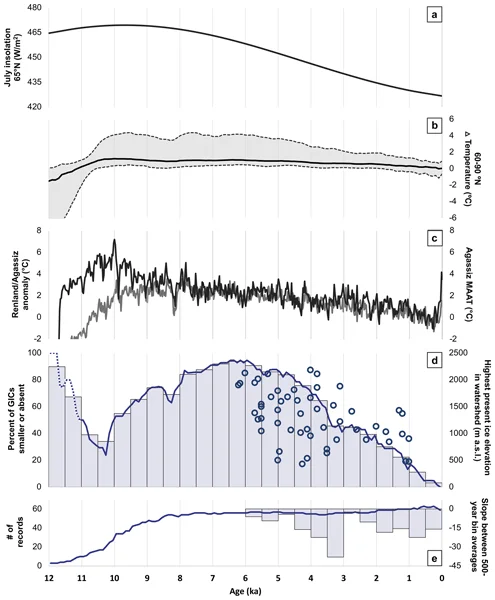
Overall, our compilation of Holocene lake-based GIC records spanning the Arctic (Fig. 10d) shows that the majority (50â% or more) of the studied GICs were smaller than present or absent between 12â10.9 and 10â3.4âka and that most (80â% or more) were smaller than present or absent between 7.9 and 4.5âka (and before â¼â11.3âka; however, only three records extend back 12âkyr). The circumpolar dataset also indicates a relatively abrupt increase in the percent of GICs smaller than present or absent at â¼â10âka. The percent of GICs smaller or absent peaks in the middle Holocene between â¼â7.1 and 5.7âka, when greater than 90â% of GICs were smaller or absent. In the middle to late Holocene (after â¼â6âka), GICs began to regrow across the Arctic, although the timing of individual GIC regrowth is variable (Fig. 10d). We find a weak relationship between the timing of earliest GIC regrowth and GIC elevation (GICs with the highest present-day ice elevation in their catchments tended to regrow earliest) (Fig. 10d). The combined records also indicate two periods of intensified GIC growth in the late Holocene (denoted by more abrupt drops in the percent of GICs smaller than present or absent) between â¼â4.5 and 3âka as well as after 2âka (Fig. 10d and e).
We estimate an approximate average magnitude of Arctic-wide summer warming
of at least ââC above present using the difference in elevation between the GICs' present steady-state ELAs (calculated here using an AAR ratio of 0.67) and their highest present ice elevations multiplied by a standard lapse rate of 6.5ââCâkmâ1 (after Larocca et al., 2020a, b; however, we note that current glacier geometries are most likely not in equilibrium with respect to current climate). The calculation excludes the GICs that were reported to have survived early to middle Holocene warmth and includes all GICs that became smaller than present or absent at some point in the early or middle Holocene. This approximation is the average summer temperature rise needed to elevate ELAs above modern ice surfaces, but ELAs may have risen higher than that minimum threshold, and these calculations assume no change in precipitation (whereas the HTM is generally believed to have been wetter
on average, e.g., Thomas et al., 2016, 2018), so it represents a minimum
constraint on average Arctic warming during the early Holocene (roughly
between 10 and 8âka), when most Arctic GICs first became smaller or absent.
Solomina et al. (2015) present the most recent global review of Holocene glacier fluctuations and find that Northern Hemisphere middle- to high-latitude glaciers were smaller than present or at least equal to their present sizes at â¼â8â4âka (Solomina et al., 2015). Similarly, a recent study investigating Neoglacial cooling in the Arctic developed a simple index to summarize the relative extent of GICs in Arctic regions (the status of which was derived from the above global review) and reported that GICs retreated throughout the Arctic at â¼â8â6.5âka (McKay et al., 2018). The study suggested that this period of uniform retreat, and by inference widespread warmth, can be attributed to high summer insolation combined with the absence of (or lessening influence of) the Laurentide Ice Sheet, which lingered well after peak insolation as late as â¼â7âka (McKay et al., 2018). Although our Arctic dataset broadly agrees with other syntheses of Holocene glacier status, our focus on lacustrine archives provides unique direct evidence for periods of smaller-than-present ice extent and suggests that most GICs first became smaller than today in the early Holocene Arctic-wide.
4.1âThe early to middle Holocene: when were summers warmer in the Arctic?
Early to middle Holocene climate in the northern high latitudes was
modulated by the interplay between climate forcings, changing surface
boundary conditions, and resulting feedbacks. Summer insolation peaked in
the early Holocene and was up to â¼â10â% higher than today at
60ââN in June, while decaying Northern Hemisphere ice sheets
altered local albedo as well as regional atmospheric circulation and discharged
cold fresh water and icebergs into adjacent seas, modifying sea surface
conditions and ocean circulation (Kaufman et al., 2004; Jennings et al., 2015). Broadly speaking, summer temperatures in the Arctic appear to have peaked â¼â1â3ââC above 20th century averages in the first half of the Holocene and were largely driven by orbital forcing; however, the timing and magnitude of peak warmth varied geographically across the Arctic, differing by thousands of years and by several degrees between locations (Kaufman et al., 2004, 2016; Kaplan and Wolfe, 2006; Miller et al., 2010; Briner et al., 2016; Sejrup et al., 2016; Axford et al., 2021). This marked variability speaks to the complexity of the Arctic climate system's response to insolation, local modulating factors such as ice sheet and ocean influences, and feedback mechanisms (see Kaufman et al., 2004).
Our compilation of lake-based records shows strong coherence across the Arctic at a broad scale and suggests that summer air temperatures were likely warmer than present (as inferred from GICs smaller than present or absent) across the majority of the Arctic in the early Holocene from at least â¼â10âka and that most places were warmer than present by at least â¼â8âka. Although we find evidence for the onset of warmer-than-present summers across most of the Arctic in the early Holocene, our compilation shows the highest percentage of GICs smaller than present or absent during the middle Holocene (>90â% smaller than present or absent) from â¼â7â6âka (Fig. 10d). We suggest that this pattern reflects the asynchronous timing and magnitude of peak Holocene warmth across the Arctic (e.g., Kaufman et al., 2004; Briner et al., 2016) and does not necessarily indicate that the warmest part of the Holocene occurred in the middle Holocene uniformly. Instead, these data more likely indicate that the mid-Holocene was a more spatially consistent period of warmer-than-present summers across the Arctic as a whole. The complex boundary conditions of the early Holocene, including residual Pleistocene ice sheets, likely modulated regional and sub-regional climatic response to changing insolation and greenhouses gases. It is also possible that counteracting effects on glacier mass balance from increased precipitation were stronger in the early Holocene in some locations. Given the pronounced asymmetries in early Holocene climate, somewhat expectedly we find substantial variability in the timing that GICs first became smaller or absent between sites within our defined geographic regions (Fig. 11). This variability may be due to significant climatic differences across the (sometimes geographically large) regions, causing differing responses to temperature and/or precipitation change as well as differing sub-regional and local-scale responses to early Holocene forcings and feedbacks, changing atmosphereâoceanâsea ice dynamics, and differing glacier or site-specific characteristics.
The onset of summer warmth in the early Holocene in most of the Arctic is
supported by a wide variety of evidence from terrestrial and marine archives
(e.g., Kaufman et al., 2004; Miller et al., 2010). In addition, a recent
review of Holocene temperature reconstructions from around Greenland found
that when accounting for some key issues with proxy interpretation, much of
Greenland (with the possible exception of southern Greenland) experienced
warmer-than-present summers in the early Holocene by â¼â10âka
(Axford et al., 2021). Although reflective of annual temperature,
elevation-corrected reconstructions from ice cores based upon stable isotopes of ice suggest early peak warmth. The elevation-corrected temperature reconstruction derived from average δ18O data from
the Renland and Agassiz ice cores (located in centralâeastern Greenland and on
Ellesmere Island in Canada, respectively) shows peak warmth in the early
Holocene from â¼â9.5 to 7.5âka with annual temperature
deviations up to â¼â3.5ââC above the smoothed estimate of present temperatures in Greenland (Fig. 10c; Vinther et al., 2009). A revised temperature reconstruction from Agassiz Ice Cap suggests even earlier and stronger peak warmth from â¼â11 to 8âka, peaking at 6.1ââC at â¼â10âka (with an applied Gaussian low-pass filter Ï=50 years; 2Ï uncertainty 4.3â8.3ââC) (Fig. 10c; Lecavalier et al., 2017). Finally, using an extensive multi-proxy database of paleotemperature time series, Kaufman et al. (2020) reconstruct mean annual surface temperature over the Holocene for the globe and for six 30â latitudinal bands using five different statistical methods. The multi-method ensemble median for the latitudinal zone 60â90ââN shows the warmest interval at â¼â10.1â9.7âka with annual mean surface temperatures
â¼â1.2ââC (0.4, 4.2) warmer than the 19th century (5th, 95th percentiles) (Kaufman et al., 2020; Fig. 10b).
Both proxy-based and climate-model-based studies have concluded that the disintegrating Laurentide Ice Sheet counteracted early Holocene insolation-driven warming and caused a subdued and/or delayed warming over the northwestern North Atlantic, particularly in the Baffin BayâLabrador Sea region, while summer temperatures in other regions followed orbital forcing (Mitchell et al., 1988; Kaufman et al., 2004; Renssen et al., 2009; Briner et al., 2016). Long-term suppression of summer temperatures around Baffin Bay through the early Holocene is not clear in our synthesis (though there are very few lake-based records of GIC change there). However, the influence of early Holocene abrupt cold event(s) attributed to meltwater pulses from the collapsing LIS are apparent in our compilations between 9 and 8âka (Fig. 10d). Some GICs reappeared in their catchments during the 8.2âka cooling event (associated with the catastrophic drainage of ice-dammed glacial lakes in the Hudson Bay area and collapse of the Hudson Bay Ice Saddle, e.g., Hoffman et al., 2012; Lochte et al., 2019). Interestingly, some studies record GIC advance prior to â¼â8.2âka, supporting the idea of a broader (â¼â160â400-year) event as seen in other proxy records (Lochte et al., 2019). It is also possible that radiocarbon dating uncertainties contribute to this spread.
4.2âThe middle to late Holocene: when did summer cooling commence in the Arctic?
In the northern high latitudes, summer cooling from the middle to late Holocene was primarily driven by the slow and steady decline in summer insolation, partially offset by radiative forcing by greenhouse gases, which rose through the middle to late Holocene (Ramaswamy et al., 2001; McKay et al., 2018). Recent Arctic-focused paleoclimate syntheses and modeling studies have highlighted regional asymmetries in cooling onset, as well as differences in the rate and magnitude of cooling between regions and between larger-scale areas of the Arctic (e.g., between the Pacific and Atlantic sectors) (McKay et al., 2018; Zhong et al., 2018). Thus, other forcings and feedbacks, such as volcanic eruptions, solar activity, sea-ice expansion, and changes in terrestrial snow cover and in ocean circulation, probably also played a major role in the expression of the Neoglacial regionally and/or caused sub-millennial-scale climate variations superimposed on the progressive orbitally driven cooling trend in the second half of the Holocene (e.g., Miller et al., 2012; Solomina et al., 2015; McKay et al., 2018; Zhong et al., 2018). Yet, much about the mechanisms for and relationship between these climate drivers, feedbacks, and GIC fluctuations remains uncertain.
Across the Arctic, GICs in our compilation first began to regrow or expand in the middle Holocene, mostly after â¼â6âka (Fig. 10d). By roughly â¼â3.4âka, less than 50â% of studied glaciers were smaller than present or absent, and by roughly â¼â1.2âka less than 20â% were smaller than present or absent (Fig. 10d). This suggests that summer air temperatures began to cool in some areas from at least â¼â6âka and that summer temperatures were cool enough to support erosive GICs in the majority of the Arctic by â¼â3.4âka and across most of the Arctic by â¼â1.2âka. The regional lake-based GIC evidence suggests substantial variability in the timing of the earliest GIC regrowth between and within regions (Fig. 11). Our regional compilations show the earliest GIC regrowth in Scandinavia, where GICs first regrew in lake catchments in the middle Holocene, as early as â¼â6.2âka (Fig. 11). Similarly, in a review of global Holocene and late Pleistocene alpine glacier fluctuations, Davis et al. (2009) find that glaciers reformed and/or advanced beginning as early as 6.5âka in some areas. Likewise, using proxy data and climate model simulations, McKay et al. (2018) examine the spatiotemporal patterns, onset, and rate of Neoglacial cooling in the Arctic and, consistent with our inferences, find the earliest onset of cooling in Fennoscandia.
Our results suggest a weak relationship between the timing of the earliest GIC regrowth and the highest present ice elevation inside the studied lake's watershed (Fig. 10d). This indicates that topography had some influence on the pattern of GIC regrowth (probably within very small geographic areas, e.g., Larsen et al., 2017; Larocca et al., 2020b) and that very broadly as summer temperature declined, ELAs lowered to intersect the local landscape where GICs regrew on the highest peaks first. Although differences in topography might help to explain some of the variability within regions, the weakness of this relationship on an Arctic-wide scale (and even within geographically large regions) supports the findings of McKay et al. (2018): namely, that the timing of GIC regrowth is not simply a local threshold effect, and is associated with other key controls, such as increased cooling rates, the timing of which differed between regions, probably at least in part due to regional climate dynamics. Two periods of intensified glacier growth (indicated by the change in slope between 500-year bin intervals; Fig. 10d and e) are apparent in our Arctic-wide compilation between â¼â4.5 and 3âka as well as after â¼â2âka. These periods align well with other evidence of neoglaciation in the Arctic and potentially suggest periods with higher rates of cooling. Consistent with the GIC evidence presented here, McKay et al. (2018) find no evidence for a synchronous Arctic-wide onset of cooling but find two major pulses of Neoglacial advance from the GIC evidence â the first between â¼â4.5 and 2âka and the second beginning at â¼â2âka and culminating in the LIA (McKay et al., 2018). Furthermore, the timing of these two identified intervals of Neoglacial onset are consistent with times of accelerated Holocene cooling (McKay et al., 2018). In addition, radiocarbon ages of ice-entombed plants from Svalbard suggest snow-line lowering from at least 4â3.4âka and progressive, but episodic, lowering since then, indicating a significant response to other forcings and/or substantial internal climate variability in addition to insolation forcing (Miller et al., 2017). Solomina et al. (2015) find numerous Neoglacial advances after roughly 4âka, as well as clustering of glacier advances which correspond to cooling in the North Atlantic, at 4.4â4.2, 3.8â3.4, 3.3â2.8, 2.6, 2.3â2.1, 1.5â1.4, 1.2â1.0, and 0.7â0.5âka that roughly correspond to multi-decadal periods of low solar activity or volcanic eruptions. Similarly, in comparing glacial records across the Northern Hemisphere, Bakke et al. (2010) find common glacier advances centered at roughly 4.0, 2.7, 2.0, and 1.3âka as well as during the LIA.
In summary, it is becoming clear that the Arctic did not cool synchronously from the middle to late Holocene despite the smooth, nearly linear decline in Northern Hemisphere summer insolation â the primary driver of climate change during this period. Instead, the current body of evidence suggests a stepwise-like cooling (i.e., with times of intensified and/or accelerated cooling) as well as significant variability in the onset and rate of cooling regionally and sub-regionally. This implies that mechanisms, forcings, and feedbacks other than orbitally driven insolation were important contributors to the regional and Arctic-wide expression of Neoglacial cooling.
Lake-based GIC records reveal that a large majority of Arctic GICs shrank smaller than today beginning in the early Holocene, suggesting warmer-than-present summer air temperatures around much of the Arctic quite early in the Holocene. This was followed by nearly ubiquitous GIC retraction in the middle Holocene between â¼â7 and 6âka, when nearly all the records
indicate smaller-than-present or absent GICs. This could but does not
necessarily imply higher summer temperatures in the middle Holocene than in
the early Holocene. Indeed, prior work using different proxies has found
peak summer temperatures in the early Holocene in some parts of the Arctic,
but also a more spatially and temporally variable climate versus the middle
Holocene (e.g., Kaufman et al., 2016; Lecavalier et al., 2017; Axford et al., 2021). We suggest that the ubiquity of glacier retraction across the Arctic
in the middle Holocene reflects more spatially widespread, consistent summer
warmth than in the early Holocene. GICs subsequently reformed and grew
through the middle to late Holocene, with GIC regrowth beginning at some
sites at or before â¼â6âka. Two periods of intensified GIC growth occurred between â¼â4.5 and 3âka as well as after 2âka, probably indicating intervals of intensified cooling. Although Arctic-wide patterns
emerge, overall, our results indicate pronounced spatial and temporal
variability in the timing of early to middle Holocene warming and
middle to late Holocene cooling. Finally, our early Holocene estimate of
Arctic-wide summer warming of at least â¼â2ââC above
present is consistent with previous syntheses of paleotemperature evidence
from the Arctic. Our synthesis therefore reinforces the idea that relatively modest
summer warming (compared with projections of larger future climate change,
e.g., Collins et al., 2013) drove major environmental changes across the
Arctic including the widespread loss of GICs. This knowledge foretells the
continued rapid retreat and eventual disappearance of most of the Arctic's
small GICs. Along with environmental impacts, this loss will have numerous
sociocultural and economic ramifications for many Arctic communities in the
coming decades (e.g., Huntington et al., 2019). More studies that model
projected GIC loss at regional to sub-regional scales are needed to provide
a more comprehensive view of future Arctic change and to address these often
overlooked local implications.
LJL and YA designed the study and prepared the paper. LJL compiled the data.
The contact author has declared that neither they nor their co-author has any competing interests.
Publisher's note: Copernicus Publications remains neutral with regard to jurisdictional claims in published maps and institutional affiliations.
We first acknowledge Arctic Indigenous Peoples who have lived on and stewarded Arctic lands for thousands of years and still do today, whose communities are disproportionately affected by climate change and glacier loss. We thank Peter Puleo, Everett Lasher, Regan Steigleder, Daniel Horton, Anders Bjørk, Darrell Kaufman, and Ãslaug Geirsdóttir, who provided helpful comments and discussion. We also thank two anonymous reviewers for their detailed and constructive reviews that improved the paper.
This research was supported by the US National Science Foundation's Office of Polar Programs (CAREER award no. 1454734) and Geography and Spatial Sciences Program (DDRI award no. 1812764).
This paper was edited by Irina Rogozhina and reviewed by two anonymous referees.
Adamson, K., Lane, T., Carney, M., Bishop, T., and Delaney, C.: High-resolution proglacial lake records of pre-Little Ice Age glacier advance, northeast Greenland, Boreas, 48, 535â550, https://doi.org/10.1111/bor.12361, 2019.â
Allaart, L., Schomacker, A., Larsen, N. K., Nørmark, E., Rydningen, T. A., Farnsworth, W. R., Retelle, M., Brynjólfsson, S., Forwick, M., and Kjellman, S. E.: Glacial history of the à sgardfonna Ice Cap, NE Spitsbergen, since the last glaciation, Quaternary Sci. Rev., 251, 106717, https://doi.org/10.1016/j.quascirev.2020.106717, 2021.â
Anderson, L. S., Geirsdóttir, Ã., Flowers, G. E., Wickert, A. D., Aðalgeirsdóttir, G., and Thorsteinsson, T.: Controls on the lifespans of Icelandic ice caps, Earth Planet. Sc. Lett., 527, 115780, https://doi.org/10.1016/j.epsl.2019.115780, 2019.â
Andreev, A. A., Lubinski, D. J., Bobrov, A. A., Ingólfsson, Ã., Forman, S. L., Tarasov, P. E., and Möller, P.: Early Holocene environments on October Revolution Island, Severnaya Zemlya, Arctic Russia, Palaeogeogr. Palaeocl., 267, 21â30, https://doi.org/10.1016/j.palaeo.2008.05.002, 2008.â
Axford, Y., Lasher, G. E., Kelly, M. A., Osterberg, E. C., Landis, J., Schellinger, G. C., Pfeiffer, A., Thompson, E., and Francis, D. R.: Holocene temperature history of northwest GreenlandâWith new ice cap constraints and chironomid assemblages from Deltasø, Quaternary Sci. Rev., 215, 160â172, https://doi.org/10.1016/j.quascirev.2019.05.011, 2019.â
Axford, Y., de Vernal, A. and Osterberg, E.C.: Past Warmth and Its Impacts During the Holocene Thermal Maximum in Greenland, Annu. Rev. Earth Pl. Sc., 49, 279â307, https://doi.org/10.1146/annurev-earth-081420-063858, 2021.â
Bakke, J., Dahl, S. O., Paasche, Ã., Løvlie, R., and Nesje, A.: Glacier fluctuations, equilibriumâline altitudes and palaeoclimate in Lyngen, northern Norway, during the Lateglacial and Holocene, The Holocene, 15, 518â540, https://doi.org/10.1191/0959683605hl815rp, 2005a.â
Bakke, J., Dahl, S. O., and Nesje, A.: Lateglacial and early Holocene palaeoclimatic reconstruction based on glacier fluctuations and equilibrium-line altitudes at northern Folgefonna, Hardanger, western Norway, J. Quaternary Sci., 20, 179â198, https://doi.org/10.1002/jqs.893, 2005b.â
Bakke, J., Lie, Ã., Nesje, A., Dahl, S. O., and Paasche, Ã.: Utilizing physical sediment variability in glacierâfed lakes for continuous glacier reconstructions during the Holocene, northern Folgefonna, western Norway, The Holocene, 15, 161â176, https://doi.org/10.1191/0959683605hl797rp, 2005c.â
Bakke, J., Dahl, S. O., Paasche, Ã., Simonsen, J. R., Kvisvik, B., Bakke, K., and Nesje, A.: A complete record of Holocene glacier variability at Austre Okstindbreen, northern Norway: an integrated approach, Quaternary Sci. Rev., 29, 1246â1262, https://doi.org/10.1016/j.quascirev.2010.02.012, 2010.â
Bakke, J., Trachsel, M., Kvisvik, B.C., Nesje, A., and LysÃ¥, A.: Numerical analyses of a multiâproxy data set from a distal glacierâfed lake, Sørsendalsvatn, western Norway, Quaternary Sci. Rev., 73, 182â195, https://doi.org/10.1016/j.quascirev.2013.05.003, 2013.â
Balascio, N. L., D'Andrea, W. J., and Bradley, R. S.: Glacier response to North Atlantic climate variability during the Holocene, Clim. Past, 11, 1587â1598, https://doi.org/10.5194/cp-11-1587-2015, 2015.â
Barclay, D. J., Wiles, G. C., and Calkin, P. E.: Holocene glacier fluctuations in Alaska, Quaternary Sci. Rev., 28, 2034â2048, https://doi.org/10.1016/j.quascirev.2009.01.016, 2009.â
Bjørk, A. A., Kjær, K. H., Korsgaard, N. J., Khan, S. A., Kjeldsen, K. K., Andresen, C. S., Box, J. E., Larsen, N. K., and Funder, S.: An aerial view of 80 years of climate-related glacier fluctuations in southeast Greenland, Nat. Geosci., 5, 427â432, https://doi.org/10.1038/ngeo1481, 2012.â
Björnsson, H. and Pálsson, F.: Icelandic glaciers, Jökull, 58, 365â386, 2008.â
Black, J. L.: Holocene climate change in south-central Iceland: A multi-proxy lacustrine record from glacial lake HvÃtárvatn, doctoral dissertation, University of Colorado at Boulder, https://www.proquest.com/openview/c9950fc5a86a9485bace6918798628e1/1?pq-origsite=gscholar&cbl=18750 (last access: 15 July 2021), 2008.â
Braithwaite, R. J. and Müller, F.: On the parameterization of glacier equilibrium line altitude, IAHS-AISH P., 126, 263â271, 1980.â
Briner, J. P., Davis, P. T., and Miller, G. H.: Latest Pleistocene and Holocene glaciation of Baffin Island, Arctic Canada: key patterns and chronologies, Quaternary Sci. Rev., 28, 2075â2087, https://doi.org/10.1016/j.quascirev.2008.09.017, 2009.â
Briner, J. P., McKay, N. P., Axford, Y., Bennike, O., Bradley, R. S., de Vernal, A., Fisher, D., Francus, P., Fréchette, B., Gajewski, K., and Jennings, A.: Holocene climate change in Arctic Canada and Greenland, Quaternary Sci. Rev., 147, 340â364, https://doi.org/10.1016/j.quascirev.2016.02.010, 2016.â
Calkin, P. E.: Holocene glaciation of Alaska (and adjoining Yukon Territory, Canada), Quaternary Sci. Rev., 7, 159â184, https://doi.org/10.1016/0277-3791(88)90004-2, 1988.â
Cappelen, J.: The observed climate of Greenland, 1958â99 â with climatological standard normals, 1961â90, Danish Meteorological Institute, 2001.â
Cappelen, J.: Greenland â DMI Historical Climate Data Collection 1784â2019, Danish Meteorological Institute, 2020.â
Collins, M., Knutti, R., Arblaster, J., Dufresne, J. L., Fichefet, T., Friedlingstein, P., Gao, X., Gutowski, W. J., Johns, T., Krinner, G., and Shongwe, M.: Longâterm climate change: projections, commitments and irreversibility, in: Climate Change 2013âThe Physical Science Basis: Contribution of Working Group I to the Fifth Assessment Report of the Intergovernmental Panel on Climate Change, edited by: Stocker, T. F., Qin, D., Plattner, G.-K., Tignor, M. M. B., Allen, S. K., Boschung, J., Alexander Nauels, A., Xia, Y., Bex, V., and Midgley, P. M., Cambridge University Press, ISBN (Print) 9781107057991, 9781107661820, 2013.â
Dahl, S. O. and Nesje, A.: Holocene glacier fluctuations at Hardangerjøkulen, central-southern Norway: a high-resolution composite chronology from lacustrine and terrestrial deposits, The Holocene, 4, 269â277, https://doi.org/10.1177/095968369400400306, 1994.â
Dahl, S. O. and Nesje, A.: A new approach to calculating Holocene winter precipitation by combining glacier equilibriumâine altitudes and pine-tree limits: a case stud from Hardangerjokulen, central southern Norway, The Holocene, 6, 381â398, https://doi.org/10.1177/095968369600600401, 1996.â
Dahl, S. O., Bakke, J., Lie, Ã., and Nesje, A.: Reconstruction of former glacier equilibriumâline altitudes based on proglacial sites: an evaluation of approaches and selection of sites, Quaternary Sci. Rev., 22, 275â287, https://doi.org/10.1016/S0277-3791(02)00135-X, 2003.â
Daigle, T. A. and Kaufman, D. S.: Holocene climate inferred from glacier extent, lake sediment and tree rings at Goat Lake, Kenai Mountains, Alaska, USA, J. Quaternary Sci., 24, 33â45, https://doi.org/10.1002/jqs.1166, 2009.â
Davis, P. T., Menounos, B., and Osborn, G.: Holocene and latest Pleistocene alpine glacier fluctuations: a global perspective, Quaternary Sci. Rev., 28, 2021â2033, https://doi.org/10.1016/j.quascirev.2009.05.020, 2009.â
de Wet, G. A., Balascio, N. L., D'Andrea, W. J., Bakke, J., Bradley, R. S., and Perren, B.: Holocene glacier activity reconstructed from proglacial lake Gjøavatnet on Amsterdamøya, NW Svalbard, Quaternary Sci. Rev., 183, 188â203, https://doi.org/10.1016/j.quascirev.2017.03.018, 2018.â
Einarsson, M. Ã.: Climate of Iceland, World Survey of Climatology, 15, 673â697, 1984.â
ESWG â Ecological Stratification Working Group: A national ecological framework for Canada, Agriculture and Agri-Food Canada, Ottawa, Ontario/Hull, Quebec, Canada, 1995.â
Farnsworth, W. R., Ingólfsson, Ã., Alexanderson, H., Allaart, L., Forwick, M., Noormets, R., Retelle, M., and Schomacker, A.: Holocene glacial history of Svalbard: Status, perspectives and challenges, Earth-Sci. Rev., 208, 103249, https://doi.org/10.1016/j.earscirev.2020.103249, 2020.â
Fisher, D., Zheng, J., Burgess, D., Zdanowicz, C., Kinnard, C., Sharp, M., and Bourgeois, J.: Recent melt rates of Canadian arctic ice caps are the highest in four millennia, Global Planet. Change, 84, 3â7, https://doi.org/10.1016/j.gloplacha.2011.06.005, 2012.â
Førland, E. J., Benestad, R., Hanssen-Bauer, I., Haugen, J. E., and Skaugen, T. E.: Temperature and precipitation development at Svalbard 1900â2100, Adv. Meteorol., 2011, 893790, https://doi.org/10.1155/2011/893790, 2011.â
Geirsdóttir, Ã., Miller, G. H., Axford, Y., and Ãlafsdóttir, S.: Holocene and latest Pleistocene climate and glacier fluctuations in Iceland, Quaternary Sci. Rev., 28, 2107â2118, https://doi.org/10.1016/j.quascirev.2009.03.013, 2009.â
Geirsdóttir, Ã., Miller, G. H., Larsen, D. J., and Ãlafsdóttir, S.: Abrupt Holocene climate transitions in the northern North Atlantic region recorded by synchronized lacustrine records in Iceland, Quaternary Sci. Rev., 70, 48â62, https://doi.org/10.1016/j.quascirev.2013.03.010, 2013.â
Geirsdóttir, Ã., Miller, G. H., Andrews, J. T., Harning, D. J., Anderson, L. S., Florian, C., Larsen, D. J., and Thordarson, T.: The onset of neoglaciation in Iceland and the 4.2âka event, Clim. Past, 15, 25â40, https://doi.org/10.5194/cp-15-25-2019, 2019.â
Gross, G., Kerschner, H., and Patzelt, G.: Methodische Untersuchungen über die schneegrenze in alpinen gletschergebieten, Zeitschrift für Gletscherkunde und Glazialgeologie, 12, 223â251, 1976.â
Haflidason, H., Zweidorff, J. L., Baumer, M., Gyllencreutz, R., Svendsen, J. I., Gladysh, V., and Logvina, E.: The lastglacial and Holocene seismostratigraphy and sediment distribution of Lake Bolshoye Shchuchye, polar ural mountains, arctic Russia, Boreas, 48, 452â469, https://doi.org/10.1111/bor.12387, 2019.â
Hanssen-Bauer, I., Førland, E. J., Hisdal, H., Mayer, S., AB, S., and Sorteberg, A.: Climate in Svalbard 2100 â A knowledge base for climate adaptation, NCCS Report 1/2019, Norwegian Centre for Climate Services, Oslo, https://www.miljodirektoratet.no/globalassets/publikasjoner/M1242/M1242.pdf (last access: 15 July 2021), 2019.â
Harning, D. J., Geirsdóttir, Ã., Miller, G. H., and Zalzal, K.: Early Holocene deglaciation of Drangajökull, Vestfirðir, Iceland, Quaternary Sci. Rev., 153, 192â198, https://doi.org/10.1016/j.quascirev.2016.09.030, 2016a.â
Harning, D. J., Geirsdóttir, Ã., Miller, G. H., and Anderson, L.: Episodic expansion of Drangajökull, Vestfirðir, Iceland, over the last 3âka culminating in its maximum dimension during the Little Ice Age, Quaternary Sci. Rev., 152, 118â131, https://doi.org/10.1016/j.quascirev.2016.10.001, 2016b.â
Heaton, T. J., Köhler, P., Butzin, M., Bard, E., Reimer, R. W., Austin, W. E., Ramsey, C.B., Grootes, P. M., Hughen, K. A., Kromer, B., and Reimer, P. J.: Marine20 â The marine radiocarbon age calibration curve (0â55,000âcalâBP), Radiocarbon, 62, 779â820, https://doi.org/10.1017/RDC.2020.68, 2020.â
Hoffman, J. S., Carlson, A. E., Winsor, K., Klinkhammer, G. P., LeGrande, A. N., Andrews, J. T., and Strasser, J. C.: Linking the 8.2âka event and its freshwater forcing in the Labrador Sea, Geophys. Res. Lett., 39, L18703, https://doi.org/10.1029/2012GL053047, 2012.â
Hugonnet, R., McNabb, R., Berthier, E., Menounos, B., Nuth, C., Girod, L., Farinotti, D., Huss, M., Dussaillant, I., Brun, F., and Kääb, A.: Accelerated global glacier mass loss in the early twenty-first century, Nature, 592, 726â731, 2021.â
Huntington, H. P., Carey, M., Apok, C., Forbes, B. C., Fox, S., Holm, L. K., Ivanova, A., Jaypoody, J., Noongwook, G., and Stammler, F.: Climate change in context: putting people first in the Arctic, Reg. Environ. Change, 19, 1217â1223, 2019.â
Jennings, A., Andrews, J., Pearce, C., Wilson, L., and Ãlfasdótttir, S.: Detrital carbonate peaks on the Labrador shelf, a 13â7âka template for freshwater forcing from the Hudson Strait outlet of the Laurentide Ice Sheet into the subpolar gyre, Quaternary Sci. Rev., 107, 62â80, https://doi.org/10.1016/j.quascirev.2014.10.022, 2015.â
Kaplan, M. R. and Wolfe, A. P.: Spatial and temporal variability of Holocene temperature in the North Atlantic region, Quaternary Res., 65, 223â231, https://doi.org/10.1016/j.yqres.2005.08.020, 2006.â
Karlén, W.: Lacustrine sediments and treeâlimit variations as indicators of Holocene climatic fluctuations in Lappland, northern Sweden, Geogr. Ann. A, 58, 1â34, https://doi.org/10.1080/04353676.1976.11879921, 1976.â
Karlén, W.: Lacustrine sediment studies: A technique to obtain a continous record of Holocene glacier variations, Geogr. Ann. A, 63, 273â281, https://doi.org/10.1080/04353676.1981.11880042, 1981.â
Karlén, W. and Matthews, J. A.: Reconstructing Holocene glacier variations from glacial lake sediments: studies from Nordvestlandet and JostedalsbreenâJotunheimen, southern Norway, Geogr. Ann. A, 74, 327â348, https://doi.org/10.1080/04353676.1992.11880374, 1992.â
Kaufman, D., McKay, N., Routson, C., Erb, M., Dätwyler, C., Sommer, P. S., Heiri, O., and Davis, B.: Holocene global mean surface temperature, a multi-method reconstruction approach, Scientific Data, 7, 1â13, 2020.â
Kaufman, D. S. and Manley, W. F.: Pleistocene maximum and Late Wisconsinan glacier extents across Alaska, USA, Developments in Quaternary Sciences, 2, 9â27, https://doi.org/10.1016/S1571-0866(04)80182-9, 2004.â
Kaufman, D. S., Ager, T. A., Anderson, N. J., Anderson, P. M., Andrews, J. T., Bartlein, P. J., Brubaker, L. B., Coats, L. L., Cwynar, L. C., Duvall, M. L., and Dyke, A. S.: Holocene thermal maximum in the western Arctic (0â180ââW), Quaternary Sci. Rev., 23, 529â560,
https://doi.org/10.1016/j.quascirev.2003.09.007, 2004.â
Kaufman, D. S., Schneider, D. P., McKay, N. P., Ammann, C. M., Bradley, R. S., Briffa, K. R., Miller, G. H., Otto-Bliesner, B. L., Overpeck, J. T., Vinther, B. M., and Lakes, A.: Recent warming reverses long-term Arctic cooling, Science, 325, 1236â1239, 2009.â
Kaufman, D. S., Axford, Y. L., Henderson, A. C. G., McKay, N. P., Oswald, W. W., Saenger, C., Anderson, R. S., Bailey, H. L., Clegg, B., Gajewski, K., Hu, F. S., Jones, M. C., Massa, C., Routson, C. C., Werner, A., Wooller, M. J., and Yu, Z.: Holocene climate changes in eastern Beringia (NW North America) â A systematic review of multi-proxy evidence, Quaternary Sci. Rev., 147, 312â339, 2016.â
Kelly, M. A. and Lowell, T. V.: Fluctuations of local glaciers in Greenland during latest Pleistocene and Holocene time, Quaternary Sci. Rev., 28, 2088â2106, https://doi.org/10.1016/j.quascirev.2008.12.008, 2009.â
Knudsen, N. T., Nørnberg, P., Yde, J. C., Hasholt, B., and Heinemeier, J.:
Recent marginal changes of the Mittivakkat Glacier, Southeast Greenland and
the discovery of remains of reindeer (Rangifer tarandus), polar bear (Ursus maritimus) and peaty material, Geogr. Tidsskr.-Den., 108, 137â142, https://doi.org/10.1080/00167223.2008.10649579, 2008.â
Koerner, R. M.: Mass balance of glaciers in the Queen Elizabeth Islands, Nunavut, Canada, Ann. Glaciol., 42, 417â423, https://doi.org/10.3189/172756405781813122, 2005.â
LaBrecque, T. S. and Kaufman, D. S.: Holocene glacier fluctuations inferred from lacustrine sediment, Emerald Lake, Kenai Peninsula, Alaska, Quaternary Res., 85, 34â43, https://doi.org/10.1016/j.yqres.2015.11.004, 2016.â
Larocca, L.: Holocene lake-based Arctic glacier and ice cap records, NSF Arctic Data Center [data set], https://doi.org/10.18739/A22805070, 2021.â
Larocca, L. J., Axford, Y., Bjørk, A. A., Lasher, G. E., and Brooks, J. P.: Local glaciers record delayed peak Holocene warmth in south Greenland, Quaternary Sci. Rev., 241, 106421, https://doi.org/10.1016/j.quascirev.2020.106421, 2020a.â
Larocca, L. J., Axford, Y., Woodroffe, S. A., Lasher, G. E., and Gawin, B.: Holocene glacier and ice cap fluctuations in southwest Greenland inferred from two lake records, Quaternary Sci. Rev., 246, 106529, https://doi.org/10.1016/j.quascirev.2020.106529, 2020b.â
Larsen, D. J., Miller, G. H., Geirsdóttir, Ã., and Ãlafsdóttir, S.: Nonâlinear Holocene climate evolution in the North Atlantic: a high-resolution, multi-proxy record of glacier activity and environmental change from HvÃtárvatn, central Iceland, Quaternary Sci. Rev., 39, 14â25, https://doi.org/10.1016/j.quascirev.2012.02.006, 2012.â
Larsen, N. K., Strunk, A., Levy, L. B., Olsen, J., Bjørk, A., Lauridsen, T. L., Jeppesen, E., and Davidson, T. A.: Strong altitudinal control on the response of local glaciers to Holocene climate change in southwest Greenland, Quaternary Sci. Rev., 168, 69â78, https://doi.org/10.1016/j.quascirev.2017.05.008, 2017.â
Larsen, N. K., Levy, L. B., Strunk, A., Søndergaard, A. S., Olsen, J., and Lauridsen, T. L.: Local ice caps in finderup land, north Greenland, survived the Holocene thermal maximum, Boreas, 48, 551â562, https://doi.org/10.1111/bor.12384, 2019.â
Larsen, N. K., Siggaard-Andersen, M. L., Bjørk, A. A., Kjeldsen, K. K., Ruter, A., Korsgaard, N. J., and Kjær, K. H.: Holocene ice margin variations of the Greenland Ice Sheet and local glaciers around Sermilik Fjord, southeast Greenland, Quatern. Int., 607, 10â21, https://doi.org/10.1016/j.quaint.2021.06.001, 2021a.â
Larsen, N. K., Søndergaard, A. S., Levy, L. B., Laursen, C. H., Bjørk, A. A., Kjeldsen, K. K., Funder, S., Strunk, A., Olsen, J., and Kjær, K. H.: Cosmogenic nuclide inheritance in Little Ice Age moraines â A case study from Greenland, Quat. Geochronol., 65, 101200, https://doi.org/10.1016/j.quageo.2021.101200, 2021b.â
Lecavalier, B. S., Fisher, D. A., Milne, G. A., Vinther, B. M., Tarasov, L., Huybrechts, P., Lacelle, D., Main, B., Zheng, J., Bourgeois, J., and Dyke, A. S.: High Arctic Holocene temperature record from the Agassiz ice cap and Greenland ice sheet evolution, P. Natl. Acad. Sci. USA, 114, 5952â5957, https://doi.org/10.1073/pnas.1616287114, 2017.â
Lemmen, D. S., Gilbert, R., Smol, J. P., and Hall, R. I.: Holocene sedimentation in glacial Tasikutaaq Lake, Baffin Island, Can. J. Earth Sci., 25, 810â823, https://doi.org/10.1139/e88-080, 1988.â
Leonard, E. M.: Glaciological and climatic controls on lake sedimentation, Canadian Rocky Mountains, Zeitschrift für Gletscherkunde und Glazialgeologie, 21, 35â42, 1985.â
Leonard, E. M.: Use of lacustrine sedimentary sequences as indicators of Holocene glacial history, Banff National Park, Alberta, Canada, Quaternary Res., 26, 218â231, https://doi.org/10.1016/0033-5894(86)90106-7, 1986.â
Levy, L. B., Kaufman, D. S., and Werner, A.: Holocene glacier fluctuations, Waskey Lake, northeastern Ahklun Mountains, southwestern Alaska, The Holocene, 14, 185â193, https://doi.org/10.1191/0959683604hl675rp, 2004.â
Levy, L. B., Kelly, M. A., Lowell, T. V., Hall, B. L., Hempel, L. A., Honsaker, W. M., Lusas, A. R., Howley, J. A., and Axford, Y. L.: Holocene fluctuations of Bregne ice cap, Scoresby Sund, east Greenland: a proxy for climate along the Greenland Ice Sheet margin, Quaternary Sci. Rev., 92, 357â368, https://doi.org/10.1016/j.quascirev.2013.06.024, 2014.â
Lie, Ã., Dahl, S. O., Nesje, A., Matthews, J. A., and Sandvold, S.: Holocene fluctuations of a polythermal glacier in high-alpine eastern Jotunheimen, central-southern Norway, Quaternary Sci. Rev., 23, 1925â1945, https://doi.org/10.1016/j.quascirev.2004.03.012, 2004.â
Liu, Z., Zhu, J., Rosenthal, Y., Zhang, X., Otto-Bliesner, B. L., Timmermann, A., Smith, R. S., Lohmann, G., Zheng, W., and Timm, O. E.: The Holocene temperature conundrum, P. Natl. Acad. Sci. USA, 111, E3501âE3505, https://doi.org/10.1073/pnas.1407229111, 2014.â
Lochte, A. A., Repschläger, J., Kienast, M., GarbeâSchönberg, D., Andersen, N., Hamann, C., and Schneider, R.: Labrador Sea freshening at 8.5âkaâBP caused by Hudson Bay Ice Saddle collapse, Nat. Commun., 10, 586, https://doi.org/10.1038/s41467-019-08408-6, 2019.â
Lowell, T. V., Hall, B. L., Kelly, M. A., Bennike, O., Lusas, A. R., Honsaker, W., Smith, C. A., Levy, L. B., Travis, S., and Denton, G. H.: Late Holocene expansion of Istorvet ice cap, Liverpool Land, east Greenland, Quaternary Sci. Rev., 63, 128â140, https://doi.org/10.1016/j.quascirev.2012.11.012, 2013.â
Lubinski, D. J., Forman, S. L., and Miller, G. H.: Holocene glacier and climate fluctuations on Franz Josef Land, Arctic Russia, 80ââN, Quaternary Sci. Rev., 18, 85â108, https://doi.org/10.1016/S0277-3791(97)00105-4, 1999.â
Matthews, J. A. and KarleÌn, W.: Asynchronous neoglaciation and Holocene climatic change reconstructed from Norwegian glaciolacustrine sedimentary sequences, Geology, 20, 991â994, https://doi.org/10.1130/0091-7613(1992)020<0991:ANAHCC>2.3.CO;2, 1992.â
Matthews, J. A., Dahl, S. O., Nesje, A., Berrisford, M. S., and Andersson, C.: Holocene glacier variations in central Jotunheimen, southern Norway based on distal glaciolacustrine sediment cores, Quaternary Sci. Rev., 19, 1625â1647, https://doi.org/10.1016/S0277-3791(00)00008-1, 2000.â
McKay, N. P. and Kaufman, D. S.: Holocene climate and glacier variability at Hallet and Greyling Lakes, Chugach Mountains, south-central Alaska, J. Paleolimnol., 41, 143â159, 2009.â
McKay, N.P., Kaufman, D. S., Routson, C. C., Erb, M. P., and Zander, P. D.: The onset and rate of Holocene Neoglacial cooling in the Arctic, Geophys. Res. Lett., 45, 12487â12496, https://doi.org/10.1029/2018GL079773, 2018.â
Medford, A. K., Hall, B. L., Lowell, T. V., Kelly, M. A., Levy, L. B., Wilcox, P. S., and Axford, Y.: Holocene glacial history of Renland Ice Cap, East Greenland, reconstructed from lake sediments, Quaternary Sci. Rev., 258, 106883, https://doi.org/10.1016/j.quascirev.2021.106883, 2021.â
Miller, G. H., Wolfe, A. P., Briner, J. P., Sauer, P. E., and Nesje, A.: Holocene glaciation and climate evolution of Baffin Island, Arctic Canada, Quaternary Sci. Rev., 24, 1703â1721, https://doi.org/10.1016/j.quascirev.2004.06.021, 2005.â
Miller, G. H., BrighamâGrette, J., Alley, R. B., Anderson, L., Bauch, H. A., Douglas, M. S. V., Edwards, M. E., Elias, S. A., Finney, B. P., Fitzpatrick, J. J., and Funder, S. V.: Temperature and precipitation history of the Arctic, Quaternary Sci. Rev., 29, 1679â1715, https://doi.org/10.1016/j.quascirev.2010.03.001, 2010.â
Miller, G. H., Geirsdóttir, Ã., Zhong, Y., Larsen, D. J., Otto-Bliesner, B. L., Holland, M. M., Bailey, D. A., Refsnider, K. A., Lehman, S. J., Southon, J. R., and Anderson, C.: Abrupt onset of the Little Ice Age triggered by volcanism and sustained by sea-ice/ocean feedbacks, Geophys. Res. Lett., 39, L02708, https://doi.org/10.1029/2011GL050168, 2012.â
Miller, G. H., Lehman, S. J., Refsnider, K. A., Southon, J. R., and Zhong, Y.: Unprecedented recent summer warmth in Arctic Canada, Geophys. Res. Lett., 40, 5745â5751, https://doi.org/10.1002/2013GL057188, 2013.â
Miller, G. H., Landvik, J. Y., Lehman, S. J., and Southon, J. R.: Episodic Neoglacial snowline descent and glacier expansion on Svalbard reconstructed from the 14C ages of ice-entombed plants, Quaternary Sci. Rev., 155, 67â78, https://doi.org/10.1016/j.quascirev.2016.10.023, 2017.â
Mitchell, J. F., Grahame, N. S., and Needham, K. J.: Climate simulations for 9000Â years before present: Seasonal variations and effect of the Laurentide ice sheet, J. Geophys. Res., 93, 8283â8303, https://doi.org/10.1029/JD093iD07p08283, 1988.â
Moore, J. J., Hughen, K. A., Miller, G. H., and Overpeck, J. T.: Little Ice Age recorded in summer temperature reconstruction from vared sediments of Donard Lake, Baffin Island, Canada, J. Paleolimnol., 25, 503â517, 2001.â
Moros, M., Emeis, K., Risebrobakken, B., Snowball, I., Kuijpers, A., McManus, J., and Jansen, E.: Sea surface temperatures and ice rafting in the Holocene North Atlantic: climate influences on northern Europe and Greenland, Quaternary Sci. Rev., 23, 2113â2126, https://doi.org/10.1016/j.quascirev.2004.08.003, 2004.â
Nesje, A.: Latest Pleistocene and Holocene alpine glacier fluctuations in Scandinavia, Quaternary Sci. Rev., 28, 2119â2136, https://doi.org/10.1016/j.quascirev.2008.12.016, 2009.â
Nesje, A., Dahl, S. O., Løvlie, R., and Sulebak, J. R.: Holocene glacier activity at the southwestern part of Hardangerjøkulen, centralâsouthern Norway: evidence from lacustrine sediments, The Holocene, 4, 377â382, https://doi.org/10.1177/095968369400400405, 1994.â
Nesje, A., Dahl, S. O., and Løvlie, R.: Late Holocene glaciers and avalanche activity in the à lfotbreen area, western Norway: evidence from a lacustrine sedimentary record, Norsk Geol. Tidsskr., 75, 120â126, 1995.â
Nesje, A., Dahl, S. O., Andersson, C., and Matthews, J. A.: The lacustrine sedimentary sequence in Sygneskardvatnet, western Norway: a continuous, highâresolution record of the Jostedalsbreen ice cap during the Holocene, Quaternary Sci. Rev., 19, 1047â1065, https://doi.org/10.1016/S0277-3791(99)00090-6, 2000.â
Nesje, A., Matthews, J. A., Dahl, S. O., Berrisford, M. S., and Andersson, C.: Holocene glacier fluctuations of Flatebreen and winter-precipitation changes in the Jostedalsbreen region, western Norvay, based on glaciolacustrine sediment records, The Holocene, 11, 267â280, https://doi.org/10.1191/095968301669980885, 2001.â
Nesje, A., Bjune, A. E., Bakke, J., Dahl, S. O., Lie, Ã., and Birks, H. J. B.: Holocene palaeoclimate reconstructions at Vanndalsvatnet, western Norway, with particular reference to the 8200âcal.âyrâBP event, The Holocene, 16, 717â729, https://doi.org/10.1191/0959683606hl954rp, 2006.â
Nesje, A., Bakke, J., Dahl, S. O., Lie, Ã., and Matthews, J. A.: Norwegian mountain glaciers in the past, present and future, Global Planet. Change, 60, 10â27, https://doi.org/10.1016/j.gloplacha.2006.08.004, 2008.â
Oerlemans, J.: Extracting a climate signal from 169 glacier records, Science, 308, 675â677, 2005.â
Oien, R. P., Spagnolo, M., Rea, B. R., Barr, I. D., and Bingham, R. G.: Climatic controls on the equilibriumâline altitudes of Scandinavian cirque glaciers, Geomorphology, 352, 106986, https://doi.org/10.1016/j.geomorph.2019.106986, 2020.â
Ãlafsson, H., Furger, M., and Brümmer, B.: The weather and climate of Iceland, Meteorol. Z., 16, 5â8, https://doi.org/10.1127/0941-2948/2007/0185, 2007.â
IPCC: Climate Change 2007: Synthesis Report. Contribution of Working Groups I, II and III to the Fourth Assessment Report of the Intergovernmental Panel on Climate Change, edited by: Core Writing Team, Pachauri, R. K., and Reisinger, A., IPCC, Geneva, Switzerland, 104 pp., 2007.â
Pellitero, R., Rea, B. R., Spagnolo, M., Bakke, J., Hughes, P., Ivy-Ochs, S., Lukas, S., and Ribolini, A.: A GIS tool for automatic calculation of glacier equilibrium-line altitudes, Comput. Geosci., 82, 55â62, https://doi.org/10.1016/j.cageo.2015.05.005, 2015.â
Porter, C., Morin, P., Howat, I., Noh, M.-J., Bates, B., Peterman, K., Keesey, S., Schlenk, M., Gardiner, J., Tomko, K., Willis, M., Kelleher, C., Cloutier, M., Husby, E., Foga, S., Nakamura, H., Platson, M., Wethington, M., Williamson, C., Bauer, G., Enos, J., Arnold, G., Kramer, W., Becker, P., Doshi, A., D'Souza, C., Cummens, P., Laurier, F., and Bojesen, M.: ArcticDEM, V1, Harvard Dataverse [data set], https://doi.org/10.7910/DVN/OHHUKH, 2018.â
Ramaswamy, V., Boucher, O., Haigh, J., Hauglustine, D., Haywood, J., Myhre, G., Nakajima, T., Shi, G., and Solomon, S.: Radiative forcing of climate change, Chapter 6, in: Climate Change, 349â416, https://www.ipcc.ch/site/assets/uploads/2018/03/TAR-06.pdf (last access: 15 July 2021), 2001.â
RadiÄ, V. and Hock, R.: Regionally differentiated contribution of mountain glaciers and ice caps to future sea-level rise, Nat. Geosci., 4, 91â94, 2011.â
RadiÄ, V., Bliss, A., Beedlow, A. C., Hock, R., Miles, E., and Cogley, J. G.: Regional and global projections of twentyâfirst century glacier mass changes in response to climate scenarios from global climate models, Clim. Dynam., 42, 37â58, 2014.â
Raup, B., Kääb, A., Kargel, J. S., Bishop, M. P., Hamilton, G., Lee, E., Paul, F., Rau, F., Soltesz, D., Khalsa, S. J. S., and Beedle, M.: Remote sensing and GIS technology in the Global Land Ice Measurements from Space (GLIMS) project, Comput. Geosci., 33, 104â125, https://doi.org/10.1016/j.cageo.2006.05.015, 2007.â
Reimer, P. J., Austin, W. E., Bard, E., Bayliss, A., Blackwell, P. G., Ramsey, C. B., Butzin, M., Cheng, H., Edwards, R. L., Friedrich, M., and Grootes, P. M.: The IntCal20 Northern Hemisphere radiocarbon age calibration curve (0â55âcalâkBP), Radiocarbon, 62, 725â757, https://doi.org/10.1017/RDC.2020.41, 2020.â
Renssen, H., Seppä, H., Heiri, O., Roche, D. M., Goosse, H., and Fichefet, T.: The spatial and temporal complexity of the Holocene thermal maximum, Nat. Geosci., 2, 411â414, 2009.â
RGI Consortium: Randolph Glacier Inventory â A Dataset of Global Glacier Outlines, Version 6.0, Technical Report, Global Land Ice Measurements from Space, Colorado, USA, Digital Media [data set], https://doi.org/10.7265/N5-RGI-60, 2017.â
Rosqvist, G., Jonsson, C., Yam, R., Karlén, W., and Shemesh, A.: Diatom oxygen isotopes in pro-glacial lake sediments from northern Sweden: a 5000 year record of atmospheric circulation, Quaternary Sci. Rev., 23, 851â859, https://doi.org/10.1016/j.quascirev.2003.06.009, 2004.â
Røthe, T. O., Bakke, J., Vasskog, K., Gjerde, M., D'Andrea, W. J., and Bradley, R. S.: Arctic Holocene glacier fluctuations reconstructed from lake sediments at Mitrahalvøya, Spitsbergen, Quaternary Sci. Rev., 109, 111â125, https://doi.org/10.1016/j.quascirev.2014.11.017, 2015.â
Røthe, T. O., Bakke, J., Støren, E. W., and Bradley, R. S.: Reconstructing Holocene glacier and climate fluctuations from lake sediments in VÃ¥rfluesjøen, northern Spitsbergen, Front. Earth Sci., 6, 91, https://doi.org/10.3389/feart.2018.00091, 2018.â
Shakesby, R. A., Smith, J. G., Matthews, J. A., Winkler, S., Dresser, P. Q., Bakke, J., Dahl, S. O., Lie, Ã., and Nesje, A.: Reconstruction of Holocene glacier history from distal sources: glaciofluvial streamâbank mires and a glaciolacustrine sediment core near Sota Sæter, Breheimen, southern Norway, The Holocene, 17, 729â745, https://doi.org/10.1177/0959683607080514, 2007.â
Schomacker, A., Brynjólfsson, S., Andreassen, J. M., Gudmundsdóttir, E. R., Olsen, J., Odgaard, B. V., HÃ¥kansson, L., Ingólfsson, Ã., and Larsen, N. K.: The Drangajökull ice cap, northwest Iceland, persisted into the early-mid Holocene, Quaternary Sci. Rev., 148, 68â84, https://doi.org/10.1016/j.quascirev.2016.07.007, 2016.â
Schweinsberg, A. D., Briner, J. P., Miller, G. H., Bennike, O., and Thomas, E. K.: Local glaciation in West Greenland linked to North Atlantic Ocean circulation during the Holocene, Geology, 45, 195â198, https://doi.org/10.1130/G38114.1, 2017.â
Schweinsberg, A. D., Briner, J. P., Miller, G. H., Lifton, N. A., Bennike, O., and Graham, B. L.: Holocene mountain glacier history in the Sukkertoppen Iskappe area, southwest Greenland, Quaternary Sci. Rev., 197, 142â161, https://doi.org/10.1016/j.quascirev.2018.06.014, 2018.â
Schweinsberg, A. D., Briner, J. P., Licciardi, J. M., Bennike, O., Lifton, N. A., Graham, B. L., Young, N. E., Schaefer, J. M., and Zimmerman, S. H.: Multiple independent records of local glacier variability on Nuussuaq, West Greenland, during the Holocene, Quaternary Sci. Rev., 215, 253â271, https://doi.org/10.1016/j.quascirev.2019.05.007, 2019.â
Seierstad, J., Nesje, A., Dahl, S. O., and Simonsen, J. R.: Holocene glacier fluctuations of Grovabreen and Holocene snow-avalanche activity reconstructed from lake sediments in Grningstlsvatnet, western Norway, The Holocene, 12, 211â222, https://doi.org/10.1191/0959683602hl536rp, 2002.â
Sejrup, H. P., Seppä, H., McKay, N. P., Kaufman, D. S., Geirsdóttir, Ã., de Vernal, A., Renssen, H., Husum, K., Jennings, A., and Andrews, J. T.: North Atlantic-Fennoscandian Holocene climate trends and mechanisms, Quaternary Sci. Rev., 147, 365â378, https://doi.org/10.1016/j.quascirev.2016.06.005, 2016.â
Snowball, I. and Sandgren, P.: Lake sediment studies of Holocene glacial activity in the KÃ¥rsa valley, northern Sweden: contrasts in interpretation, The Holocene, 6, 367â372, https://doi.org/10.1177/095968369600600312, 1996.â
Snyder, J. A., Werner, A., and Miller, G. H.: Holocene cirque glacier activity in western Spitsbergen, Svalbard: sediment records from proglacial Linnévatnet, The Holocene, 10, 555â563, https://doi.org/10.1191/095968300667351697, 2000.â
Solomina, O. N., Bradley, R. S., Hodgson, D. A., Ivy-Ochs, S., Jomelli, V., Mackintosh, A. N., Nesje, A., Owen, L. A., Wanner, H., Wiles, G. C., and Young, N. E.: Holocene glacier fluctuations, Quaternary Sci. Rev., 111, 9â34, https://doi.org/10.1016/j.quascirev.2014.11.018, 2015.â
Solomina, O., Ivanov, M., and Bradwell, T.: Lichenometric studies on moraines in the Polar Urals, Geogr. Ann. A, 92, 81â99, https://doi.org/10.1111/j.1468-0459.2010.00379.x, 2010.â
Striberger, J., Björck, S., Holmgren, S., and HamerlÃk, L.: The sediments of Lake Lögurinn â A unique proxy record of Holocene glacial meltwater variability in eastern Iceland, Quaternary Sci. Rev., 38, 76â88, https://doi.org/10.1016/j.quascirev.2012.02.001, 2012.â
Stuiver, M., Reimer, P. J., and Reimer, R. W.: CALIB 8.2 [WWW program], http://calib.org/ (last access: 15Â July 2021), 2021.â
Svendsen, J. I. and Mangerud, J.: Holocene glacial and climatic variations on Spitsbergen, Svalbard, The Holocene, 7, 45â57, https://doi.org/10.1177/095968369700700105, 1997.â
Svendsen, J. I., Færseth, L. M. B., Gyllencreutz, R., Haflidason, H., Henriksen, M., Hovland, M. N., Lohne, Ã. S., Mangerud, J., Nazarov, D., Regnéll, C., and Schaefer, J. M.: Glacial and environmental changes over the last 60â000 years in the Polar Ural Mountains, Arctic Russia, inferred from a high-resolution lake record and other observations from adjacent areas, Boreas, 48, 407â431, https://doi.org/10.1111/bor.12356, 2019.â
Thomas, E. K., Szymanski, J., and Briner, J. P.: Holocene alpine glaciation inferred from lacustrine sediments on northeastern Baffin Island, Arctic Canada, J. Quaternary Sci., 25, 146â161, https://doi.org/10.1002/jqs.1286, 2010.â
Thomas, E. K., Briner, J. P., Ryan-Henry, J. J., and Huang, Y.: A major increase in winter snowfall during the middle Holocene on western Greenland caused by reduced sea ice in Baffin Bay and the Labrador Sea, Geophys. Res. Lett., 43, 5302â5308, https://doi.org/10.1002/2016GL068513, 2016.â
Thomas, E. K., Castañeda, I. S., McKay, N. P., Briner, J. P., Salacup, J. M., Nguyen, K. Q., and Schweinsberg, A. D.: A wetter Arctic coincident with hemispheric warming 8,000 years ago, Geophys. Res. Lett., 45, 10637â10647, https://doi.org/10.1029/2018GL079517, 2018.â
van der Bilt, W. G., Bakke, J., Vasskog, K., D'Andrea, W. J., Bradley, R. S., and Ãlafsdóttir, S.: Reconstruction of glacier variability from lake sediments reveals dynamic Holocene climate in Svalbard, Quaternary Sci. Rev., 126, 201â218, https://doi.org/10.1016/j.quascirev.2015.09.003, 2015.â
van der Bilt, W. G., Rea, B., Spagnolo, M., Roerdink, D. L., Jørgensen, S. L., and Bakke, J.: Novel sedimentological fingerprints link shifting depositional processes to Holocene climate transitions in East Greenland, Global Planet. Change, 164, 52â64, https://doi.org/10.1016/j.gloplacha.2018.03.007, 2018.â
Vasskog, K., Paasche, Ã., Nesje, A., Boyle, J. F., and Birks, H. J. B.: A new approach for reconstructing glacier variability based on lake sediments recording input from more than one glacier, Quaternary Res., 77, 192â204, https://doi.org/10.1016/j.yqres.2011.10.001, 2012. â
Vaughan, D. G., Comiso, J. C., Allison, I., Carrasco, J., Kaser, G., Kwok, R., Mote, P., Murray, T., Paul, F., Ren, J., Rignot, E., Solomina, O., Steffen, K., and Zhang, T.: Observations: Cryosphere, Chapter 4, in: Climate Change 2013: The Physical Science Basis. Contribution of Working Group I to the Fifth Assessment Report of the Intergovernmental Panel on Climate Change, edited by: Stocker, T. F., Qin, D., Plattner, G.-K., Tignor, M., Allen, S. K., Boschung, J., Nauels, A., Xia, Y., Bex, V., and Midgley, P. M., Cambridge University Press, Cambridge, United Kingdom and New York, NY, USA, 317â382, 2013.â
Vinther, B. M., Buchardt, S. L., Clausen, H. B., Dahl-Jensen, D., Johnsen, S. J., Fisher, D. A., Koerner, R. M., Raynaud, D., Lipenkov, V., Andersen, K. K., and Blunier, T.: Holocene thinning of the Greenland ice sheet, Nature, 461, 385â388, 2009.â
Wittmeier, H. E., Bakke, J., Vasskog, K., and Trachsel, M.: Reconstructing Holocene glacier activity at Langfjordjøkelen, Arctic Norway, using multi-proxy fingerprinting of distal glacier-fed lake sediments, Quaternary Sci. Rev., 114, 78â99, https://doi.org/10.1016/j.quascirev.2015.02.007, 2015.â
Zander, P. D., Kaufman, D. S., Kuehn, S. C., Wallace, K. L., and Anderson, R. S.: Early and late Holocene glacial fluctuations and tephrostratigraphy, Cabin Lake, Alaska, J. Quaternary Sci., 28, 761â771, https://doi.org/10.1002/jqs.2671, 2013.â
Zemp, M., Hoelzle, M., and Haeberli, W.: Six decades of glacier mass-balance observations: a review of the worldwide monitoring network, Ann. Glaciol., 50, 101â111, https://doi.org/10.3189/172756409787769591, 2009.â
Zhong, Y., Jahn, A., Miller, G. H., and Geirsdottir, A.: Asymmetric Cooling of the Atlantic and Pacific Arctic During the Past Two Millennia: A Dual Observation-Modeling Study, Geophys. Res. Lett., 45, 12497â12505, https://doi.org/10.1029/2018GL079447, 2018.â