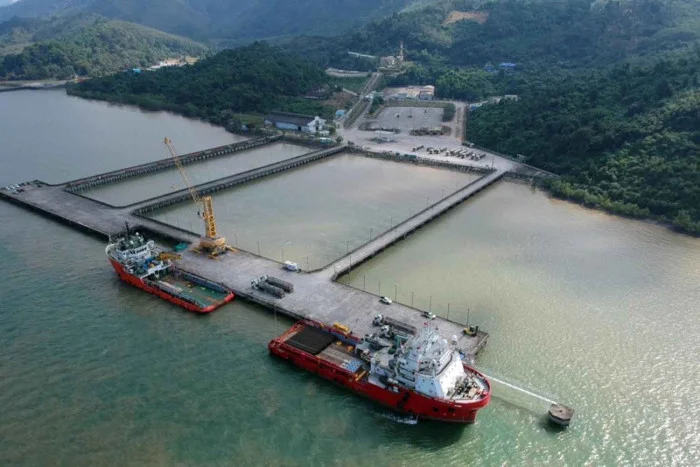
The government is set to end the Land Bridge megaproject after a review found low financial viability, increased budget risks and environmental concerns.
Ekniti Nitithanprapas, Deputy Prime Minister and Finance Minister, who chaired the committee reviewing the project, said on Friday the study was completed before the 90-day deadline set by the prime minister's order. The findings concluded that the project had a low probability of success due to financial, operational and environmental risks.
The committee will submit its findings to Prime Minister Anutin Charnvirakul and the cabinet for consideration, recommending the termination of the project in its original format. Mr Ekniti said no investment losses had occurred because land acquisition and construction had not yet started.
The review found the project's financial outlook had deteriorated significantly due to global economic uncertainty following the Covid-19 pandemic, the Russia-Ukraine war and tensions in the Middle East.
The Land Bridge project, estimated to cost about 1 trillion baht, includes deep-sea ports, double-track railways, motorways and industrial estates. The scheme aims to create a transport corridor linking Ranong on the Andaman Coast with Chumphon on the Gulf of Thailand, allowing cargo to bypass the Strait of Malacca.
Danucha Pichayanan, secretary-general of the National Economic and Social Development Council (NESDC) and chairman of the economic and financial working group, said the revised study showed the project's financial return rate had fallen from 8% to 4.8%. The net present value (NPV) also shifted from an expected positive 637.7 billion baht to a negative 10.3 billion baht.
Mr Danucha said container volumes were estimated to have declined by 15-16%, reducing returns by 38%. He added that nine of the world's 10 major shipping lines had already invested in similar projects elsewhere, leaving limited opportunities to attract major cargo volumes.
The committee also raised concerns over operational complexity, as the project would require multiple transfers between ships, trucks and rail. The original estimate of completing cargo transfers within three days did not account for delays, operational risks and actual costs.
Environmental concerns were another factor. A representative from the Ministry of Natural Resources and Environment said the proposed route would pass through forests, mountainous areas and sensitive ecosystems.
Ranong province, home to the country's largest mangrove forest, a biosphere reserve and internationally recognised wetland, could face impacts on marine ecosystems, rare species, local fisheries and coastal communities. The review also found gaps in environmental impact assessments, with seven separate reports prepared by three agencies lacking an integrated assessment of overall impacts. The existing strategic environmental assessment from 2016 also did not cover the current route.
Mr Ekniti said the government would continue developing transport links on the Andaman coast despite ending the Land Bridge plan.
He said more than 34% of southern exports still pass through neighbouring countries, while trade with India, the Middle East and Europe is expected to grow.