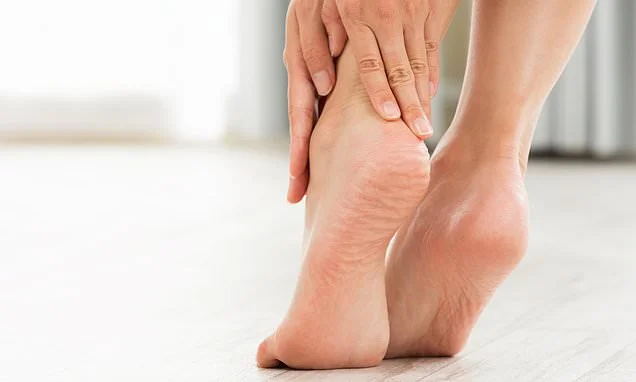
It's one of the most common complaints that GPs see – and it appears that the hot weather only makes it worse. Achy ankles affect nearly one in five over-55s according to research, making it second only to knees as Britain’s sorest joint.
Yet, for many patients, the cause can be a mystery.
Last week, Dr Ellie Cannon, The Mail on Sunday’s resident GP columnist, wrote how she had developed stiff ankles during the recent heatwaves.
She admitted that she was unsure of the trigger, ‘as embarrassing as it is to admit as a GP’.
The article prompted a flood of emails and letters from readers who said they too had experienced the same issue.
One 55-year-old woman said how, in the past year, her ankles had become stiff in the morning and seemed to improve when she elevated them.
Another reader, a 76-year-old man, told how he had developed ‘stiffness and unpleasant pain’ in his right ankle in recent weeks.
Meanwhile an 85-year-old female reader described how her ‘very stiff’ ankle pain made her feel as if she was ‘standing in glue’.
Experts say there are several potential causes of this problem.
Achy ankles affect nearly one in five over-55s according to research, making it second only to knees as Britain’s sorest joint
One of these, in women at least, is the menopause, which research shows can trigger joint pain.
Of course, some patients may also have an undiagnosed ankle injury, such as a strain or sprain.
However, some experts say there is a surprisingly likely cause: Hidden varicose veins.
Most people think of varicose veins as bulging, twisted veins that can be seen beneath the skin.
But experts say that is a common misconception – many of the veins responsible for symptoms are hidden deeper under the surface and cannot be seen.
So, how can you tell whether your ankle pain is being caused by the condition?
Varicose veins affect one in five adults and occur when valves inside the blood vessels malfunction, causing blood to pool in the veins rather than return to the heart. Research suggests that most cases are genetic.
And while it is often considered a women’s health issue, studies show it is just as common among men.
Crucially, experts say that achy ankles are often one of the first symptoms of varicose veins.
‘There’s a misconception that all patients get visible varicose veins, but for many, these are hidden,’ says Professor Mark Whiteley, a varicose vein expert at The Whiteley Clinic.
‘There’s a misconception that all patients get visible varicose veins, but for many, these are hidden,’ says Professor Mark Whiteley, a varicose vein expert at The Whiteley Clinic
‘The condition typically starts off with stiff and painful ankles. Many patients report that the pain tends to get better when they elevate their feet.
‘Over time, patients might begin to notice the ankle skin is itchy or they might develop sores. Some patients may then get visible varicose veins – but others might not.’
For this reason, research shows that many patients will need to undergo a specialist scan – known as a venous duplex ultrasound – that can reveal whether the valves in the legs are working properly.
However, experts say many GPs do not send their patients for these scans. This is largely due to the fact that the NHS does not cover the cost of varicose vein treatment. The condition can be effectively treated by either burning away the broken veins – a procedure known as endothermal ablation – or blocking these blood vessels with medical foam – called foam sclerotherapy.
But varicose vein patients are offered NHS treatment only if they are classed as being in severe pain or suffer complications.
The criteria are so strict that only 20,000 operations for varicose veins are carried out on the NHS every year – for a condition that affects millions.
Studies show that patients often spend as much as £3,000 per leg to have their varicose veins removed.
Experts stress that ankle pain is not always varicose veins.
Dr Naomi Potter, a menopause expert, says mid-life hormone changes often trigger joint pain.
‘The loss of the sex hormone oestrogen can make joints stiff and achy,’ says Dr Potter. ‘The good news is that hormone replacement therapy [the most common menopause treatment] is really effective for this problem.’
But Dr Potter adds that menopause patients who experience achy ankles will likely also experience other common symptoms such as brain fog and sweating.
Experts say that it is important to know when ankle pain is due to a muscle injury.
‘If there is damage to the ankle, you would expect to see redness or swelling,’ says Dr Potter. ‘It would likely be quite sensitive to touch too.’
But experts are convinced that many cases of achy ankles are linked to hidden varicose veins – and they urge patients to get checked for the problem.
‘This is an issue that 15 to 20 per cent of the population has but doesn’t realise it,’ adds Professor Whiteley.
‘If you have achy ankles, it’s worth asking your GP to be referred for a scan.’