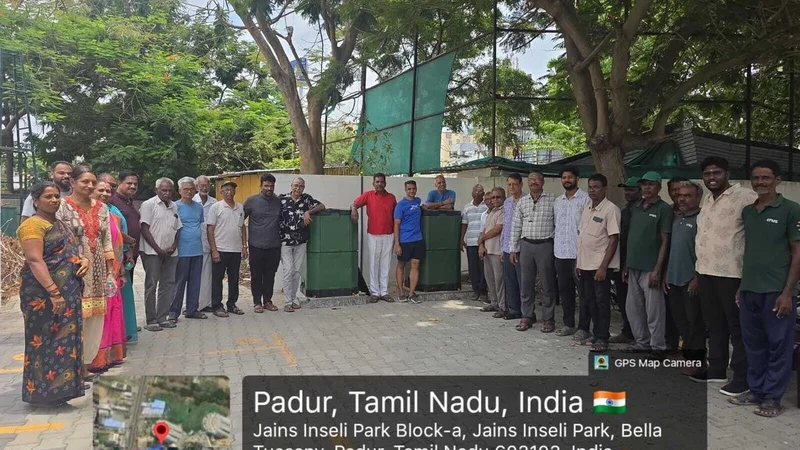
In parts of Rajiv Gandhi Salai, gated communities that take source segregation seriously have found an ally. PLAN Foundation, a Mumbai-based NGO working with communities on climate and waste solutions, is encouraging in situ composting. And it walks the talk by establishing free in-house composting facilities for bulk waste generators. Going on steam in February, the exercise has benefitted gated communities in Kelambakkam, Padur and Kazhipattur. Educational institutions and companies also come under the ambit of this initiative.
Under SORT (Segregation of Waste for Recycling and Treatment), a flagship initiative of Swarn Lata Motherson Trust and PLAN Foundation, community composters called ‘aerobins’ are being given to educational institutions, gated communities and companies that fall under the category of bulk waste generators.
To get aerobins, the community must be following the practice of only collecting segregated waste from residents or promise to start doing it with a stern resolve. The community must have an active housekeeping team that is ready to oversee functioning of aerobins.
The NGO first does an audit of the community’s waste management studying the amount of biodegradable and non-biodegradable matter that it generates and through a baseline survey understands the gaps. An average of six bins are given to most bulk waste generators, each measuring 400 litres.
All stakeholders including housekeeping staff and residents are trained in the process and expectations are set for them. “Only after they are ready to meet the conditions laid down by us do we enter into an agreement with the community,” says Rasiga Selvaganesan, assistant manager-project, PLAN Foundation.
For six months, the Foundation handholds the community in many ways including maintaining an inventory, making them use their own garden litter instead of saw dust to absorb excess moisture from the bins and supporting them to get the harvest.
Rasiga says aerobins are a patented technology from Australia and they have been promoting this idea for the last three years as it does not take much space, does not exude an odour and follows aerobic composting.
The Foundation had made headway implementing a similar model in Kovalam Panchayat.
32 and counting
Since February 2026, when the second phase of this project was initiated for bulk waste generators in Thiruporur, OMR and parts of Tambaram, the team has reached out to 120 communities. “Thirty two have signed an official agreement that spells out what is expected of the RWA and the Foundations,” says Rasiga.
For the team, persuading bulk waste generators to invest in on-site composting is not easy even though the aerobins are given at no cost. Many tell the team upfront that ensuring compliance from the majority of residents is not easy.
Dropout rate
Niraj Singh, senior manager, SORT project, says there have been many instances of communities losing interest either because of a change of guard or for other reasons. “We try persuasion with the new committee. If that falls, in a worst case scenario, we will lift the aerobins and move to other localities that could benefit from receiving composters. That has happened at two to three communities in Kovalam. So, while onboarding RWAs, this clause is mentioned,” says Niraj, adding “We see a dropout rate of 10% in SORT.”
On OMR, many eco-conscious volunteers driving green initiatives in gated communities are excited that communities that have shied away from adopting on-site composting due to the cost factor would want to try it out as much of the investment is borne by the Foundation. There are some others who have received the aerobins but waiting to see the fruits of the exercise. Some communities such as Jains Inseli Park in Padur, which has stopped giving out the wet waste to a vendor, are planning to source more aerobins. The bins that are priced at around ₹24,000 are procured for them at a discounted rate by PLAN Foundation.
Those keen on inviting the team for a demo can email rasiga.s@planfoundation.in
Community takes baby steps in managing waste purposefully
Four months ago, Pushkara Flat Owners Association at Kazhipattur in Tiruporur Taluk decided to overhaul its waste management system thanks to the nudge from PLAN Foundation and the interest by the management committee members to make a small difference in the neighbourhood.
Over the years, Marg Pushkara, a gated community with 131 flats, had no good systems in place to manage the community’s waste. Close to 16 bins were kept at a common area where residents had to come on their own to dispose of the waste, to be collected by a vendor twice or thrice a week.
Before getting into a formal agreement with the Foundation, the Association started enforcing source segregation of waste with awareness messages, constant communication and a third eye to keep a watch on those not dropping segregated waste.
“We invested in a CCTV camera, put up flex boards at the garbage collection point mentioning that a fine would be collected from those not following waste management rules,” says S. Vasudevan, secretary, Pushkara Flat Owners Association.
This served as a deterrent for residents, says members.
For better compliance, they recently introduced door-to-door collection of waste, got garbage trolleys customised from a store in Broadway and hired additional manpower to manage the aerobins. “Compliance has improved drastically in these months and we have also got two harvests from the aerobins,” says Vasudevan, adding that 52 kilos of manure they have got so far.
The Association has also streamlined collection of other non-biodegredable waste. The amount collected by selling recyclable waste is giving to the housekeeping team.
Published - July 25, 2026 04:59 pm IST