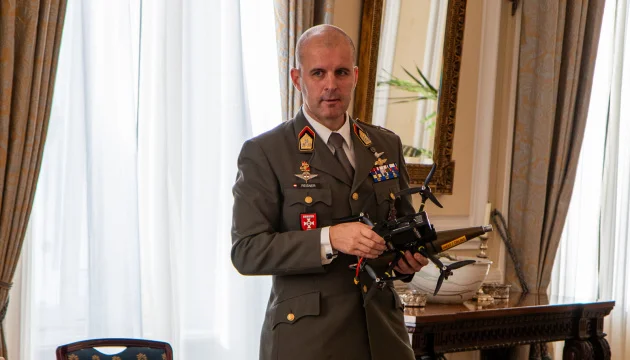
This view was expressed in an interview with Ukrinform by Colonel Markus Reisner of the Austrian Armed Forces, head of the Officer Training Institute at the Theresian Military Academy.
“I think that simply bringing in additional soldiers will not be enough. The way war is waged has changed so much that the decisive factor is, above all, the use of specialized weapon systems. Just think of drones,” Reisner said.
According to him, both sides have created a “transparent battlefield” at the tactical level, which is nearly impossible to overcome due to the widespread use of drones.
“If Russia were to simply deploy another 300,000 troops, that, in my opinion, would not be enough, because they would be crushed by Ukraine’s wall of drones,” the expert said.
He did not rule out that Russia might continue to deliberately accept extremely high casualties, but he does not consider this approach viable.
“Unless, of course, Russia continues to deliberately accept extremely high casualties and sends soldiers forward until Ukraine runs out of drones. But I think even the Russian leadership understands that this will not bring lasting success,” said Reisner.
In his assessment, Russia is currently seeking weaknesses in Ukraine’s defenses to exploit for a breakthrough.
“Right now, the Russians’ task is to find the vulnerabilities that constitute Ukraine’s Achilles’ heel. They need to strike precisely at these weak spots so that, by capitalizing on the momentum of mobilization, they can achieve a breakthrough. But they haven’t yet identified these weak spots and Achilles’ heels,” he noted.
Reisner did not rule out the possibility that a new wave of mobilization could begin in Russia after the parliamentary elections.
“Perhaps Putin is waiting for these elections to conclude so that he can then launch a new wave of mobilization, as we already saw in 2022. A new wave of mobilization would be accompanied by a further increase in the intensity of attacks and would signify an escalation,” the expert noted.
At the same time, he said that without technological or tactical means to neutralize the “transparent battlefield,” a large-scale mechanized breakthrough remains extremely difficult.
“In military-theoretical discourse, there is a consensus that this can only work through a combination of various measures,” Reisner said.
He cited the concentration of counter-drone capabilities and strike drones in a specific sector of the front to create a breakthrough corridor as one possible approach.
Read also:Ukraine succeeds when it fights unconventionally, says Austrian expert
“Whether this will succeed is an open question. The decisive moment is when the situation tips in favor of one of the sides—the so-called hinge factor,” the military expert added.
As reported by Ukrinform, President Volodymyr Zelensky stated that Putin intends to expand the war against Ukraine and intensify attacks.
Photo: UK in Austria