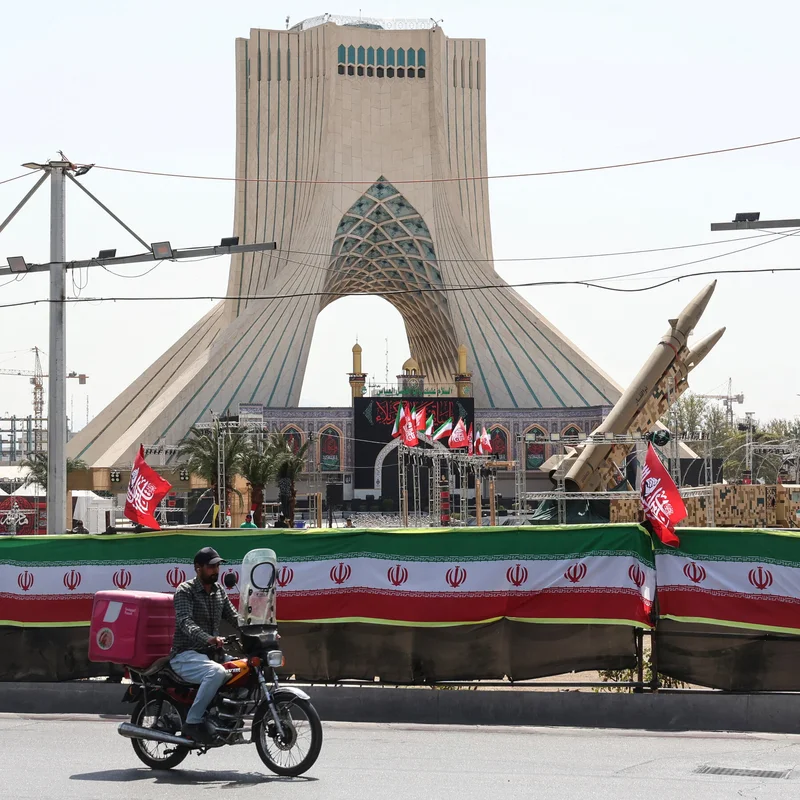
Tehran8:33 a.m. July 25
Jeddah, Saudi Arabia3:03 p.m. July 25
Latest
The fighting between the United States and Iran appeared to abate for at least one night, though tensions remained high in the region on Saturday as President Trump considered whether to intensify the military assault against Iran.
For the first time in about two weeks, U.S. forces did not announce a wave of overnight attacks on Iran. A spokesman for Iran’s health ministry said on social media that there had been no new attacks or casualties.
The two countries have been locked in a cycle of strikes and counterstrikes as they struggle for control of the Strait of Hormuz effectively unraveling a short-lived cease-fire signed last month.
Even as the bombing cooled between the U.S. and Iran, new hostilities were flaring over the Red Sea, where the Houthis declared a maritime blockade on Saudi vessels this week. Although some tankers have made it through, the Houthis, a Yemeni militia backed by Iran, have fired on passing ships, adding to the pressure on global oil supplies.
Saudi state media reported Friday that a Saudi-operated vessel had been targeted in the Red Sea, causing minor damage to its hull. The Houthi military did not immediately comment on the attack.
Early Saturday, a spokesman for Saudi-led forces operating in Yemen said that they had attacked Houthi military targets used to threaten commercial vessels. Later, the Saudi authorities briefly issued civil defense warnings in two areas on its Red Sea coast.
Air-raid alerts also went off in neighboring Bahrain overnight, though there were no immediate reports of damage or casualties. Kuwait, which has been pummeled by Iranian drones and ballistic missiles almost every day, did not warn of any new attacks.
The apparent decrease in fighting did little to soothe fears that the situation could rapidly deteriorate. Mr. Trump met with top advisers on Friday to discuss a potential escalation with Iran, according to four people briefed on the discussion. T
The consultations happened just days before Mr. Trump was set to meet Israel’s prime minister, Benjamin Netanyahu, on Tuesday. It would be the first such visit since Mr. Netanyahu made the case in February for a joint U.S.-Israeli offensive against Iran, which began weeks later.
Now nearing the end of its fifth month, the war with Iran stands at a critical juncture. The Trump administration has had little success in its war aims, having failed to topple the Iranian government and end its nuclear program. Instead, Iranian forces have effectively blockaded the Strait of Hormuz, a vital corridor for global oil and gas shipments that was open before the war, throttling the global economy.
U.S. fighter jets and bombers have rushed to the region in anticipation of a potential military escalation, U.S. officials said. On Friday, however, Mr. Trump said he had yet to decide whether to ramp up the offensive. He said the White House was still communicating with the Iranians, adding that he was “not in a hurry.”
“We’re locked and loaded and we’re ready to go, but we’re talking to them,” he added.
Here’s what else we’re covering:
- Energy markets:The price of Brent crude, the global benchmark for oil, was up more than 7 percent at $100.95 a barrel on Friday, before dropping to around $98 a barrel. The price of crude is nearly 40 percent higher since the start of the war. Read more ›
- Strait of Hormuz:U.S. forces disabled a tanker identified as the Lavine after it repeatedly tried to breach the American blockade on the strait, according to Capt. Tim Hawkins, a U.S. Central Command spokesman. He said the crew ignored at least four warnings and added that he was aware of reports of crew casualties but could not confirm them. Read more ›
U.S. forces disabled a tanker identified as the Lavine by firing into its engine room after the vessel’s crew tried to breach the American blockade on the Strait of Hormuz, said Capt. Tim Hawkins, spokesman for U.S. Central Command, on Friday. Captain Hawkins said the crew had been warned but failed to comply during at least four previous attempts. “The ship is no longer transiting to Iran,” he said.
The Houthi Foreign Ministry said Saudi strikes on Hodeidah Province would be met with “escalation for escalation,” according to a statement carried by the Houthi-run Saba news agency. The ministry also accused the Saudi government of refusing demands to lift the blockade on Yemen.
A Saudi-owned vessel, the NCC Masa, sustained minor damage to its hull after being targeted while sailing in the Red Sea on Friday, the Saudi Press Agency reported, citing an official source at the country’s Transport General Authority. The source said the ship continued to its destination after officials confirmed that the vessel and its crew were safe.
The Houthis announced a blockade targeting Saudi shipping earlier this week and have claimed attacks on two other Saudi tankers in the Red Sea.
The maritime confrontation coincided with renewed reports of Saudi attacks inside Yemen. Al Masirah, a Houthi-run television network, reported on Friday night that Saudi airstrikes had targeted telecommunications facilities in Yemen’s western Hodeidah Province and that the Saudis had also attacked Kamaran Island, at the southern end of the Red Sea.
A Saudi-led alliance in Yemen that supports the Yemeni government against the Houthis confirmed the strikes on the military sites in Hodeidah, saying they were linked to threats against commercial vessels in the Red Sea.
Times exclusive
President Trump abruptly switched aircraft when leaving Turkey this month after what officials judged to be a credible threat that Iranian proxy forces were targeting him and Air Force One, according to multiple people briefed on the matter.
The threat emerged while Mr. Trump was attending the NATO summit. He had flown into Ankara on the new Qatari-donated Boeing 747-8, which lacks the same advanced defensive capabilities of the old Air Force One, as The New York Times previously reported.
After the U.S. government picked up on the threat, the Secret Service urged Mr. Trump to change planes. He later announced that he would be using the old plane to leave the country.
The information about the nature of the threat, which has not been reported before, sheds light on why the White House moved swiftly to swap out the planes. It also underscores the concerns about the security of the donated jet, which Mr. Trump pressed to be ready as soon as possible for his use.
The information that U.S. officials had did not indicate that the proxy forces had any specific focus on the new plane, but rather that they were targeting Mr. Trump and whatever aircraft he was traveling in.
The people briefed on the matter spoke to The Times on condition of anonymity to discuss the information.
The White House did not comment. But in response to questions from The Times, a senior administration official pointed to Mr. Trump’s public remarks about Iran’s efforts to kill him and expressed confidence in the steps taken to protect the president and the traveling delegation. The official spoke on condition of anonymity to discuss the matter.
The details of the threat were not disseminated widely even within the administration; some officials were told only that the switch in planes was a precautionary measure because of general concerns about Iran. Key members of Congress have not been briefed on the specific threat.
Mr. Trump initially said the switch in planes was to give American service members in Britain a chance to tour the new aircraft, and he denied the decision was security related. The Times reported that the Secret Service had urged him to switch planes.
After The Times reported this month that federal officials had significant concerns about the security capabilities of the jet, the government launched a leak investigation seeking grand jury testimony from several Times journalists as well as their phone records and those of their relatives. (The Justice Department withdrew the subpoenas on Thursday.)
The president appeared to acknowledge on Sunday that the plane was lacking some of the features that the older Boeings used as Air Force One have, telling a reporter who noted that the Qatari plane lacks antimissile defenses that it would soon be “maxed out.” The roughly 14-year-old plane went through a costly yet relatively rushed process to retrofit the aircraft to serve as Air Force One.
At the time of the swap, there were reports that Israel had shared intelligence with the United States about Iranian efforts to kill Mr. Trump. Some American officials viewed Israel’s intelligence with skepticism, believing it was an effort to provoke Mr. Trump to intensify attacks against Iran.
The threat to Air Force One in Turkey that prompted the change in airplanes was separate from the one attributed to Israeli intelligence, according to some of the people briefed on the matter.
The United States had resumed strikes against Iran while Mr. Trump was in Ankara, roughly 1,000 miles away from Tehran. While at the summit, Mr. Trump also spoke openly about Iranian efforts to try to kill him when asked about why he was swapping out the Qatari-donated jet for the older one.
“They want to take out the U.S. leader — me,” he said. “I’m on every list. I saw this morning, I’m on every single one of their lists. And so far, I guess I’ve been a little bit lucky, but that maybe doesn’t last very long.”
Forces with ties to Iran have long wanted to assassinate Mr. Trump, dating back to his first term when U.S. forces killed Qassim Suleimani, a top Iranian general.
Mr. Trump for years has complained about the state of the two airplanes that have served as Air Force One since 1990, saying they were not impressive enough to bring on foreign trips. Military officials separately expressed concerns that the current Air Force One jets had been used for many more years than had been intended.
Last year, Qatar said it was donating a Boeing 747-8 for Mr. Trump’s use, and Mr. Trump has said he plans to take it with him for his presidential library when he leaves office.
Officials have described the new plane as a “bridge” until the long-delayed Boeing jets commissioned by the Air Force are delivered.
Since Mr. Trump returned to the United States from Turkey, White House officials have said the new plane will be taken out of service for about one month this fall for additional upgrades.
“The new Air Force One is perfectly safe for the president’s travels, but will receive additional upgrades and enhancements in the fall which will take approximately one month to complete,” Karoline Leavitt, the White House press secretary, said in a statement. “During that time, the president will fly on the old Air Force One.”
It is unclear what upgrades can be completed in such a short time frame.
At a briefing on Wednesday before the rescheduled White House Correspondents' Dinner, which was interrupted in April when a gunman rushed past a security checkpoint, Secret Service officials said the threat level for the agency’s protectees was the highest they had ever seen.
“The numbers at this agency, and certainly I’ve never seen in my 24-year career, they’re off the charts,” Sean Curran, the director of the Secret Service, told reporters. “I think the environment has become very volatile and that’s just across the board. I think not just to our protectees, but local officials. The threat picture and environment is as large as I’ve ever seen it.”
Mr. Curran was the head of Mr. Trump’s Secret Service protective detail between Mr. Trump’s two terms. He was among the agents with Mr. Trump when, as a candidate, he was shot in an assassination attempt during a rally in Butler, Pa., in July 2024.
Shawn McCreesh contributed reporting.
American intelligence agencies believe that Iran’s new supreme leader, Ayatollah Mojtaba Khamenei, is far more interested than his father and predecessor in pursuing a nuclear weapon, according to officials briefed on the assessments.
Ayatollah Khamenei’s father, who was killed at the start of the war in an Israeli attack aided by U.S. intelligence, had sworn off developing a nuclear weapon. While American officials long asserted that Iran wanted to be capable of building a nuclear weapon, many believed Ayatollah Ali Khamenei’s hesitancy was genuine.
His successor has never publicly called for Iran to build a nuclear weapon. But U.S. intelligence agencies believe that Mojtaba Khamenei and the harder-line government that emerged after the United States and Israel killed many of Iran’s previous leaders have ambitions to develop advanced nuclear weaponry.
The current government has already worked to assert greater control over the Strait of Hormuz and proved a difficult negotiating partner. If the U.S.-Israeli war has made Tehran more, rather than less, likely to pursue a nuclear weapon, it would amount to one more grave consequence of the killing of the supreme leader and the steps toward regime change the Trump administration initially pursued.
American officials caution that most of the intelligence on Mojtaba Khamenei’s views comes from before the war. He was badly injured in the first part of the war, and American officials said he has limited his communications and public appearances because of his injuries and also because he does not want to be targeted in an airstrike.
The officials assess that he remains in charge of the government but does not have the absolute authority and influence of his father, who ruled for more than 36 years.
The assessment comes as President Trump is weighing whether to intensify the military campaign against Iran. A determination that the supreme leader is potentially open to pursuing a bomb would provide additional justification for an escalation.
While U.S. officials insist Tehran has not made any moves to restart its nuclear program, Iran has taken some steps to preserve its nuclear assets after the U.S. strikes on key facilities last year or during pauses in fighting during the current war.
Iran has moved at least some centrifuges, according to American officials, to a heavily fortified underground complex in central Iran that the United States refers to as Pickaxe Mountain. The Wall Street Journal first reported this week that Israeli intelligence had tracked the movement of the centrifuges.
While such a move could be a first step toward rebuilding enrichment capability, U.S. officials said they believe that for now Iran is more interested in preserving some of its equipment by trying to move it outside the range of American bombs.
In June 2025, Mr. Trump ordered the U.S. military to conduct strikes on three key nuclear facilities. B-2 stealth bombers dropped the largest conventional bombs in the Air Force inventory on two of the sites, Fordo and Natanz. A third site, at Isfahan, was hit with Tomahawk missiles.
Mr. Trump immediately claimed that the military operation had obliterated the facilities, but initial intelligence assessments were far more measured, suggesting the program had only been set back by months.
Iran’s nuclear site at Pickaxe Mountain was not targeted in the attacks last summer. And the facilities there are a far more difficult target for the U.S. military. The underground facilities are buried deep below a mountain, out of the range of the most powerful conventional U.S. bombs, according to multiple American officials.
After assessing the damage at the Fordo nuclear facility, the Iranians learned just how deep the U.S. weapons could penetrate, and are confident that Pickaxe’s even deeper underground halls are safe from conventional aerial attack.
But Iranians remain worried that U.S. forces could mount a commando raid against Pickaxe, potentially using ground forces to enter the site and destroy it from within. U.S. intelligence agencies have reported that Iran has moved ground forces to Pickaxe to deter any ground raid.
Mr. Trump this week threatened to attack the facility, calling it “a possible target for a nice big fat shot right in their front door.”
He also said the United States saw no activity there, a reference, officials said, to the fact that Iran has not restarted nuclear enrichment or other work, despite moving equipment there.
American officials declined to discuss the planning for any attack on the site, and said Mr. Trump has been presented a broad range of options and an array of potential targets. It was foolish, several officials said, to predict what targets Mr. Trump might approve.
Whatever missteps the United States has made in its war with Iran, the damage to the Iranian nuclear facilities, particularly in its strikes last year, succeeded in at least freezing progress on the nuclear program.
The intelligence agencies assessed that the damage would have set back the program by only six months, had the Iranians immediately moved to repair centrifuges or restart enrichment work at other sites. But, American officials said, the Iranians did not immediately dig out all of the facilities or restart enrichment at other locations.
Still, the building blocks of a bomb, most notably Iran’s stockpile of highly enriched uranium, remain intact and accessible to Tehran.
Ali Khamenei had issued a religious order, or fatwa, prohibiting the use of nuclear weapons by Iran, a stance publicly announced to the International Atomic Energy Agency in 2005.
The fatwa had its limits. While it prevented Iran from using a nuclear bomb, it did not block the government from developing its overall program or taking steps toward weaponization. Even after the fatwa was in place, harder-line elements in the Iranian government wanted to be able to quickly develop a nuclear weapon.
But based on public statements and intercepted conversations before the war, American intelligence officials assessed that Mojtaba Khamenei did not share his father’s hesitancy and was interested in pursuing an advanced nuclear weapon.
At the end of the Biden administration, U.S. officials said Iran was looking at ways to develop a cruder nuclear weapon, potentially like the Hiroshima-style bombs, that would be difficult to deliver but would provide something of a deterrent.
The new supreme leader, according to U.S. officials, sees less utility in that type of weapon but appears to support developing the kind of thermonuclear warhead that could eventually be miniaturized and placed on a long-range missile.
In his public statements, Ayatollah Khamenei has vowed to preserve Iran’s nuclear capabilities, but has not spoken directly of a need to obtain a weapon. He distanced himself from an agreement the United States and Iran signed in June that said Iran would not pursue a nuclear weapon. Ayatollah Khamenei said he had allowed the agreement, but did not agree with it as a “matter of principle.”
Rosemary Kelanic, the director of the Middle East program at Defense Priorities, a think tank skeptical of American military intervention, said the war and the announcement this week that the United States may help Saudi Arabia build enrichment facilities make it “significantly more likely” that Iran pursues a nuclear weapon.
“Iran now has a much greater incentive to weaponize to deter future U.S. or Israeli attempts at collapsing the regime or the Iranian state, which means that the war is counterproductive to its own ostensible goals of preventing Iranian proliferation,” she said.
Iranian officials who previously argued in internal debates that only a nuclear weapon could prevent an Israeli or American attack believe their position has been strengthened, U.S. officials have said.
Dustin Volz and Michael Crowley contributed reporting.
President Trump met on Friday with top advisers and senior members of his cabinet to decide whether to intensify the military assault against Iran, according to four people briefed on the discussion.
The meeting took place as Mr. Trump faces a potential inflection point in his approach to Iran, after the collapse of a fragile cease-fire and a memorandum of understanding that was intended to bring the United States and Iran back to the negotiating table for a longer-term denuclearization.
The White House did not divulge whether Mr. Trump determined how to proceed. But the president indicated that the military was ready to carry out heavier assaults if ordered to do so even while leaving open the door to a diplomatic solution.
“Look, we’re locked and loaded,” Mr. Trump told reporters on Friday afternoon. “We’re ready to go, but we’re talking to them, so maybe there will be, maybe there won’t be a tipping point.”
He added: “Maybe they will cry uncle, or maybe they’ll just give up, or maybe they’ll just go into a cave and hide.”
Mr. Trump previewed some of his discussions in an interview with Axios on Thursday, saying: “I am considering a massive attack. Bigger than ever before. I am close to making a decision. We are all set for it.”
He also indicated that the Israelis most likely would not be part of a new escalation, saying there could be “consequences” for them, apparently meaning from Iran. Prime Minister Benjamin Netanyahu of Israel is coming to the United States on Monday and plans to meet with Mr. Trump, Mr. Netanyahu’s office announced.
Mr. Trump has insisted that the U.S.-Israeli war in Iran would be a relatively short “excursion,” although it has lasted nearly five months, with no end in sight.
The cease-fire collapsed after Iran hit a cargo ship traversing the Strait of Hormuz with a drone strike late last month, which was followed by additional strikes on ships soon after. The United States resumed strikes against Iran as well as its military blockade of the Strait.
In the past two weeks, Iranian strikes against U.S. interests in the Middle East, including a military base in Jordan, have killed four service members.
Mr. Trump’s meeting with top advisers came as the Pentagon has been rushing more forces, weaponry and supplies to the Middle East in case the war sharply escalates.
Additional Air Force F-16 fighters from Germany and stealthy F-35 jets from Britain have arrived in the Middle East in recent days, joining scores of warplanes and attack drones already positioned at land bases or on two aircraft carriers, according to several U.S. military officials who spoke on the condition of anonymity to discuss operational matters.
U.S. Central Command has declined to comment on any new deployments.
Long-range B-2 and B-52 bombers in the United States are on high alert, and additional aerial refueling planes that would gas up the bombers have been moved closer to the region, military officials said. This week, the Pentagon used a B-1B long-range bomber based in Britain to strike Islamic Revolutionary Guards Corps targets in Iran, U.S. officials said. Axios previously reported the B-1B mission, the first against Iran in weeks.
Nearly 20 warships are on station in or near the Arabian Sea, launching Tomahawk missiles and enforcing a naval blockade against commercial vessels entering or leaving Iranian ports. Some 50,000 American troops in the region and in Europe are assigned to the overall mission.
As of early Friday, Central Command had carried out 13 consecutive nights of bombing runs, hitting coastal radars, anti-ship missile launchers and a fleet of small Iranian attack boats and other sites that the Pentagon says have contributed to attacks on commercial ships transiting the Strait of Hormuz.
The U.S. military has also damaged or destroyed an increasing number of railway bridges that civilians use but that also enable Iranian commanders to flow supplies to the southern coastal region near the strait.
Central Command has stopped saying in its nightly statements how many targets it is striking — arguing that gives the Iranian high command too much information — but U.S. military officials said more than 1,000 targets have been hit in the latest two-week escalation.
In contrast, the 38-day major military campaign that started on Feb. 28 struck some 13,000 targets before the two countries reached a cease-fire agreement on April 8.
So far, threats of increased bombings by Mr. Trump have not deterred new attacks from Iran. Some of the country’s current leaders appear to be more hard line than those who were killed by joint U.S. and Israeli operations earlier in the year. And while Iran is struggling economically and has seen some erosion of its military, its leadership appears willing to endure conflict with the United States regardless of the broader costs.