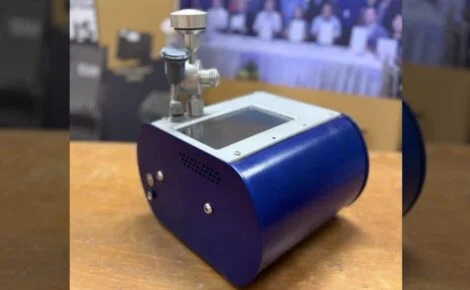
UP researchers build first Filipino-made air quality monitor
MANILA, Philippines — A chemist and an engineer from the University of the Philippines developed the first Filipino-made air quality monitoring device.
Len Herald Lim of the Institute of Chemistry began collaborating in 2014 with engineer Paul Alexander Darwin of the UP Los Baños Department of Electrical Engineering to develop the Robust Optical Aerosol Monitor (ROAM), the UP Diliman College of Science (UPD-CS) said in a press release.
Described as an “air microscope,” ROAM performs comparably to contemporary aerosol monitoring devices used in the industry and by the Department of Environment and Natural Resources’ Environmental Management Bureau.
Article continues after this advertisement
What began as a simple idea for measuring air quality became a critical step toward understanding the health effects of air pollution. ROAM has a much higher saturation limit, making it more durable and better suited than standard air monitoring equipment for highly polluted areas.
RELATED STORY: UP scientists: SAI.Kit to boost justice for sexual assault victims’
“If you’ve experienced microscopy before, like cell counting under a microscope, this is very similar. The difference is that instead of cells, what we are counting are particles in the air,” Lim said during the sixth Innovation Impact Stories webinar of the UPD-CS Innovation Program.
ROAM was first deployed in Cauayan City, Isabela, where it remained for about six to eight months. Its farthest deployment was in South Cotabato, where it continued to function even after being left unattended for almost six months.
Article continues after this advertisement
Lim said ROAM does not depend on a pinhole, making it suitable for highly polluted areas across the Philippines. The World Health Organization (WHO) has highlighted the need for air quality monitoring.
RELATED STORY: UP scientists develop micro-satellite markers for maliputo fish
“Monitoring air quality — for example, collecting continuous and quality data — is integral and critical to detecting air pollutants and to ensuring information sharing with the public, policymakers and regulatory compliance,” the WHO said.
Article continues after this advertisement
The WHO said air quality monitoring is among the first and necessary steps in quantifying the health effects of air pollution and tracking progress toward reducing it.
“The main pollutants, like particulate matter, nitrogen dioxide and tropospheric ozone, should be monitored continuously and consistently. Sharing these high-quality and standardized data publicly is essential to raise awareness and encourage decision-makers to take action,” it said.
In 2025, IQAir data showed that the average PM2.5 concentration was 3.8 times the WHO annual PM2.5 guideline value. /dm