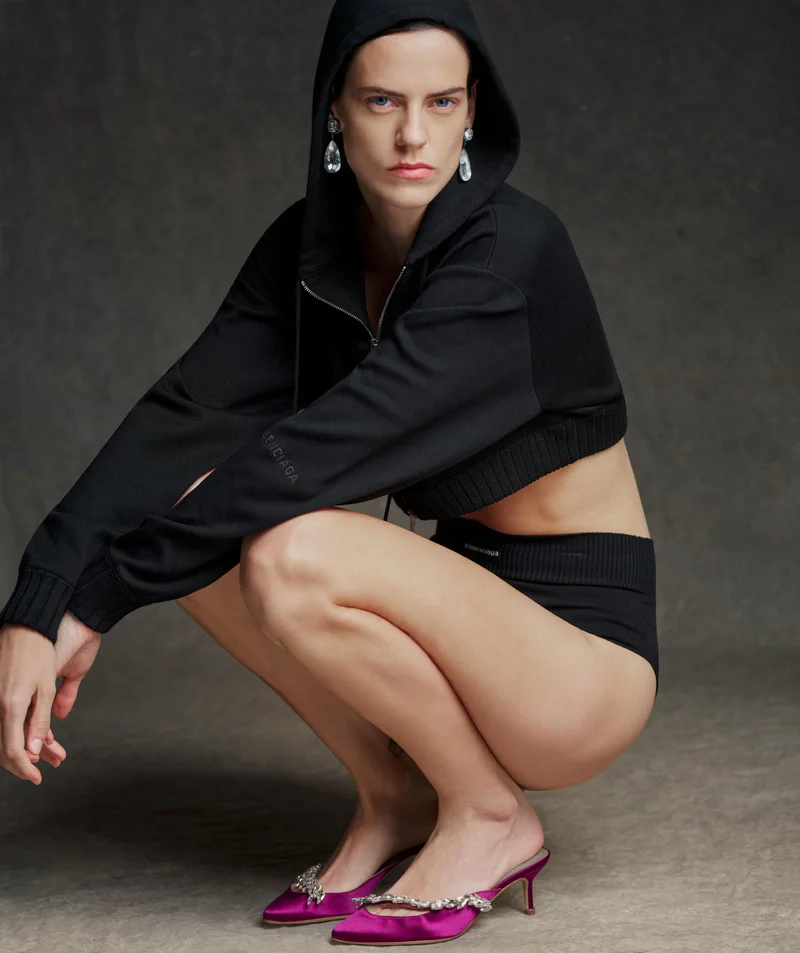
Pierpaolo Piccioli recalls that when he was working as accessories director alongside Maria Grazia Chiuri at Valentino, his office was filled with sketches and samples of Manolo Blahnik shoes.
“Because he was, and still is, the ultimate reference point,” he says.
He fell in love with the work first, and then with the person.
“A collaboration only works when there is a real connection between the two parties,” he says via Zoom.
Blahnik, on the other side of the screen, nods in agreement:
“I’ve admired your work from the very beginning. You are unique and courageous,” he tells him. “So for me, it is an honor that you wanted to work with me.”
For the past year, the Italian designer has been working at the fashion house founded by his great idol, Cristóbal Balenciaga. During that time, he has visited Getaria, the couturier’s hometown, several times to see the Balenciaga Museum.
“It also reminds me of Nettuno, where I was born. A small coastal fishing town where time passes differently,” he explains.
The pressure of carrying forward such a legacy, both personally and professionally, is immense. That is why the designer has set out to “revive the values, not the archives. I don’t want to simply engage in an exercise in style because you can’t turn back time,” he says.
It’s also why, in his collections for the house, he has mixed sneakers with high heels; dresses that echo those invented by the Spanish designer but are made from far more democratic fabrics, from denim and cotton to leather; and sportswear paired with more ceremonial pieces.
Then, in January, while creating this coming autumn’s collection, he decided to call Manolo Blahnik to develop a footwear collection that blends elements from Blahnik’s own archive with Balenciaga’s colors and jewel-like embellishments.
“He is the other great Spanish designer, and I believe they share a common sensibility,” he explains.
Blahnik has spent most of his life away from his native Canary Islands, although he still owns a home there and returns regularly. Yet he remains deeply Spanish at heart.
During the conversation, he references his great idol, Federico García Lorca; the singer Juanita Reina, “whose style was pure and impossible to categorize”; and, of course, the Basque designer Balenciaga, whom he came to admire through his greatest muse, his mother.
“It’s not about the garment itself, it’s about the structure, the movement, the way everything comes together as a whole. Shoes were not merely an accessory for him; they were part of the structure. And that’s not very common, especially at that time,” he explains, while Pierpaolo nods in agreement.
There may seem to be a vast gulf between Juanita Reina and Cristóbal Balenciaga, but the shoemaker distills the connection down to a single idea.
“The idea of giving freedom to the body, of changing the relationship between the body and clothing, is perhaps the most important thing,” adds Pierpaolo.
“It’s not so much about the list of women he dressed,” Blahnik concludes, “but about that idea of freedom and authenticity.”
From the white shirt to leggings
A few years ago, it would have been unthinkable to see a luxury collection combining sports leggings with high heels, hoodies with draped dresses, or baseball caps with sharply structured jackets. At least not without a layer of irony or some conceptual justification.
“That lack of rules defines a lot of how people dress now,” Pierpaolo admits.
He was among the first contemporary designers to break with sartorial conventions without resorting to elaborate theoretical explanations. During his years at Valentino, he repeatedly created haute couture white shirts and jeans that were, in fact, made of silk. In other words, he became obsessed with bringing together the most basic garments and the highest expressions of luxury and craftsmanship.
“For me it’s not about complexity but about emotion,” the designer explains, “in the end it’s an exercise in honesty. No one remembers or keeps a garment for the design alone, but for the feelings that garment provokes.”
If he has now chosen to experiment with the contrast between sportswear and high fashion, in the conventional sense of the term, it is precisely because he wants to bring a sense of authenticity and realism to his work at Balenciaga. In fact, he decided to call the collection Body and Being, a reference to the functionality of everyday life.
“I believe comfort today is what makes you feel powerful and secure,” he says.
The idea is to place the body at the center, not to display it, or even to enhance it, but to free it from discomfort and artifice. That, precisely, is the value Pierpaolo wants to recover from Balenciaga, beyond archives or technical innovations in pattern-cutting.
“He changed the relationship between women and clothing. For the first time, it was the woman who wore the clothes, not the other way around. That freedom is what interests me,” he says.
This is why Balenciaga’s curved backs, sloping collars and trapeze silhouettes are translated into everyday garments; elaborate headpieces become hoods, and tailoring takes on the character of technical apparel. It is also why he combines all these elements with trailing evening gowns, long gloves and Blahnik’s classic shoes.
It is a play of contrasts that, he says, “puts the body at the center” in a contemporary way. “There is no longer any issue with wearing a jacket or coat over a sportswear garment,” he says.
Shoes without labels
Over the course of a career spanning more than half a century, and even before that, when he was still a teenager, Manolo Blahnik has designed hundreds of shoes. Many of them have stood the test of time and are still as relevant today as when he first created them in the 1980s and 1990s. He brushes off the significance of that achievement.
“Look, in the end it’s about the person, not the shoe itself. I learn from the people who wear them, like a sociologist,” he says.
He is not talking about the celebrities, and there have been plenty of them, who have worn and continue to wear his designs.
“I like people with personality, those who don’t fit any label. Those are the people who give value to what I do. It doesn’t matter whether the shoe is higher, flatter, whatever — at a certain point it belongs to the person, and they wear it for various reasons, each their own,” he explains.
That is why, despite having handed over the management of his company to his niece Kristina a decade ago, he continues to sketch and design. And that is why, at 83, he so enthusiastically accepted Pierpaolo’s call.
“I have been fascinated by his work at Valentino; he has a sensibility few have right now,” he says, quickly sketching one of the collection’s designs as he speaks. “This dress, for example, has a shape that any woman could wear and look incredible. It takes great talent to do something like that — something with attitude that at the same time imposes nothing, that encourages women to be free.”
“For me this collaboration is personal. I have liked Manolo forever, as a person and as a creator,” replies Pierpaolo.
He personally selected the three styles that make up this first collaboration between them, choosing them for their enduring relevance and, above all, for how they complement the collection they accompany, particularly in the way they reveal the foot.
“We have tried to fuse his work with the codes of this house, recreating some models but with Balenciaga’s own details,” he explains.
The embellishments on the shoes, for example, combine motifs from Blahnik’s own designs with references to the costume jewellery Cristóbal Balenciaga created in the 1960s.
“He was a complete creator,” the shoemaker notes. “He had a holistic vision of every detail. What feels modern about him is his sense of structure.”
All of the shoes are covered in a shade of grey leather that is distinctive to the French house, the same color used throughout its packaging.
A shared ethic
This Balenciaga collection is Pierpaolo’s first pre-collection for the house. Normally, these interim lines serve to translate the main Spring/Summer and Autumn/Winter collections into something more commercial and visually accessible, grounding the designer’s creative vision in pieces with broader appeal.
That is not the case here. Not only because this collection, a kind of haute couture for technical design, amounts to a clear statement of intent, but also because Pierpaolo never tires of talking about process and craftsmanship, two concepts he has championed relentlessly over the past several years.
Manolo Blahnik, too, sees himself as a craftsman and a draftsman, despite being one of the most recognizable names in contemporary fashion. He believes that what matters most in fashion today is “having values and showing them. We need them more than ever. What matters is dressing people with values.”
In an era shaped by the growing influence of artificial intelligence, among many other uncertainties, Pierpaolo argues that “the human touch and creativity are vital in the world we live in. And so is the process, of course,” he says.
“I like to think that beauty can still provoke positive emotions. It’s not about whether people buy a collection or not. That’s not the point. It’s about the idea that it is still possible to create things that make people dream, that pull them out of their surroundings for a moment.”
For him, however, reality still governs his approach to fashion, even if it is a stylized version of reality.
“In the end, if there is one thing I’ve learned over the years, it is that being honest and following your own instincts will always be the most modern thing you can do. It doesn’t matter what you design, as long as it feels authentic to you. Authenticity is what allows you to connect with people,” says Pierpaolo.
Blahnik adds: “And in a world like this, what matters, ultimately, is not following certain dictates. I love people who use fashion to break the rules. Breaking conventions — that is elegant.”