Mohammed Nashbatwith
Euronews Arabic
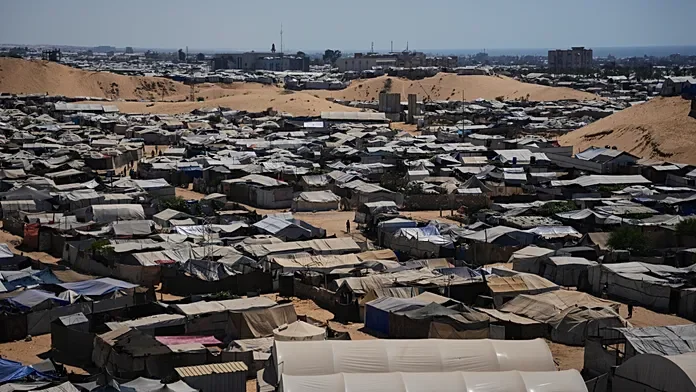
Doctors say the real scale of the outbreak is likely far larger, as overcrowding makes isolation impossible, and families of six or more share tents of a few square metres. Thousands of children born during the war could not complete their vaccination, leaving the most vulnerable without protection.
Chickenpox is spreading rapidly through Gaza's displacement camps, with around 9,300 cases recorded in just two weeks across more than 130 health facilities, as doctors warn that the real scale of the outbreak is almost certainly larger than the figures suggest.
The UN health cluster attributed the surge to extreme overcrowding in displacement sites, high summer temperatures and declining access to clean water.
More than half the recorded cases were concentrated in Khan Younis governorate. In the same week, health teams recorded more than 18,000 new cases of infectious skin diseases across the Strip, including scabies, head lice and impetigo.
For families living in tents that measure only a few square metres, the medical advice to isolate sick children is simply unworkable.
"They said he has to be on his own, with his own mattress, his own clothes and washing, but where? We are living in a tent and there is literally no space," said Hamada Abu Ghali, displaced in Nuseirat, whose daughter was initially misdiagnosed before a dermatologist confirmed she had chickenpox.
The infection had already passed to one of her brothers. "Before the war we had a house and rooms, but today all of us are in one tent," Abu Ghali told Euronews.
His son wanted to go outside like any child, Abu Ghali said, but the area around the tent offered no protection. "However hard you try to protect him, as soon as he goes out he is surrounded by sewage and rubbish. Everything about the situation helps the disease to spread."
Ahmed Abu Hussein, displaced in Deir al-Balah, described conditions in which sometimes more than one family shares a single tent.
"In theory he should be isolated because it is an infectious disease, but there is no space and all the children are together," Abu Hussein told Euronews.
"We can't control them or keep them inside the tent, so the infection ends up spreading to the whole family."
Vaccine crisis heightening risk
Around 1.7 million people are now living in more than 1,600 displacement sites across the Gaza Strip, according to UN data, amid severe shortages of drinking water, hygiene items and sanitation services.
At Al-Rantisi Children's Hospital, paediatric consultant Dr Sharif Mattar said the published statistics were likely a significant undercount.
Most children with chickenpox were being seen in tents or primary healthcare centres and never reached hospital, he said, meaning a substantial share of cases did not appear in the data.
Chickenpox is caused by the varicella-zoster virus and spreads through respiratory droplets, direct contact with blisters or contact with contaminated surfaces — precisely the conditions that are impossible to control in displacement camps.
Nurse Sheimaa Hajji, working at a health centre, said facilities were seeing daily increases in children with skin diseases.
Most arrived only after the rash had already spread widely across their bodies.
Treatment was largely limited to relieving itching and reducing the risk of secondary bacterial infections — and even basic supplies for that were running short.
"The sick child is supposed to be kept away from other children until the infectious period is over, but in the tents this is almost impossible," Hajji told Euronews.
"All the children play together and use the same space, so we see the disease passing from child to child and from family to family," she said.
The shortage of calamine lotion — used to relieve itching and soothe rashes — was adding to children's distress, Hajji said, because continued scratching risked leading to inflammation and further complications.
Bassam Zaqout, director of Medical Relief in the Gaza Strip, said thousands of children born during the war had been unable to complete their vaccination schedules, while restrictions on importing new vaccine shipments had left the health sector unable to strengthen community immunity.
He also warned that chickenpox posed risks for pregnant women, including a higher chance of complications for the mother or foetus — at a time when specialised maternity care was severely limited.
Aid trickles in, more needed
The World Health Organisation said Gaza's health system was still operating with limited capacity because of extensive damage to facilities and shortages of medicines and staff.
OCHA field visits had found displacement sites lacking safe water, with sewage flowing through the streets surrounding the camps.
Israel's Coordination of Government Activities in the Territories, COGAT, said 18,000 tonnes of medicines and medical supplies had entered the Strip since the ceasefire between Hamas and Israel began on 10 October last year.
Health workers on the ground said the pace remained insufficient to contain the current outbreak.
The UN health cluster said medical teams had stepped up distribution of fever-reducing medicines, anti-itch treatments and antibiotics for cases that developed bacterial complications, and had deployed health education teams in displacement sites.
It said those interventions would not be enough unless the pace of aid deliveries increased significantly and far greater quantities of hygiene supplies and medical inputs were made available.