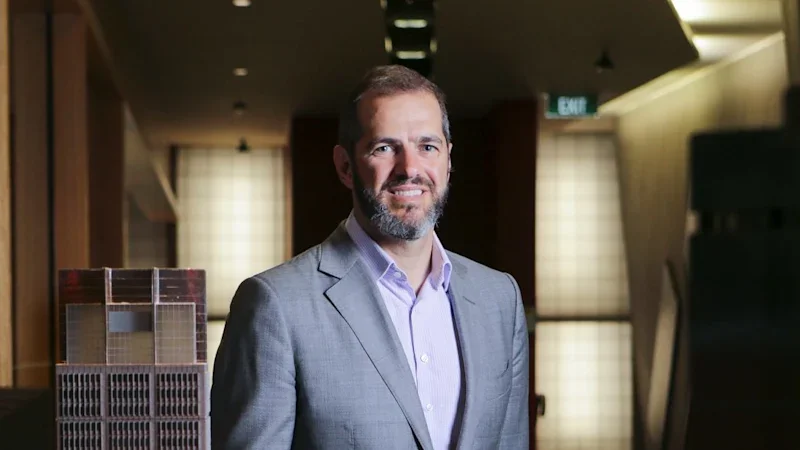
Once arguably the biggest name in Melbourne’s property and construction world, Daniel Grollo’s financial unravelling has deepened after the scion filed for bankruptcy and his luxury New York penthouse was seized by an American bank.
Grollo, whose corporate empire, under the Grocon banner, was placed in administration in 2020 amid a messy dispute with the NSW government, also faces the prospect of investigation from Australian liquidators.
He managed to avoid liquidation of his Grocon businesses at the time, through a deal with creditors, but it emerged on Sunday that he had entered personal bankruptcy in March, having filed for bankruptcy with the Australian Financial Security Authority that month.
His Grocon construction empire collapsed owing debts of about $104 million. Grollo blamed the building giant’s downfall on a $270 million legal dispute with Infrastructure NSW over the Central Barangaroo development in Sydney.
Grollo’s spokeswoman issued a “statement of facts” on Sunday saying the bankruptcy “represented the final chapter of a long-running dispute arising from the Central Barangaroo project”.
The statement said a NSW inquiry has found Grocon was treated unfairly by the state government over the harbourside project and a subsequent settlement was reached in 2024.
That settlement was not “sufficient to discharge creditor claims in full. Mr Grollo’s personal bankruptcy arose from the financial obligations that remained following that process,” the statement said.
“Mr Grollo is now looking forward to closing the book on the past few years. While this chapter has been difficult, Mr Grollo remains committed to meeting his obligations under the bankruptcy process, including making the required income contributions for the benefit of the two creditors,” the statement said, adding those creditors were the Tax Office and a project bonder.
The statement said the financial troubles did not affect Grollo’s position as chief executive of Grocon Funds Management, which was set up in 2010 to manage family interests.
New financial documents also show one Grollo company owed more to lender CitiMortgage than the value of his New York property portfolio, which featured a sprawling apartment inside the Trump Parc building overlooking Central Park that he bought for $US14.25 million in 2012.
After the bank seized it, the multi-unit apartment was listed for sale at $US16.4 million. The mortgage alone against the unit is valued at $US18.89 million.
“On 16 June 2025, the company, in its capacity as trustee, and CitiMortgage executed a deed in lieu of foreclosure, effectively surrendering the NYC property to CitiMortgage in full and final satisfaction of the mortgage,” states the insolvency report by Aston Chace for the company that owns the property.
The company, 106 Central Park South Pty Ltd, is also under investigation for insolvent trading, uncommercial transactions and breach of directors duties, according to the report from March 30 this year.
Insolvency records show the Australian-based company that owned the US property had $37 million worth of assets and $100 million in debts when it and its associated companies went under late last year.
“My investigations into a claim against the director [Daniel Grollo] for trading the company whilst insolvent are ongoing and subject to provision of documents which indicate to a period when the company became aware of its liabilities exceeding the realisable value of the NYC property, the primary asset of the company,” Aston Chace wrote.
“Notwithstanding this, my preliminary analysis of the company’s solvency, based on the available books and records, indicates that the company may have been insolvent from at least as early as June 2025.
“Irrespective of whether a claim for insolvent trading can be both identified or quantified, given the Director’s current financial circumstances and the possibility of a counterclaim, it is unlikely that there would be any commercial merit in pursuing a claim against him,” the report found, after noting Grollo had declared personal bankruptcy on March 12.
Grollo’s building empire, which was founded as a concreting and paving business in the 1940s by patriarch Luigi Grollo, was run by three generations of the family.
Under the stewardship of Luigi’s sons, Bruno and Rino, Grocon erected some of the Melbourne skyline’s most iconic buildings, including the Rialto Towers and Crown’s Southbank casino.
The family formally handed over control of the company to Daniel Grollo in 1999, with the Eureka Tower development and Melbourne Emporium construction occurring under his tenure.
Grocon was restructured in 2011, to allow Daniel Grollo to run the business without the input of his father, Bruno, or brother Adam. Grollo took control of the group and its development projects, while other assets were spun out or sold to family interests.
For more than a decade, Grollo had made New York his semi-permanent home, relocating his family there in 2009. He would regularly fly back and forth from Australia in a move that some linked to what became some of the growing problems with the business.
Back at home, Grollo was also the owner via a company of an 80th-floor apartment in Eureka Tower that was sold in the midst of financial problems and a marital separation for $10.5 million in 2022. It was still under renovation when listed for sale.
Early in his reign at Grocon, in 2002, Grollo tried to push through a Howard government era non-union agreement that was overwhelmingly rejected by workers. It began a more than decade-long stoush as he tried to break the hold the CFMEU had over Grocon workers.
In August 2012, the CFMEU engaged in a blockade of Grocon’s Emporium building site after a dispute over the appointment of health and safety representatives and wearing of union apparel.
The company’s safety measures were again under the microscope in 2013 when a retaining wall at its Swanston Street apartment development collapsed, killing three people walking past the site. A Grocon subsidiary was fined $250,000 after pleading guilty to failing to ensure a safe workplace in 2014.
At the time of Grocon’s demise, the Australian Taxation Office was Grocon’s largest creditor, owed $13.7 million in GST payments by Grocon companies.
When contacted on Sunday, a spokeswoman for the ATO said it does not comment on individual matters.
Australian Securities and Investments Commission documents show Grollo’s bankruptcy has coincided with his resignation as director of more than 100 companies.
PKF partner Brad Tonks is the trustee for the bankruptcy, and did not respond to a request for comment.
Be the first to know when major news happens. Sign up for breaking news alertson email or turn on notifications in the app.