- READ MORE: Dogs can become addicted to their toys, study reveals
- See more Daily Mail on Google - save us as a Preferred Source
Whether it's slogging through the freezing rain or waking up at the crack of dawn to avoid the heat, taking the dog out for a walk is a daily ritual for millions of pet owners.
But just how often should you really be walking your dog?
While some pet owners say that their pooch needs multiple excursions, others swear by a single lengthy trek.
Now, experts have settled the debate once and for all – and it's bad news if you've only been going walkies once a day.
Professor Nicholas Dodman, CEO of the Center for Canine Behavior Studies, told the Daily Mail that owners should be going on 'at least three shortish walks plus two longer walks'.
These daily jaunts should include longer walks for exercise as well as 'short walks for bathroom breaks, and to alleviate boredom'.
Professor Dodman adds: 'An athletic breed of dog needs a longer walk of say three to five miles in the middle of the day and another couple of miles before dinner time.'
However, experts say that this general rule should be adjusted to your dog's specific breed, disposition, and habits.
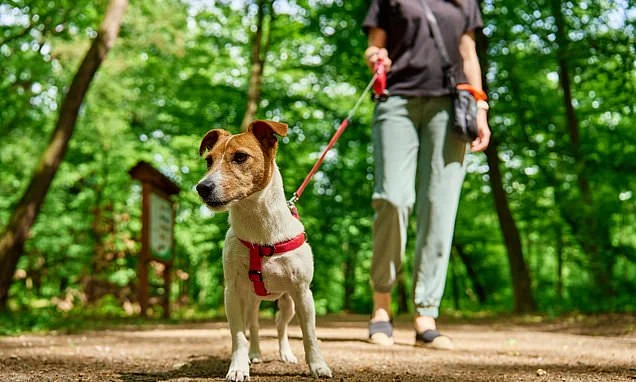
Experts have revealed how often you should be walking your dog each day, and say that owners should be taking at least three shortish walks plus two longer walks (stock image)
The question of how often to walk your dog each day has left pet owners on social media bitterly divided.
In one debate on Reddit, one commenter said they were 'amazed at the amount of exercise people say they give their dogs daily.'
Some owners admitted to walking relatively rarely, with one writing that they walk 'maybe twice a week with the way my work schedule is.'
Others reported taking their pets for hours of exercise every day, such as one commenter who goes for 'minimum two walks daily ranging from 40 to 90 minutes.'
Experts generally recommend that all dogs be given at least one walk outside a day, but walking your dog more often could improve their health and happiness.
Paula O'Sullivan, canine behaviourist at London–based dog trainers Walkies and Wagtails, told the Daily Mail: 'A walk shouldn't simply be about covering miles or counting steps – it should also provide opportunities for the dog to engage with the world in a way that is meaningful to them.
'For most dogs, multiple shorter, enriching walks can often be more beneficial than one long walk, particularly if those walks allow the dog to sniff, explore and make choices.'
However, how long those walks take and what they involve will need to be carefully tailored for your specific dog.
'In reality, there isn't a "one–size–fits–all" answer. A young working–line Spaniel has very different needs from a senior Cavalier with arthritis,' says Ms O'Sullivan.
If you have a highly energetic working dog, such as a Malinois or Border Collie, you might need to carve out several hours a day for walking and playing.
On the other hand, some dogs, such as Dachshunds or Pugs, have short legs and joint issues that make walking long distances difficult or painful.
Puppies are another important exception, and owners should be careful to avoid over–exercising young dogs.
Ms O'Sullivan says: 'As a very rough guide, many professionals use around five minutes of structured walking per month of age, up to around six months, but this should never be treated as a rigid rule.'
What is more important, according to the experts, is ensuring that the walks you do take are as engaging as possible.
Dr Jacqueline Boyd, animal behaviour expert from Nottingham Trent University, told the Daily Mail she distinguishes between 'functional walks' and 'fun walks'.
Functional walks are about giving your dog some basic physical exercise and going to the bathroom, whereas fun walks 'might involve more bonding and playing or training between dog and handler, free time off lead for the dog and interactive activities including sniffing'.
This debate has left social media bitterly divided, with some dog owners saying they are 'amazed' at the amount of exercise others are claiming to be giving their dogs
Dr Boyd adds: 'I tend to talk to my canine coaching clients about activity and exercise rather than walking because it is not often as simple as popping a lead on and going for a "walk around the block".
'Ditch the headphones and your phone. Walk WITH your dog.
'Be aware of them and the world around you too.
'Play with them. Get some fun toys, although be very careful of repetitive ball throwing and retrieving, as this can be detrimental to your dog's long–term physical health and can predispose them to injury.'