Scientists just found sugar in space. Here's why that matters
New discovery brings us closer to 'understanding where life comes from,' experts say
It's a sweet discovery that has the science world talking — and may help us better understand the origins of life on Earth.
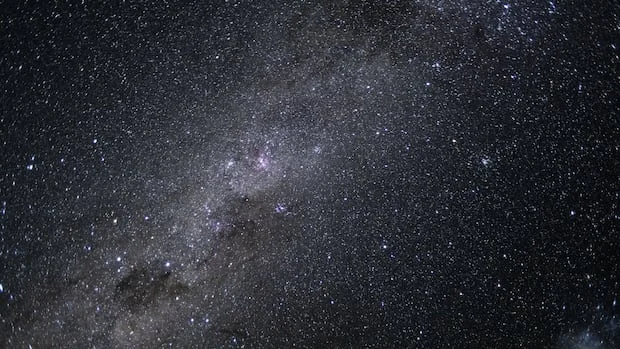
Earlier this month, a group of researchers in Spain uncovered sugar near the centre of the Milky Way, about 26,000 light-years from our planet.
Using two radio telescopes, the team at Spain's Centre for Astrobiology said they uncovered a four-carbon sugar in a molecular cloud. Known as erythrulose, that sugar is most commonly found on Earth in raspberries. It is also used in self-tanning products.
Their discovery marks the first time a sugar has been found in what's known as the interstellar medium — a collection of gas and dust that exists between stars.
According to experts, that's significant because sugars were a critical component for jump-starting life on Earth, and how exactly sugar molecules first formed on our planet has been a long-standing question among scientists.
"The reason it's so exciting is that these are some of the basic building blocks that you need in order to make nucleic acids, which are essential for life as we know it on Earth," said Sarah Gallagher, director of the Institute for Earth and Space Exploration at Western University.
The discovery
Types of five-carbon sugars form the backbone of both DNA and RNA, making it a key ingredient in the formation of living organisms.
Based on previous research, including last year's discovery of ribose and glucose sugars in samples taken from an asteroid called Bennu, scientists believe sugar was likely transported to Earth via comets and asteroids that struck the nascent planet.
But where the sugars originated from has been unclear. The provenance of sugar on Earth was "one of the missing links in terms of understanding where life comes from," said Gallagher, who was not involved in the Spanish study.
"And there's a story now — that [sugars] could come from the giant clouds that stars are born in."
WATCH | A view of black hole at centre of the Milky Way:The researchers in Spain, led by Izaskun Jiménez-Serra, measured enough erythrulose in the molecular cloud that they estimate as much as 50 million tons of it could have reached Earth's surface approximately 4.1 to 3.8 billion years ago during the Late Heavy Bombardment.
That's an unconfirmed, controversial theory that posits the planets of the inner solar system — Mercury, Venus, Earth and Mars — suffered a "cataclysmic pummelling" by asteroids in their early years.
The researchers said their study — published July 13 in the Nature Astronomy journal — suggests that the interstellar medium could be a "viable source" of sugar not only on early Earth but elsewhere in the universe, as well.
And, it could lead to further discoveries in space of other sugars and "other important molecules for the origin of life."
- In our search for alien life, stars might be muddying their signals
- Canadian-developed technology helps new telescope probe mysteries of the cosmos
How rare is life on Earth?
The study provides more support for the idea that some of the materials needed for RNA to form could have been readily available on the early Earth, said Nagissa Mahmoudi, an associate professor in the Department of Earth and Planetary Sciences at McGill University.
"This is another piece of the puzzle of what was actually there."
Mahmoudi told CBC News the discovery also hints at the possibility that comets and asteroids may have delivered sugar molecules to other planets.
"That's the exciting thing. Whenever we think about life on Earth, the big question is: Is life rare here? What's so special about Earth? Or is it not special? Is life actually everywhere and we just haven't found it?"
The study only confirms her thoughts that life may exist elsewhere in the universe.
"We know that these molecules made it here to Earth and they turned into the building blocks of life here, and there's no reason to think that wouldn't have happened elsewhere."