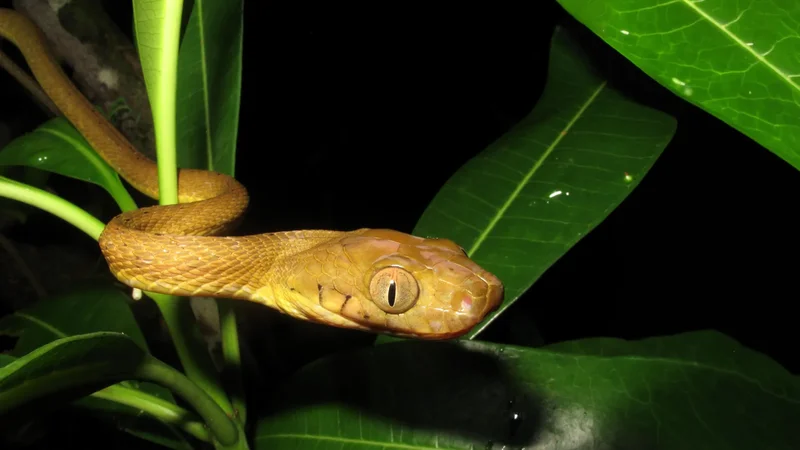
Hidden genetic diversity helped inbred brown tree snakes conquer guam
Hidden genetic diversity may explain how a handful of brown tree snakes turned into a devastating invasion across Guam.
- Date:
- July 26, 2026
- Source:
- University at Buffalo
- Summary:
- A notorious snake invasion that devastated Guamâs native birds may have succeeded because the reptiles carried hidden genetic advantages. Using advanced long-read DNA sequencing, researchers uncovered more than 19,000 large genetic differences in brown tree snakes, many concentrated in genes tied to immunity and smell. This overlooked diversity may have helped a population founded by only a few snakes survive inbreeding, adapt to a new environment, and multiply to extraordinary densities.
- Share:
The brown tree snake has become one of the world's best-known examples of an invasive species.
Native to Australia and the South Pacific, the snake likely reached Guam sometime after World War II, possibly by hiding aboard military cargo planes. Its arrival had devastating consequences. Brown tree snakes have driven many of Guam's native forest birds to local extinction, and they cause hundreds of power outages each year by climbing utility poles and electrical equipment.
In some parts of the U.S. territory, their numbers have climbed as high as 30,000 snakes per square mile.
A Snake Invasion That Defied Expectations
The invasion has long puzzled biologists because Guam's population is believed to have begun with only a small number of snakes.
Such a limited founding population usually creates a severe genetic bottleneck. With fewer genetic differences to draw upon, inbreeding would normally reduce a species' ability to adapt and make rapid population growth less likely.
A new University at Buffalo-led study, published on July 24 in Science Advances, suggests that brown tree snakes possess far more genetic variation than scientists previously recognized.
Researchers from UB and the U.S. Geological Survey (USGS) used advanced long-read sequencing to examine large sections of the snake's genome. They uncovered thousands of structural variants, including DNA segments that had been duplicated, deleted, or rearranged.
Many of these variations were concentrated in genes related to immunity and smell.
This hidden genetic diversity may help explain how a population founded by only a handful of snakes survived intense inbreeding, adapted to Guam, and expanded so dramatically.
"The brown tree snake is maybe not wildly diverse, but it has important sources of genetic diversity that have been underappreciated," says the study's corresponding author, Trevor Krabbenhoft, PhD, associate professor in the UB Department of Biological Sciences.
Findings With Implications Beyond Guam
The discovery may be discouraging for agencies that have spent decades trying to contain Guam's brown tree snake population. Greater genetic flexibility could make the invasive species more resilient than previously assumed.
At the same time, the results may offer hope for endangered species with small or highly inbred populations.
"It's possible that endangered species may have more flexibility in their genes than we realize," says first author Christopher Osborne, PhD, a former PhD student in Krabbenhoft's lab and now an aquatic biologist with State University of New York Oswego. "We're now getting a better understanding of unappreciated sources of genetic diversity that may explain how some inbred species can still respond to their environment."
Long-Read Sequencing Reveals Hidden DNA Changes
Much of what scientists know about genetic diversity has come from studying changes in individual DNA base pairs, such as an A changing to a G or a T changing to a C.
Early DNA sequencing tools were designed primarily to detect these small changes. They were much less effective at identifying major differences involving longer stretches of DNA.
Long-read sequencing allows researchers to examine much larger, continuous pieces of a genome. This makes it possible to detect structural variants that affect 50 base pairs or more.
Taken together, structural variants alter nearly eight times more of the genome than changes involving single base pairs.
"It's like looking at portions of two books letter by letter with a magnifying glass and thinking they're the same, but not realizing entire paragraphs have been moved around or duplicated. Older sequencing technology didn't allow us to easily see that DNA in one individual might be in a completely different place on the chromosome than in another," says Levi Gray, PhD, a postdoctoral researcher in Krabbenhoft's lab. "How we define genetic diversity and how we actually measure it is shaped largely by the technology of the day."
Gray previously studied Guam's brown tree snake problem while working for the USGS. Through that collaboration, the researchers obtained DNA from the USGS Brown Tree Snake Rapid Response Team (RRT), which works to prevent the invasive species from spreading elsewhere in the U.S. and its territories.
More Than 19,000 Structural Variants
When the team analyzed the samples in Krabbenhoft's laboratory, they identified more than 19,000 structural variants in the brown tree snake genome.
That means the researchers found roughly 19,000 locations where sections of DNA differed because they had been duplicated, deleted, or rearranged.
These variations were not scattered randomly throughout the genome. Instead, they appeared especially often in genes involved in immune function and olfaction, or the sense of smell.
Brown tree snakes depend heavily on smell to navigate and hunt. By flicking their forked tongues, they collect chemical signals from the air that help them locate potential prey.
The unusual diversity found in their olfactory genes could also help explain a behavioral mystery. Brown tree snakes are known to eat other snakes in their native range, but there is little evidence that they frequently prey on one another in Guam.
"The snakes' heightened sense of smell may allow them to recognize one another as something more like siblings -- especially given the high levels of inbreeding -- than as prey," Gray says.
Did the Genetic Diversity Emerge on Guam?
Scientists still do not know whether the structural variants were already present before the snakes reached Guam or whether some appeared after the invasion began.
Large genomic changes usually build up over many generations. However, some research suggests that severe population bottlenecks may accelerate the development of structural variants.
Determining when these changes appeared will require comparisons with brown tree snakes from their native range.
"Is it possible some of this diversity emerged after the invasion? It is, but we would have to sequence snakes from the native populations to know for sure," Gray says.
Other co-authors include USGS scientists M. Renee Bellinger, PhD, and Melia Nafus, PhD, as well as UB research scientist Brian Foote, postdoctoral researcher Steven Fleck, PhD, and PhD students Sarah Chang and Hannah Waterman.
Story Source:
Materials provided by University at Buffalo. Note: Content may be edited for style and length.
Journal Reference:
- Christopher A. Osborne, Brian M. Foote, Steven J. Fleck, Hannah M. Waterman, Sarah L. Chang, Melia G. Nafus, M. Renee Bellinger, Levi N. Gray, Trevor J. Krabbenhoft. Genomic structural variation rescues a classic biological invader from a population bottleneck.Science Advances, 2026; 12 (30) DOI: 10.1126/sciadv.aed3656
Cite This Page:
ScienceDaily. Retrieved July 26, 2026 from www.sciencedaily.com