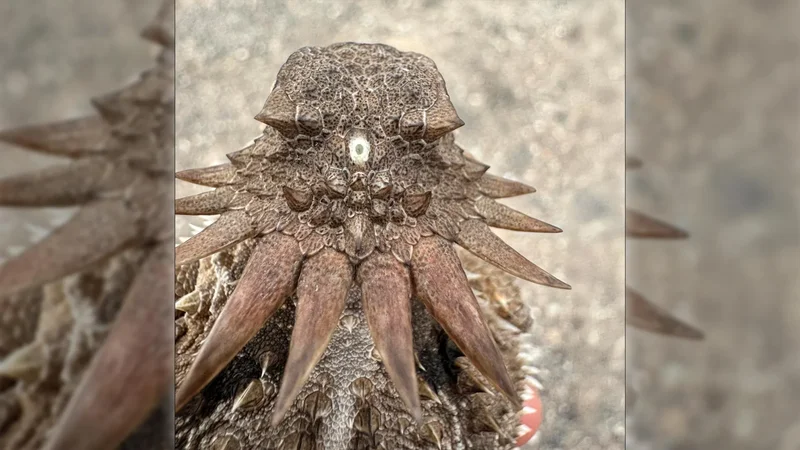
Scientists trace the shocking origin of human eyes to an ancient âcyclopsâ
- Date:
- July 26, 2026
- Source:
- Lund University
- Summary:
- Researchers say a tiny one-eyed ancestor that lived nearly 600 million years ago may have shaped the evolution of every vertebrate eye, including our own. They also found that its ancient median eye lives on today as the pineal gland, which helps synchronize our sleep with daylight.
- Share:
Humans and every other vertebrate may share an astonishingly strange ancestor: a tiny creature with a single eye centered on the top of its head.
Recent research from Lund University and the University of Sussex proposes that the earliest ancestor of vertebrates passed through a cyclops-like stage nearly 600 million years ago. According to the researchers, this animal's central eye eventually contributed to the development of the paired eyes used by vertebrates today.
Even more remarkably, part of that ancient visual system may still survive inside the modern brain as the pineal gland, an organ that helps regulate sleep.
"The results are a surprise. They turn our understanding of the evolution of the eye and the brain upside down," says Dan-E Nilsson, professor emeritus in sensory biology at Lund University.
A Tiny One-Eyed Ancestor
The distant ancestor described by the researchers was a small creature with a body resembling a worm. It lived in the ocean almost 600 million years ago and spent much of its life in one place, filtering plankton from the surrounding seawater for food.
Earlier in its evolutionary history, the organism appears to have possessed two eyes or at least two groups of cells capable of detecting light. Paired eyes are common throughout the animal kingdom because they help moving animals judge direction, distance, and the location of objects around them.
"We don't know whether the paired eyes in our branch of the evolutionary tree were just light-sensitive cells or simple image-forming eyes. We only know that the organism later lost them," says Dan-E Nilsson.
Because the creature had adopted such a quiet and stationary way of life, it no longer depended heavily on paired vision. Over many generations, the eyes gradually disappeared because they offered little advantage.
The animal did, however, retain a cluster of cells that could sense light in the middle of its head. These cells developed into a primitive central eye, also known as a median eye.
This simple organ probably did not create detailed pictures. Instead, it may have helped the animal distinguish night from day and determine which direction was upward, both of which would have been useful for surviving in the ocean.
How Paired Eyes Returned
Millions of years later, the animal's descendants began swimming actively again. A mobile lifestyle created a renewed need for vision, especially the ability to detect food, obstacles, predators, and direction of movement.
The researchers conclude that portions of the original median eye were repurposed during evolution. From this central visual structure, a new pair of eyes capable of forming images eventually developed.
This unusual process may explain why vertebrate eyes are constructed so differently from the eyes of many other animals.
"Now we finally understand why the eyes of vertebrates differ so radically from the eyes of all other animal groups, such as insects and squid. The film of our eyes -- the retina -- developed from the brain, whereas the eyes of insects and squid originate in the skin on the sides of the head," says Dan-E Nilsson.
The retina is the thin layer of tissue lining the back of the eye. It contains cells that detect light and convert it into electrical signals, which are then sent to the brain and assembled into the images we see.
In vertebrates, the retina is closely linked to the brain because it developed from brain tissue during evolution. By comparison, the eyes of insects and squid arose through a different evolutionary route involving tissue on the surface of the head.
A Strange Detour in Eye Evolution
The researchers describe vertebrate eyes as the product of an unusual evolutionary detour. An ancestor first lost its paired eyes after becoming largely inactive, retained a simple central eye, and later used parts of that structure to build a new and more advanced visual system.
Their conclusion is based on a broad comparison of light-detecting cells across animal groups. The team examined where these cells appear in the body, how they function, and how they connect with other tissues and nerves.
This evidence suggests that vertebrate eyes arose through this specific sequence of changes rather than evolving from the same structures that produced the eyes of insects, squid, and other animals.
"For the first time, we now also understand the origin of the neural circuits that analyze the image in our retina," adds Dan-E Nilsson.
Neural circuits are networks of connected nerve cells that process information. In the retina, these circuits begin organizing visual signals before they even reach the brain, helping identify features such as brightness, contrast, movement, and shape.
The Ancient Eye Still Inside the Brain
The most surprising part of the theory may be that the ancient median eye never disappeared completely.
The researchers argue that its evolutionary remains survive today as the pineal gland, a small organ located deep within the vertebrate brain. Although humans do not use the pineal gland to see images, it remains connected to the body's response to light and darkness.
The pineal gland produces melatonin, a hormone that helps control the circadian rhythm. This internal timing system influences when the body feels awake or sleepy over each roughly 24-hour cycle.
In many vertebrates, the pineal system is directly sensitive to light. In humans, information about light reaches the brain mainly through the eyes, allowing melatonin production to rise at night and fall during the day.
"It's mind-boggling that our pineal gland's ability to regulate our sleep according to light stems from the cyclopean median eye of a distant ancestor 600 million years ago," concludes Dan-E Nilsson.
Story Source:
Materials provided by Lund University. Note: Content may be edited for style and length.
Journal Reference:
- George Kafetzis, Michael J. Bok, Tom Baden, Dan-Eric Nilsson. Evolution of the vertebrate retina by repurposing of a composite ancestral median eye.Current Biology, 2026; 36 (4): R153 DOI: 10.1016/j.cub.2025.12.028
Cite This Page:
ScienceDaily. Retrieved July 26, 2026 from www.sciencedaily.com