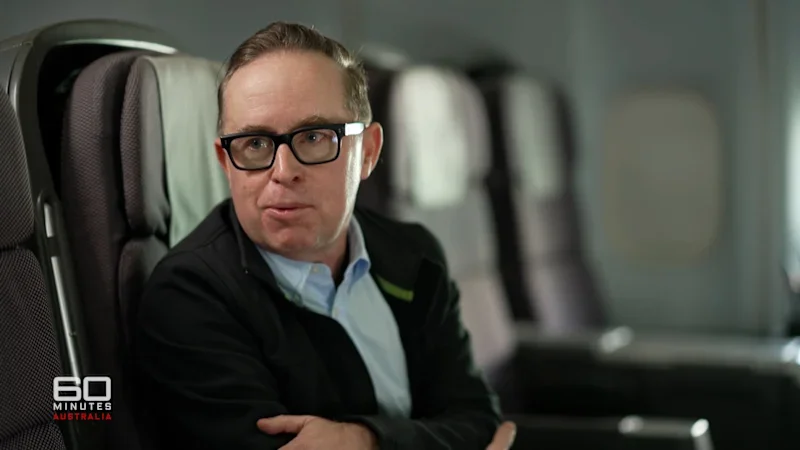
Former Qantas CEO Alan Joyce has claimed responsibility for the airline’s survival, three years after a series of customer-service outages and operational failures infuriated the public.
Joyce acknowledged the airline’s dismal post-COVID recovery experience, a chaotic period marked by skyrocketing fares and illegal sackings, in comments broadcast on 60 Minutes. Joyce stepped away from the role two months early in 2023 amid political and consumer backlash.
He said the hard decisions aided the company. “I think Qantas is in survival [mode] now because we got more things right than we got wrong,” he told 60 Minutes’ Tracy Grimshaw. “I recognise that when it comes down to it, the buck will always stop with the CEO on these things, and I accept that.”
As COVID lock-downs ended in 2022, and the airline began restarting its flight schedule, passengers were left stranded amidst endless airport queues, backed-up call centres, and cancellations. Qantas’ performance was further imperilled by the decision in 2021 to fire 1820 ground crew and baggage handlers, which meant it struggled to process customer luggage.
60 Minutes is owned by Nine Entertainment, owner of this masthead. Joyce has been speaking to the media ahead of the release of his autobiography on Tuesday.
In some of his first extensive comments on his 15 years as Qantas boss, Joyce says that one of his biggest regrets is how the company handled its exit from COVID, a period that included the notorious “ghost flights”, the withholding of flight credits, and criticism of passengers for not being “match fit” for flying.
“One of my biggest regrets is how we handled coming out of COVID because we got it badly wrong,” Joyce told The Australian this weekend. “COVID was not great. It was terrible.”
Qantas fired 1800 ground crew in 2021, which was challenged in court by the Transport Workers Union, which ultimately prevailed. Qantas agreed to pay $120 million in compensation to the workers, and then was fined another $90 million by the court for not being sufficiently contrite. The events precipitated Joyce’s early departure as CEO in 2023.
Vanessa Hudson took over as CEO and has undertaken a rebuilding of trust and relationships both within the company and with the travelling public.
Joyce said that the decision to fire the workers was that of then-CEO for Domestic and International Andrew David, according to The Australian. “This decision was Andrew David’s alone,” Joyce said, adding, however, that he takes responsibility for the airline’s actions during his time in charge. The 1820 affected workers are still awaiting compensation.
In comments carried by The Australian, Joyce denied “suggestions that he ever personally upgraded” Prime Minister Anthony Albanese to business or first class.
In a reference to Joe Aston’s book The Chairman’s Lounge, Joyce said that “claims were aired that I’d personally upgraded the prime minister’s flights. My first thought was, ‘That’s news to me.’”
Joyce also denied that he upgraded the prime minister’s son to the Chairman’s Lounge, an invitation-only club usually reserved for politicians, business leaders and top media editors.
Joyce referred questions about Albanese’s son to the PM.
Joyce, who earned global respect for his management of Qantas, was forced to front a Senate inquiry in 2023 in which he defended the company’s profits during a cost-of-living crisis.
He was criticised for earning a combined $125 million over his tenure as CEO of 15 years, a time which saw clashes with unions, the successful launch of Jetstar, and forged a lasting alliance with Dubai-based Emirates.
Joyce’s book, ‘Alan Joyce: Riding the Jet Stream’ will be released on Tuesday.
The Business Briefing newsletter delivers major stories, exclusive coverage and expert opinion. Sign up to get it every weekday morning.