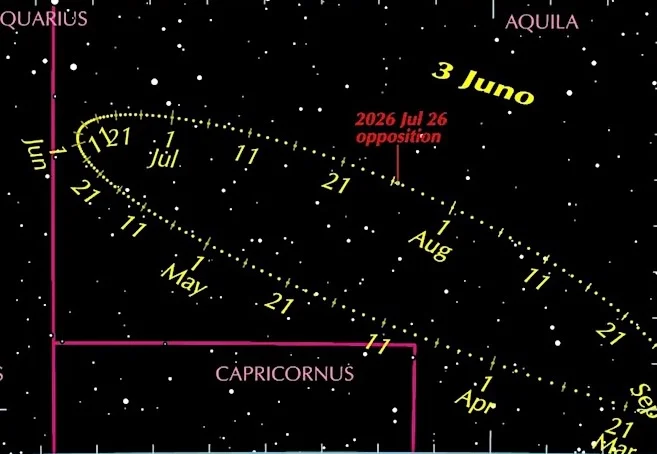
U.K. astronomer Guy Ottewell published Juno in Aquarius on his website on July 24, 2026. Edits by EarthSky. Reprinted here with permission. Thank you, Guy!
Asteroid Juno reaches opposition July 26
The large asteroid 3 Juno will be at opposition – when it’ll lie opposite the sun as viewed from Earth – on July 26, 2026. All asteroids and planets are brightest around the time of their oppositions, when they lie opposite the sun in our sky. That’s when they are closest to us in their orbits. They also rise around sunset and set around sunrise, so they are visible all night.
At opposition in 2026, Juno will shine at 9th magnitude. That means it is too dim for the unaided eye to see. But a telescope will reveal this little world, moving among the stars of the constellation Aquila the Eagle.
And it is theoretically within the reach of powerful binoculars. You’d have to look for Juno on more than one night and note a star that moved.
Juno and the other early asteroids were discovered in that way.
Juno’s discovery
Juno’s official name is 3 Juno, because it was the 3rd asteroid ever to be found. The German astronomer Karl Ludwig Harding spied it in the early 1800s, amidst a rush of asteroid discoveries. 1 Ceres was discovered in 1801, 2 Pallas in 1802, 3 Juno in 1804 and 4 Vesta in 1807.
Of these 1st four, Vesta is brightest. At Vesta’s opposition, it can reach as bright as magnitude 5.1, making it visible to observers with the unaided eye.
Now astronomers have tracked and documented over 1.5 million individual asteroids. And thousands of asteroids are still discovered each year. Most circulate in the asteroid belt located between Mars and Jupiter. But some asteroids orbit nearer in, and some even cross Earth’s orbit. All are below unaided-eye brightness … except sometimes 4 Vesta.
The 1st four asteroids are observable with telescopes or steadily held binoculars each year. And 3 Juno is usually the dimmest of the 1st four.
Main belt asteroids typically have orbital periods between 3 and 5 years.
Juno orbits near the celestial equator
Juno’s oppositions – unlike that of other asteroids – always occur near the celestial equator, the imaginary line around our sky directly above Earth’s equator. The chart below explains more about this phenomenon.
Bottom line: The asteroid Juno – officially known as 3 Juno – will be at its brightest around its opposition on July 26, 2026. It’ll be located among the stars of the constellation Aquila the Eagle.