Enhanced childcare leave among PAP Women’s Wing’s proposals after public engagements
AI generated
SINGAPORE - More financial support for parents beyond the first seven years of a child’s life and enhanced childcare-related leave are among the recommendations that the PAP Women’s Wing plans to put forward for the Government’s consideration.
This follows a series of public engagement sessions that the group has held since May, in an effort to gather feedback on how Singapore can support marriage and parenthood.
Concerns surrounding costs, time and health have emerged consistently from the five past sessions, which drew more than 500 attendees, including men and women, said PAP Women’s Wing vice-chairperson Gan Siow Huang at the sixth session held on July 26 at Junction 8 mall.
“We know that childcare costs can be quite challenging for families with young children, so we hope that cash payouts, financial support such as Baby Bonus can be extended beyond the first seven years of a child’s life – perhaps even into their teenage years,” said Gan, adding that this could help better reflect and cover the cost of raising a child today.
The group also plans to push for financial support such as the Baby Bonus scheme to be extended to single unmarried parents in Singapore, and for the Government to reduce out-of-pocket fees that parents have to pay for childcare and infant care.
“Even with subsidies for Anchor Operator centres, we know that for middle-income households, the out-of-pocket cash that they have to pay for childcare and infant care can be quite substantial,” said Gan, who is Minister of State for Foreign Affairs, and Trade and Industry.
The Baby Bonus scheme, introduced in 2001, aims to supports parents in their decision to have more children by helping to manage the costs of raising kids.
Another concern for parents is whether they have enough time to take care of their family while also managing their careers, said Gan, adding that those with more and older children tend not to have enough childcare leave.
“We hope that more can be done to enhance child-related leave for working parents,” she added.
** Employers also bear costs** when they provide child-related leave for their employees.
The Government can do more to support employers in this area, she added, so that they can better support their employees.
Many working parents have also voiced concerns about how they are perceived by colleagues and bosses when they have to take time off to attend to family matters, said Gan.
The hope is that over time, Singapore will have more family-friendly workplaces, so that working parents can feel more at peace and confident in balancing their work and family commitments.
The PAP Women’s Wing will also push for the Government to reduce the cost of fertility screening and treatment, said Gan. This comes as Singaporeans are increasingly getting married later in life, and more couples require medical help to conceive.
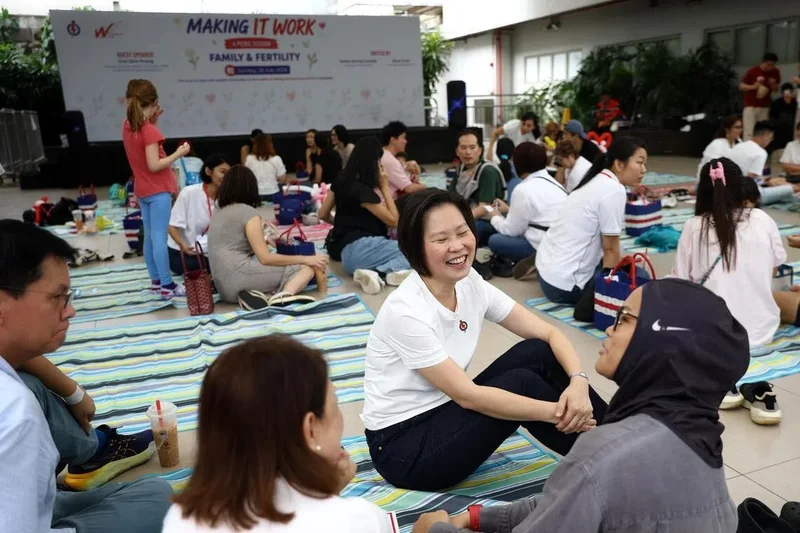
The July 26 listening session, titled Making it Work, drew about 120 attendees, including families, who shared their views and took part in fringe activities such as balloon sculpting and face painting.
The recommendations by the PAP Women’s Wing – informed by the public engagement sessions that will run until November – will be submitted to the Government’s inter-agency Marriage and Parenthood Reset Workgroup by the start of 2027.
The workgroup, chaired by Minister in the Prime Minister’s Office Indranee Rajah, was announced during the Budget debate in February after Singapore’s total fertility rate fell to a historic low of 0.87 in 2025.
Entrepreneur Zan Johan, one of the participants of the July 26 session, said she hopes to see a stronger push for flexible work arrangements, such as a four-day work week.
The mother of two boys, aged eight and 10, previously left her job as an auditor to join the civil service after having children, as she wanted to cut down on work trips and have more control over her time.
“In Singapore, the working hours tend to be very long compared with countries like those in Europe. We are drained when we come home, and the kids will probably be sleeping, which makes it very hard to catch up with them,” said the 39-year-old, who now runs her own tech firm that builds digital systems and work applications for clients.
“Now that I have my own firm and practise remote working, I get to spend time with my children at home.”
Although the Government has rolled out policies to support families, father of five Lionel Chua hopes that Singapore can cultivate a culture that better supports them.
“Maybe a little more tolerance for parents who are bringing up young children would be helpful, because when people see a huge bunch of children outside, and your children start to scream or shout, people may not understand that,” said Chua, who works in risk management.
“There is only so much that policies can do, and it is more about having a tolerant society.”