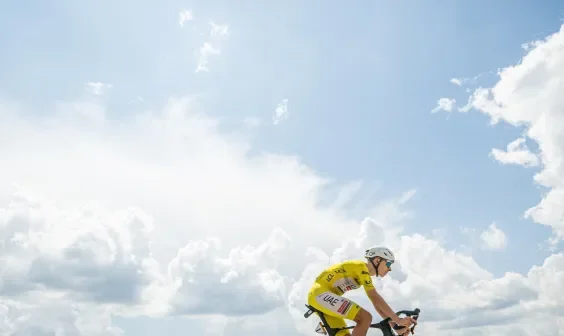
PARIS — Every story has a beginning and an end, but the best stories have worthwhile middles. Narrative stakes are established are established and then resolved. It's what happens in between that makes a story. This is where the greatest cyclist of all time currently finds himself.
Pogacar rode to his fifth Tour victory with an astonishing sense of joy. The ennui that plagued his fourth Tour win has dissolved. His greatest rival is well behind him. The yellow jersey that weighed him down now buoys him. There's nothing more for him to do as a competitor except rack up more records, a potentially paralyzing dynamic he's seemingly found a way to neutralize. Pogacar has won five Tours de France, equaling four others who were all years older than Pogacar when they won their final Tour. When I asked his director, Matxin Fernandez, what was different about this Tour, he was nearly moved to tears thinking about the accomplishment of getting to five. "Fuck, I mean, it's amazing," he grinned, apologizing for getting carried away. "It's like Hollywood. I remember watching Indurain win his fifth [in 1995] and now Tadej has done it. I'm so proud." So what was different this time around, and what lessons are there to be learned about how the rest of Pogacar's story might go?
The first and most striking sign of a new Pogacar came at the finish of Stage 2. The critical moment in Barcelona wasn't a victory, but rather an act of self-sacrifice for a teammate. The greediest winner of his generation watched as Isaac Del Toro ripped to a stage win he didn't expect, his mouth open in clear shock. After the stage, Pogacar was dubbed an honorary Mexican and took to it with more glee than I've ever seen him express.
Much attention was paid to the matter of whether or not Pogacar had given a gift for the first time in his career, though the strangest part of the finish wasn't who'd won, but rather the way Pogacar rode. As Del Toro emptied the tank and the rest of the contenders struggled to hold his wheel, there Pogacar was, breathing out of his nose and looming off to the side with an odd remove. Everyone was at their limit; Pogacar was strong enough to afford the luxury of calm, looking over as if to let anyone know that if they challenged Del Toro, he'd simply step in and win himself.
Pogacar did plenty of winning, of course, though he never needed to strain himself. He started by sprinting away from the field to win in the rainbow jersey at Les Angles on Stage 3, a finish I had the luxury of being able to watch from the barriers since fans were kept away. He's a breathtaking athlete to watch in person, even for the few seconds it takes him to power by you. Pogacar never looks like he's fighting the bike, even when putting down untouchable levels of power. The strain is only evident in the gnarled faces and faltering pedal strokes of his competitors, crumpled in the terrible gravity of Pogacar's wake.
That punchy, uphill sprint is the sort of race Pogacar's won a million times, as was his long solo win in Gavarnie-Gedre three days later. But close observers that day saw a curious modulation in the way Pogacar made his winning move. He usually rips away, puts his head down, and pounds out a pace nobody can match. This time, he waited to make his move, and did his best to bring along Del Toro as far as he possibly could. Pogacar's teamwork helped vault Del Toro into third, establishing a pattern he'd mostly adhere to for the rest of the race. Within a week, it was clear Pogacar was going to win the Tour de France and as many stages as he wanted. The question was how far he could push his young superstar teammate in the process.
Riding that way freed Pogacar from the prison of disenchantment. The difference in his post-race press conferences was striking; he was patient, and gave good answers this year, almost always about how much he loves riding with his teamates. Last year, he treated having to talk to us grubby reporters as a terrible burden, rolling his eyes, slouching in his chair, and giving the shortest answers possible. "I'm at a point where I wonder why I'm still here," he said after Stage 19 last year. "It's been three very long weeks. You're counting down the kilometers to Paris. I can't wait until it's over so I can have some fun things in my life again."
He knew the second he started the 2025 Tour that nobody could touch him, just as he knows now the only thing that can stop him from breaking every record in the sport is the exogenous shock of injury. But you can't win more than one Tour de France at a time, and they all take three weeks. Wet, miserable, dealing with a mysterious knee problem—he was still strong enough to crush the field, but he wasn't having any fun. He'd even outgrown his rivalry with Jonas Vingegaard. He was only racing against time and the concept of perfection, two opponents you can't beat. Getting bored is a logical reaction.
Pogacar was never meaningfully challenged at this year's Tour, though it wasn't without trouble. The third week began with news of a wave of late-night doping tests carried out under a somewhat confusing aegis. As the best rider in a sport that's now significantly faster than the EPO era, Pogacar naturally bears the burden of scrutiny. While adopting a guilty-until-proven-innocent framework is emotionally insulating, I don't think that's fair or justified, and all we can really see is how Pogacar has handled the extra pressure that comes with being the face of such a development. He was confident, thorough, and unequivocal the next day, rattling off a three-minute monologue about the necessity of transparency.
Week three also saw both the field and his team thinned. A remarkable stat from this year's Tour is that only Pogacar and Jordan Jegat finished in the top 10 in both 2025 and 2026. Vingegaard crashed out ahead of the Plateau de Solaison, and Florian Lipowitz binned it during the time trial one stage later. Pogacar was genuinely sad to see Vingegaard go, and there was a new, mature level of acceptance about their dwindling rivalry in the way he talked about the crash. "Maybe in the beginning we didn’t have the best relationship," he said. "But in the last two years we became good rivals, with respect, and I also think kind of friends."
That day, Pogacar gave up the second of the three wins he'd eventually cede in order to help Del Toro's pursuit of the white jersey and the Tour's final podium place. After catching the leaders and riding away with just Remco Evenepoel in tow, Pogacar rode purely as a domestique for his young teammate. Evenepoel won a three-up sprint for the stage after Del Toro couldn't capitalize on the several attacks Pogacar set him up for, though even Red Bull director Zak Dempster admitted the dynamic was more set by Pogacar than Evenepoel. "When you're riding on Pogacar's wheel," he said, "you're just waiting for him to drop a bomb on you."
Pogacar's bomb-dropping capabilities were further hampered by a wave of illness that ripped through his team. Brandon McNulty, who was also hit by a car, had to abandon, while Adam Yates, Tim Wellens, and Florian Vermeersch were severely limited. This meant Pogacar didn't have the team strength to control everything the way he did in the first two weeks, a potentially troubling state of affairs for the two showcase Alpe d'Huez stages at the end of week three. His performance on Stage 19 was an all-timer. Pogacar trailed a rugged trio of accomplished climbers by three-and-a-half minutes when he hit the bottom of the Alpe. He rode through the chaos with grim purpose, stalking them like death and eventually dispatching them in the final kilometer. He didn't even stand when he attacked.
Satisfied with what he'd done for himself, Pogacar spent the queen stage riding completely in service of Del Toro, who was trying to protect a slim lead over Paul Seixas. It turns out I was mostly correct before the Tour about the dynamic of the Seixas-Del Toro duel, only I was wrong that Del Toro would have to work for Pogacar. Instead, he had the best rider in the world patrolling the front of the race, setting tempo, and even glaring at anyone who tried to challenge him. After shredding Seixas, the pair crossed the line toegther, grinning and hitting the Torito celebration in unison.
Pogacar loved working for someone else. "Today it was an honor to ride for Isaac. I did it with pleasure," he said after the stage. "Massive respect for what all of the guys have been doing over the last three weeks. I finally experienced myself, and before I already appreciated the work of my teammates, but now it’s another level and I must say thank you to every single one of them." In other words, it took having to serve a teammate first time in his near-perfect career to get him to have some fun again.
In that answer, you can read a hint as to how Pogacar's story might end. It's still way off over the horizon, but Del Toro looks like he might become Pogacar's successor someday. That's not entirely how I read it. The camaraderie and joy of riding like a teammate, of lending some of your power and taking on some of your teammates' pain, is genuinely novel and exciting for Pogacar. He is too strong to experience such pain for himself, but by giving himself harder battles, he allows for the psychic experience of a different pressure. For a hardwired competitive freak, that must be quite the rush. Pogacar is still so much better than every rider in the world that he can race for the yellow jersey for himself and the white jersey for his teammate, and win both prizes with relative ease.
Here Pogacar is, one Tour de France away from sole possession of the all-time record, in the middle of his story, with no challengers left. His story is one of insatiability, and in riding for someone else, he found a new way to be hungry. There's something awe-inspiring in this. We are witness to a rider so skilled and a competitor so thirsty for more that he's willing to create new challenges for himself to find happiness in. With no more worlds left to conquer, Pogacar has decided to grin rather than weep.