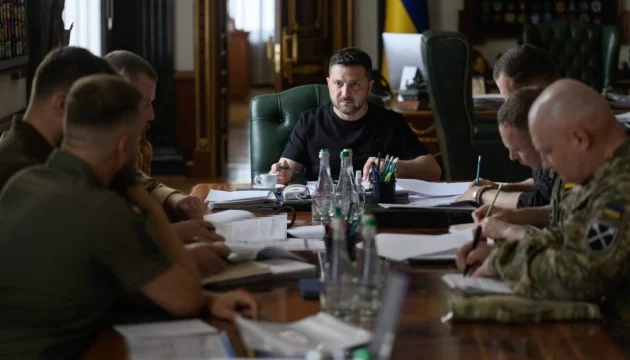
According to Ukrinform, the head of state announced this in a Telegram post.
"I held a meeting on our deep-strike operations… Today, we approved the continuation of our operations and updated the list of priority targets based on their actual impact on Russia and its ability to continue and prolong this war," Zelensky said.
He noted that Ukraine's plan for long-range sanctions against Russia over this war is being carried out in line with the set priorities. Strike ranges have already exceeded 3,000 kilometers, and Ukraine continues to expand its ability to operate at even greater distances.
The President said that Ukrainian drones are now capable of reaching targets in Russia’s Ural region, Siberia, and other areas far from Moscow. Since the beginning of this year alone, more than 1,000 strike missions have been carried out as part of the long-range campaign. The targets hit include oil facilities, critical military production sites, and strategically important Russian logistics infrastructure.
The main objective of long-range pressure, Zelensky emphasized, is to push Russia further toward diplomacy by disrupting weapons production, inflicting oil and other economic losses, and bringing this war back to its "home harbor."
"We have put forward every necessary proposal to Russia's political leadership to end this war with a dignified peace. All of our partners know what needs to be done. Our precision is effectively helping create the conditions for real diplomacy," the President said.
Read also:Civilians targeted again:
Zelenskycondemns Russian attacks on Chernihiv and Zaporizhzhia
Zelensky stressed that the strategic depth of its rear areas, which for a long time was one of Russia's advantages, is now becoming a particular problem for Russia's political and military leadership, as the vast majority of its air defense systems are concentrated around Moscow, state residences, the Crimean Bridge, and St. Petersburg.
As reported by Ukrinform, on July 24, FP-5 Flamingo cruise missiles struck the Avitek military plant in Kirov, Russia, located 1,200 kilometers from Ukraine’s border.
Photos: Office of the President of Ukraine