‘Good’ bacteria and HIIT could train Singapore corals to withstand hotter seas
AI generated
SINGAPORE – Just as some people rely on probiotic drinks and regular exercise to stay healthy, corals could also benefit from a special bacterium and a training regime to survive rising sea temperatures.
Bracing themselves for the next marine heatwave amid El Nino, Singapore scientists have identified a bacterium living in reefs that can fortify corals’ resilience to heat, potentially helping to prevent bleaching.
At the same time, researchers have been putting coral fragments through a heat-conditioning regime in aquariums to acclimatise them to higher temperatures.
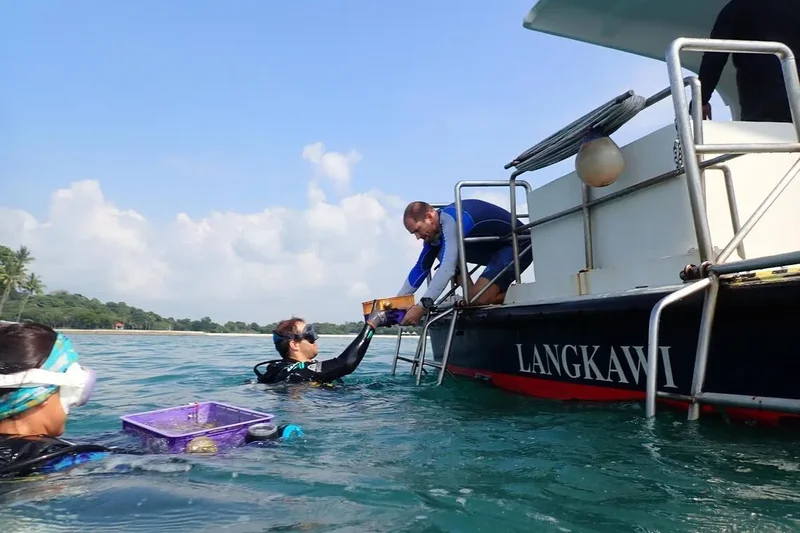
Strengthened by these methods, 160 coral fragments were transplanted into the reefs of Kusu Island and St John’s Island in late May and will remain there for a year.
Coral fragments are small pieces of living coral that can grow into new colonies.
Every two weeks, researchers will revisit the artificial reefs to keep track of the corals’ growth, survival, colour and how well they absorb sunlight to produce energy– a key indicator of the animals’ health.
They will also be monitored for any changes in their microbial communities, said Huang Danwei, an associate professor and deputy head of the NUS Lee Kong Chian Natural History Museum.
“The corals will face the warmest months of the year initially, from May to July, and potentially through the marine heatwave caused by El Nino,” he said.
Huang is overseeing the study, which is under the National Parks Board’s Marine Climate Change Science Programme.
This is part of Singapore’s quest to find solutions to address the wave of challenges climate change is bringing to the marine world.
Amid El Nino and forecasts that the phenomenon will rapidly intensify in the coming months, scientists are bracing themselves for a potential marine heatwave in 2027 that could cause mass coral bleaching – just three years after the previous El Nino killed 5 per cent of corals in Singapore.
Higher sea temperatures stress coral reefs, forcing them to expel the algae called zooxanthellae that give them their striking colours. This causes corals to bleach, or turn ash-white.
While the most well-known of coral microbes are zooxanthellae, they are not the only microscopic wonders that reside in the underwater garden. Bacteria, viruses and fungi also live on corals; some cause diseases, while others help to recycle nutrients and shield the animals from stress.
From NTU School of Biological Sciences, Rebecca Case – an associate professor and marine bacteria expert – and her team turned detective to find one microbe within the ringed plate coral species that confers protection against heat stress.
This coral species was selected as it has low susceptibility to bleaching and a strong ability to recover after it turns white.
As part of the screening process, each bacterium was isolated, and its DNA mapped to identify genes that could potentially be beneficial to corals.
Eventually, one bacterium, or probiotic, from the Roseobactereaceae family was identified as having properties that can confer heat resilience to corals.
Case’s colleague Joao Pereyra dosed coral fragments with the bacterium and raised the water temperature to test the probiotic’s effect on their survival. The stronger strains were used in the field.
Case said: “Coral fragments were submerged in a dilute wash of the bacteria for eight hours so they had time to swim to the coral and get themselves stuck to its mucus and eventually its cells and skeleton.”
Each strain differs in terms of how it sticks to the coral, so the more “sticky” ones needed to be identified, she added.
There are three ways the bacterium can make corals more resistant to warmer seas.
First, it converts sulphur-rich compounds produced by corals into a gas that can escape into the air. This gas can have a cooling effect on the atmosphere by helping clouds to form more easily and reflect some sunlight back into space.
Second, the microbes produce vitamins that stabilise heat-sensitive processes in the corals. Third, the microbes also produce antibiotics and other molecules that prevent viruses from infecting stressed corals.
Forty coral fragments were eventually treated with the bacterium before being transplanted to the reefs.
At the St John’s Island National Marine Laboratory, coral fragments have been undergoing intensive conditioning in tanks. The facility’s director, Jani Tanzil, calls it heat HIIT (high-intensity interval training) for corals.
Over four weeks, the corals are exposed to water temperatures that swing from 29 deg C – Singapore’s average sea temperature – to 32 deg C. This is higher than the surrounding waters’ average monthly maximum temperature of 30.5 deg C in the hotter months of May to June.
Senior research fellow Tanzil said: “This results in the corals being exposed to an accumulated heat load that would stress the corals, but not enough to kill them.”
The regime worked well to boost heat tolerance in the ringed plate corals, especially for the weaker fragments, she added.
Another 40 fragments in the field have undergone heat acclimatisation, while an additional 40 have been exposed to both the microbe and the HIIT. The final 40 are untreated and serve as a control.
The aim of this project is to find the optimal solution to fortify corals against a boiling sea.
Tanzil said: “All the aquarium experiments have given us confidence that these methods to boost coral resilience work in semi-controlled settings and in shorter timeframes.
“A big question is how long these methods last – what are the lasting effects of the probiotics or the HIIT treatments?”
Nearly two months in, 98 per cent of the corals are surviving, said Huang.
Three other coral species, including a cauliflower-shaped coral, are undergoing aquarium trials and will be transplanted in 2027.
Huang added that the two methods can be scaled up if the strengthened coral fragments perform better than the controls during a marine heatwave.
“In future, fragments that have undergone HIIT or microbial treatment (or both) could be transplanted to sustain natural coral populations that may face higher mortality during heat stress.
“We could develop a field-based inoculation approach to introduce the resilient microbes directly to adult coral colonies on the reef,” he said.