Most conversations about AI infrastructure focus on models, vector databases, GPUs, and retrieval pipelines. Those components are important, but during the development of an enterprise AI-assisted platform, we ran into a different problem. We needed a place to store rapidly changing project context, generated artifacts, user modifications, intermediate reasoning results, and session-level state. The challenge was not storing terabytes of information. The challenge was managing thousands of small reads and writes while keeping latency low and deployment simple. Our first instinct was to use a traditional database. That is what most software teams do. Databases are familiar, reliable, and well understood. The problem was that our workload did not behave like a typical business application. Users were continuously generating API specifications, editing artifacts, creating mock services, updating configurations, and asking AI assistants to reason over information that changed every few seconds. The amount of state was not enormous, but the frequency of updates was. That is when we started looking at RocksDB. RocksDB is often associated with storage engines, distributed systems, and high-performance infrastructure software. It is not usually the first technology people mention when discussing AI.
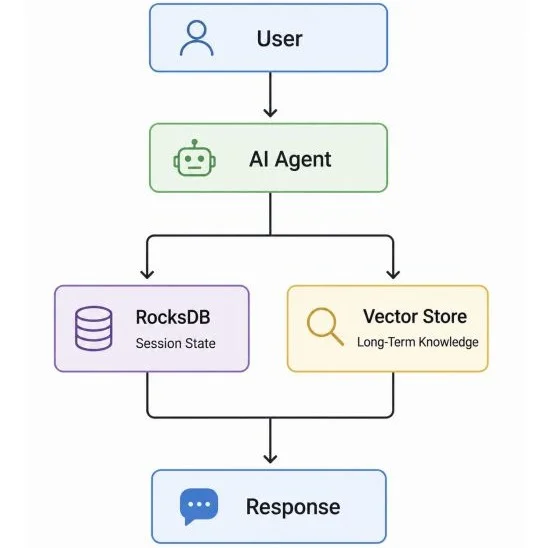
However, many AI platforms have a hidden requirement. They need a fast and efficient way to manage local state. The architecture we adopted looked similar to this:
The division of responsibility was deliberate. The vector database stored long-term organizational knowledge. RocksDB stored active session state. Keeping those concerns separate simplified both systems. One use case involved API generation. A developer would upload an OpenAPI specification and begin modifying it through a conversational interface. Every interaction produced incremental changes. The AI assistant needed immediate access to the latest version of the artifact. Writing every intermediate state to a remote database introduced unnecessary latency. Storing session state locally in RocksDB provided much faster access. A simplified example looked like this:
RocksDB db = RocksDB.open("/workspace/session1");
db.put(
    "api-spec".getBytes(),
     openApiContent.getBytes()
);
byte[] latestSpec = db.get("api-spec".getBytes());
The code is simple, but the effect was significant. Reads and writes occurred locally, allowing the AI workflow to remain responsive even during heavy editing activity. Another use case involved AI-generated test cases. During testing, the platform would generate hundreds of scenarios for a single API. Engineers frequently reviewed, modified, and regenerated those tests. Persisting every temporary version in a centralized system created unnecessary overhead. RocksDB allowed us to store those artifacts close to where processing was occurring.
db.put( "generated-tests".getBytes(), testSuiteJson.getBytes() );
As the workflow evolved, new versions simply replaced previous ones. A third use case emerged from multi-agent workflows. Different agents participated in planning, validation, generation, and review activities. Each agent produced intermediate outputs that might only exist for a few minutes. We did not want every temporary artifact becoming a permanent organizational record. RocksDB became a workspace rather than an archive.
This separation reduced complexity. Agents could exchange information through shared session storage without polluting long-term repositories. Performance was another benefit. Because RocksDB uses a Log Structured Merge Tree architecture, it handles write-heavy workloads extremely well. AI applications often generate large numbers of incremental updates rather than occasional large transactions. That pattern aligns naturally with RocksDB's design. Operational simplicity also mattered. Many enterprise AI deployments run inside Kubernetes. In our environment, each user session could have its own isolated RocksDB workspace. When the session ended, the workspace could be archived or removed. This reduced cross-user interference and simplified lifecycle management. The approach was not perfect. RocksDB is not a replacement for a relational database. It does not provide SQL queries. It does not eliminate the need for governance systems. It is not designed to replace vector search. Treating it as a universal storage solution would be a mistake. Instead, it works best as a specialized memory layer.
Think of it as the working memory of an AI system. Long-term organizational knowledge belongs elsewhere. Governance records belong elsewhere. Analytics data belongs elsewhere. RocksDB excels when information is actively changing and needs to be accessed quickly. One lesson from this experience stands out. Many organizations approach AI architecture as a model-selection exercise. In practice, the storage architecture often determines whether the system feels responsive and reliable. Users rarely ask which model generated a result. They notice when a system loses context, retrieves outdated information, or becomes slow under load. Those are often storage problems rather than model problems. As enterprise AI systems continue to evolve, I expect more teams to separate long-term knowledge from working memory. Vector databases will continue to play an important role. Traditional databases will remain essential. But there is also a place for high-performance embedded storage engines such as RocksDB. Sometimes the most valuable component in an AI architecture is not the one generating answers. It is the one quietly remembering what happened five seconds ago.