Two oil tankers carrying Saudi crude to Asia reversed course in the Red Sea on Tuesday after threats from Yemen's Iran-aligned Houthis, as a widening Middle East conflict disrupted shipping through two of the world's most critical energy chokepoints.
The U.S. military bombed targets in Iran for an 11th straight night, saying those targets included aircraft hangars and drone storage sites. Tehran residents reported hearing explosions in the early hours of Wednesday as Iran activated its air defences over the capital, Iran's semi-official Fars news agency said. Iran's state-run IRNA news agency reported that explosions rocked Bushehr, East Azerbaijan, Hamadan, Hormozgan, Khuzestan and Sistan and Baluchistan provinces.
Earlier, Iran targeted U.S. sites in Bahrain, Kuwait and Jordan, and a tanker was hit in the Strait of Hormuz at the mouth of the Gulf.
Iran said it had struck infrastructure belonging to Amazon in Bahrain, where the U.S. tech company operates a regional data centre. Amazon did not comment and Reuters could not verify the report.
The Houthis, who control northern and western Yemen, including the coast at the mouth of the Red Sea, announced a naval blockade on Saudi Arabia on Monday. This opened a potential new front in the war, which has killed thousands of people across the Gulf region since it began on Feb. 28 with U.S. and Israeli attacks on Iran.
In a letter to shippers, the Houthis threatened to attack any ships that load or discharge Saudi oil.
U.S. President Donald Trump said the Houthis had not yet shut the Bab el-Mandeb Strait, the "Gate of Tears" leading into the Red Sea, and he threatened to act against them if they did.
"If something like that happens, we take care of it," Trump said.
18 U.S. service members now killed in war
Trump also confirmed that 18 U.S. service members have been killed so far, including four in Iranian attacks on U.S. military bases in Jordan and Iraq over the last few days, in a war that is unpopular among Americans and others affected by surging global energy costs.
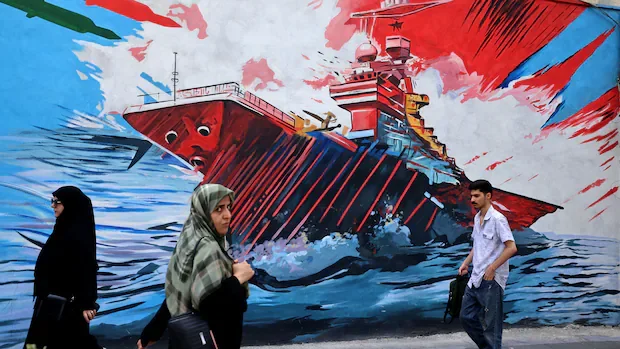
A woman walks past an anti-Trump billboard in Tehran on Tuesday. (Vahid Salemi/The Associated Press)
The Houthi announcement already appeared to be having an impact. Two tankers, which just loaded Saudi crude bound for China and India at Saudi Arabia's Red Sea port of Yanbu, made U-turns on Tuesday, heading toward the Suez Canal rather than out through the Bab el-Mandeb and toward the Indian Ocean.
With the war shutting the Strait of Hormuz leading out of the Persian Gulf, the Red Sea has served as the main alternative route out for millions of barrels of Saudi oil per day, diverted by pipeline through Yanbu.
Oil prices rose more than two per cent on Tuesday, with Brent crude hovering above $91 US a barrel and U.S. gasoline back over $4 US a gallon.
Trump renews threat to strike nuclear sites
U.S. Central Command said it had hit Iranian military command centers, maritime capabilities, missile and drone launch sites, and air defence systems in its week and a half of attacks.
WATCH \| Margaret Evans crosses into Iran:
Reporting from inside Iran
In June, CBC senior international correspondent Margaret Evans and videographer Lyza Sale were granted rare access to report from inside Iran. Where they could travel and what they could report on was tightly controlled, but Iranian authorities had no editorial influence on the content and were not given access to CBC News material before it was published.
On Tuesday, Trump renewed his threats to attack Iran's nuclear facilities at Natanz "pretty soon." In June 2025 he said the facility, which is buried in a mountain range, had been "totally obliterated" after the U.S. military bombed it that month. Iran promised it would retaliate.
Fifty civilians have been killed and 500 wounded in the recent U.S. strikes on Iran, a health ministry official said.
U.S. Secretary of War Pete Hegseth told senators during a hearing that the conflict, which Congress has not authorized, had cost $37.5 billion US so far, and he asked them to approve another $70 billion US in "supplemental" funds, in part to replenish depleted missile supplies.
Testing limits of escalation
The U.S. and Iran have been testing the limits of escalation since the collapse this month of a weeks-old interim ceasefire agreement.
Iran launched renewed attacks on Tuesday across the Persian Gulf, where recent strikes on desalination facilities have raised concerns about water shortages in desert countries that depend almost entirely on removing salt from sea water for potable supplies.
Vessels in the Strait of Hormuz on Tuesday. (Reuters)
Kuwait said it was responding to a drone and missile attack on Tuesday. Kuwait has reported attacks that have damaged power generation in recent days at plants that also produce fresh water.
Iranian state media reported that Iranian forces also launched attacks on U.S. military facilities in Bahrain, Kuwait and Jordan.
The maritime security agency UKMTO said on Tuesday a tanker in the Strait of Hormuz reported being struck by a projectile, forcing its crew to abandon the vessel and board a lifeboat.
Iran's Revolutionary Guards also said two oil tankers caught fire after explosions while attempting to transit the southern shipping lane of the strait.
The U.S. has encouraged ships to use the southern lane. Iran demands they use an alternative northern route near its coast instead, where it eventually aims to charge fees for transit.
Throughout the war, Saudi Arabia partially escaped the shipping disruption by piping oil to Yanbu on the Red Sea instead. But a full closure of that alternative route by the Houthis could further reduce global oil supply as it would leave most Saudi oil exports trapped.