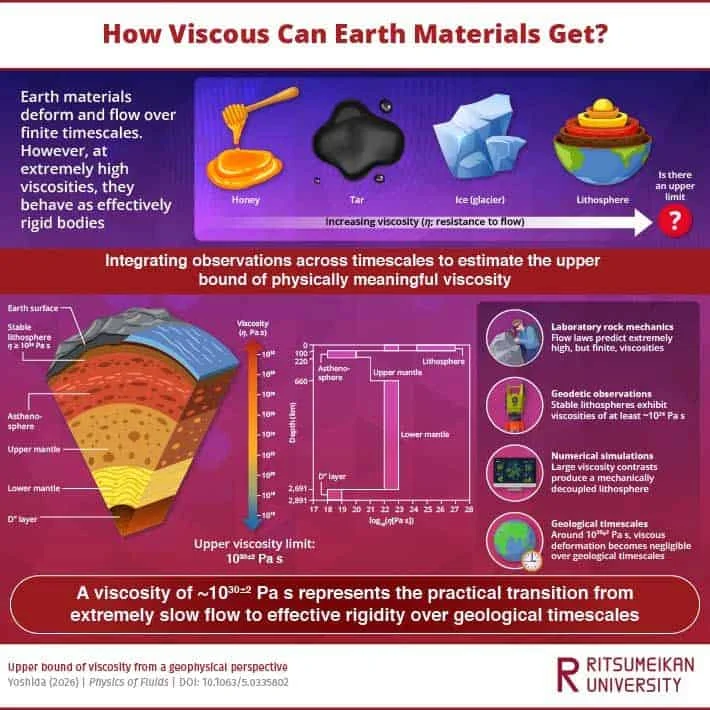
At what point does a material become so viscous that it cannot flow? The question is a tricky one because some apparently solid objects are not as rigid as they seem. A glacier, for example, may look immobile, but when viewed over long-enough timescales, its slow flow becomes apparent.
Now, thanks to satellite observations of tectonic plate deformations as well as physical and geodynamic modelling, geophysicist Masaki Yoshida of Ritsumeikan University, Japan, claims to have found an answer. The upper limit for viscosity, he says, is 1028 Pascal-seconds (Pa s), and the new boundary could yield insights into Earth’s geodynamics.
Viscosity is a measure of a material’s resistance to flow. Gases such as air and hydrogen have a viscosity of 10-5 Pa s at room temperature; the viscosity of liquid water is 10-3 Pa s; and glaciers have a viscosity of 1013-1017 Pa s depending on factors such as temperature, stress and microstructure. At the upper end, Yoshida says that the long-held view, based on rock deformation experiments, is that the viscosity of tectonic plates at the Earth’s surface (where temperatures are relatively low) is 1070 Pa s.
This number is so high that for most purposes, it might as well be infinite, meaning that these plates should behave like rigid bodies. But this accepted wisdom poses a problem: “I realized that I was unable to explain to my students why plates with such high viscosity bend and subduct into the mantle,” Yoshida tells Physics World.
Observed flow and flow parameters
To determine the “effective viscosity” of rock under the temperature and pressure conditions on Earth, Yoshida began by analysing satellite data showing tectonic plate deformations over tens to hundreds of kilometres. Using these data, he could ascertain strain rates – deformations in the plate over a given distance and time – as small as 10-9 per year.
By comparing regions under similar stress levels, Yoshida obtained an indication of comparative effective viscosity, which depends on factors such as temperature, composition, grain size, water content, stress state, deformation mechanism and structural heterogeneity. After accounting for assumed stresses, these observations suggested that observed viscosity maxes out at 1028 Pa s.
Yoshida also considered empirical descriptions for the viscosity of various minerals under different types of deformation using parameters from the literature. These yielded a similar upper bound of 1030+/-2 Pa s. Numerical simulations further corroborated this value as a viscosity maximum.
Importance of an upper bound
Taras Gerya, a geodynamicist at ETH Zürich in Switzerland who was not involved in the study, calls Yoshida’s work “an interesting discussion on the significance of viscous deformation for the lithosphere”. However, he notes that, given a realistic stress level of 30 MPa, the maximum viscosity identified gives a cumulative viscous deformation of just 8.5 m for the full 4.5 billion years of Earth’s history. That, he says, is “1000 times smaller than elastic deformation for the same deviatoric stress level”.
While pinning down an exact magnitude for such high viscosities may not greatly change models of deformation, Yoshida thinks that delineating an upper bound may nevertheless improve our understanding of the physical quantities that characterize the behaviour of matter. He also points out that thermal conductivity, which indicates how easily heat is transferred in materials, ranges over only about five orders of magnitude from water to diamond, making it “surprising that viscosity spans a range of about 35 orders of magnitude”.
Fluids only get so runny as physicists put a universal lower limit on viscosity
Yoshida is keen to explore other implications of these results. During the first hundreds of millions of years of Earth’s existence, when it formed and rapidly cooled, he explains that it was covered by a single rigid lid known as the lithosphere. Plate boundaries and motion didn’t emerge until later, approximately 4 billion years ago. “I believe that the question of why plate motion began after the rigid lid formed is closely related to the results of this study,” he says.
The research is published in Physics of Fluids.