MOSCOW, July 27. /TASS/. Russia rules out freezing the Ukraine conflict; Tehran and Washington suddenly halt exchanges of strikes; and support for Ukraine gradually declines in EU countries. These stories topped Monday’s newspaper headlines across Russia.
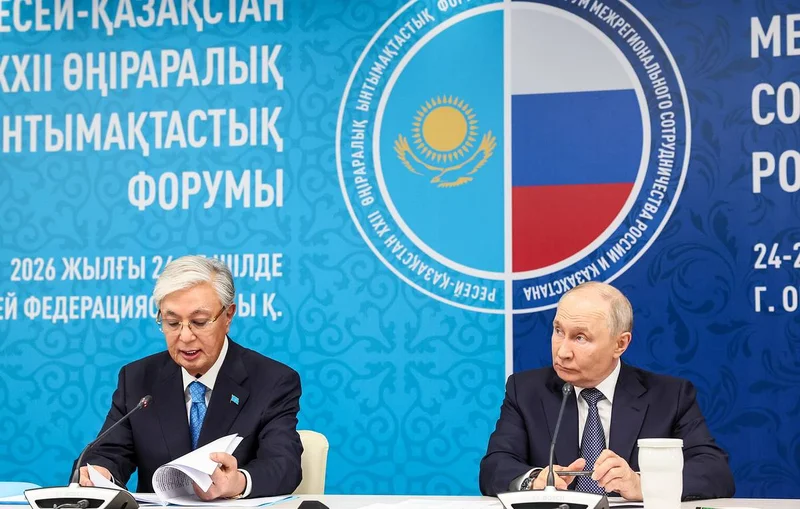
Kiev’s position makes freezing the Ukraine conflict impossible, Kremlin Spokesman Dmitry Peskov said, commenting on a proposal put forward by Kazakhstan's president during a meeting with Russian leader Vladimir Putin, where Kassym-Jomart Tokayev suggested a freeze in the fighting based on the Istanbul agreements, Vedomosti writes.
Referring to an "Istanbul formula 2.0," Tokayev seemed to be alluding to a framework based on the agreements drafted during Russia-Ukraine talks in Turkey in the spring of 2022. Under those proposals, Russia sought Ukraine's neutrality, its abandonment of plans to join NATO, recognition of Russian as an official language, and an end to persecution of the canonical Ukrainian Orthodox Church. In return, Ukraine was supposed to receive security guarantees, particularly from the permanent members of the UN Security Council (the United States, China, Britain and France), while Moscow would not oppose Kiev's bid for membership in the European Union.
Moscow has never ruled out returning to the 2022 Istanbul accords, while emphasizing the need to take the changed circumstances into account. It’s clear that Tokayev strongly disapproves of Ukraine's strikes on the Caspian Pipeline Consortium (CPC), Kazakhstan's main oil export route, Nikolay Silayev, leading researcher with the Institute of International Studies at Moscow State Institute of International Relations, pointed out. This explains the timing of Tokayev’s proposal, as Kazakhstan fears a complete suspension of oil exports via the CPC.
Moscow's response to Tokayev's proposal has been "restrained but negative" because such a scenario would not resolve any of the underlying issues, Russia in Global Affairs Editor-in-Chief Fyodor Lukyanov said. The expert sees little realistic prospect of returning to the 2022 Istanbul accords because the situation has changed dramatically since then. Reaching a package agreement based on Tokayev’s proposal, which would address Russia’s concerns and the root causes of the conflict, is becoming increasingly difficult amid intensified military cooperation between Kiev and Europe, Lukyanov concluded.
Media: Iran, US suddenly halt exchanges of strikes
For the first time since tensions between Washington and Tehran escalated again on July 8, the US military did not carry out a single airstrike on Iran over the weekend. Tehran, in turn, refrained from targeting US facilities in Arab countries, Vedomosti reports.
The pause in US-Iran military confrontation is likely to be short-lived, Alexey Yurk, a researcher with the Center for Middle East Studies under the Russian Academy of Sciences’ Institute of World Economy and International Relations, noted. He pointed out that Western media outlets and think tanks have warned since the outbreak of the war in February that the United States could face ammunition shortages. The concern may be valid to some extent as US defense companies received relatively few ammunition orders in previous decades because the Pentagon was not preparing for a big war, the analyst explained.
The United States is unable to rapidly increase production of ammunition for its air defense systems, while building up the missile stocks that have since been spent, particularly in Ukraine, took a long time, Igor Shkrobtak, senior researcher with the Department of Military and Political Studies at the Russian Academy of Sciences’ Institute for US and Canadian Studies, points out. That said, one of the main reasons why Washington is in no rush to resume a large-scale military operation against Iran is its shortage of Patriot missiles, he added.
However, Yegor Lidovskoy, director of the Hugo Chavez Latin American Center, cautioned against jumping to conclusions in a conversation with Izvestia. Similar assessments that the United States was running out of steam had been voiced before the first ceasefire was announced, but it was followed by a new escalation. In Lidovskoy’s view, US President Donald Trump has little room for maneuver. He cannot suddenly shift to negotiations without losing what little domestic support he still has, while Washington lacks the resources for a prolonged war, let alone a ground operation. This is why the expert considers a concentrated airstrike a highly likely scenario.
Even if the parties return to the negotiating table, no firm agreements should be expected. Tehran has too many levers at its disposal, with the closure of the Strait of Hormuz being the most effective tool Iran plans to continue using. Under such circumstances, any agreement would be fragile, while prospects for an early and lasting peace in the Middle East remain uncertain.
Greece’s parliamentary party Greek Solution has warned the government against transferring air defense systems to Kiev, the party’s leader Kyriakos Velopoulos told Izvestia. Earlier reports said that Ukraine had requested several Patriot systems and up to 200 missiles from Greece. Kiev is also seeking to obtain air defense systems from Spain while working to launch domestic production. Experts believe it will be difficult for Ukraine to secure additional air defense systems, as they are in demand both in Europe and the Middle East. Besides, overall support for Ukraine has been dwindling in EU countries.
Earlier, Greece provided Ukraine with Sea Sparrow and Crotale NG short-range missiles, sending them when they were close to expiration. Additional deliveries to Kiev could affect Greece’s ability to control its own airspace, a politically sensitive matter for Athens amid tense relations with Turkey, Tigran Meloyan, an analyst at the Higher School of Economics, said.
The European Union and NATO could still force Greece to transfer some of its air defense systems to Ukraine in exchange for certain preferences. Earlier, Brussels managed to persuade Athens to lift its veto on the 21st package of sanctions against Russia by offering incentives related to Russian liquefied natural gas supplies.
The Greek opposition’s efforts to block weapons supplies to Ukraine are just one of many signs of growing frustration over the rising costs of supporting Kiev. Even officials in an increasing number of countries have begun questioning spending on military assistance for Kiev. Hungary, Slovakia and the Czech Republic have refused to participate in EU and NATO aid packages. Bulgaria’s new government has ended military assistance to Ukraine and withdrawn from the Coalition of the Willing.
Political scientist Denis Denisov points out that opinion polls have shown a clear downward trend in public support for Ukraine in most European countries. However, this is unlikely to prevent national governments from continuing their support, as some European elites remain unwilling to engage in dialogue with Russia.
Escalating tensions in the Strait of Hormuz are forcing Middle Eastern exporters to step up efforts to create alternative routes for hydrocarbon supplies. Regional governments and oil and gas companies are revisiting projects that had previously been shelved for decades, RBC notes.
The first step in these efforts was an agreement between Baghdad and Damascus to restore an oil pipeline linking northern Iraq with a Syrian port on the Mediterranean coast, which had been damaged during the US invasion of Iraq in 2003. Saudi Arabia has brought its East-West pipeline to full capacity and is considering a further expansion. The United Arab Emirates plans to launch a second oil pipeline to the port of Fujairah on the Gulf of Oman by 2027.
In the current situation, pipelines are viewed as an insurance mechanism that could help maintain oil exports in the event of shipping disruptions, Murad Sadygzade, president of the Center for Middle East Research and visiting lecturer at the Higher School of Economics’ Faculty of World Economy and International Affairs, said.
For Qatar, meanwhile, no viable alternatives for moving its liquefied natural gas (LNG) supplies are on the table. According to Freedom Finance leading analyst Natalya Milchakova, onshore gas pipelines won’t be able to replace Qatari LNG deliveries in the foreseeable future.
In the short term, the Strait of Hormuz crisis is benefiting Russia as oil prices rise and demand for oil and petroleum products grows in India and China, Sadygzade pointed out. However, in the long term, the construction of new pipelines in the Middle East could intensify competition in certain markets, including Turkey and Southern Europe. Still, Russia retains structural advantages in oil supplies, including well-established logistics networks, a flexible pricing policy and strong trade ties, the expert added.
"Russia is likely to continue using a combination of pricing and logistics tools in Asian markets to maintain its significant market share, even if competition from Saudi Arabia and the UAE increases. In addition, the expansion of export infrastructure in the Middle East would not necessarily lead to a sharp increase in production, but rather strengthen the resilience of existing supply flows," the analyst concluded.
Media: Industry analysts expect strong grain harvest in Russia
Russia is expected to harvest 139 million metric tons of grain this year, Rossiyskaya Gazeta reports, citing Dmitry Rylko, director general of the Institute for Agricultural Market Studies. The harvest will allow the country to export 58.5 million tons of grain during the 2026-2027 agricultural year. Given current shipping difficulties in the Sea of Azov, the analyst expects export flows to be redirected to ports on the Black Sea and the Baltic Sea.
Russia remains the world’s largest wheat exporter. In addition, Russian farmers have been increasingly expanding the cultivation of oilseeds. According to Rylko, Russia has become one of the world’s leading producers and exporters of rapeseed in just a few years. Besides, the country has joined the ranks of major sunflower oil exporters. The pulse crop sector is also growing rapidly. This is particularly true for peas, exports of which have increased significantly in recent years amid strong demand in Asia, especially China.
Meanwhile, Ukrainian and Russian strikes on port infrastructure are driving grain prices higher on global exchanges, Nezavisimaya Gazeta writes. Wheat prices went up by 15% in the past month alone due to concerns about global grain supplies.
The wheat market shows that geopolitical developments can have a significant impact on the market situation, according to analysts at CRM AgriCommodities. "The Black Sea is as important for the wheat market as the Strait of Hormuz is for oil supplies. Serious disruptions there quickly begin to affect global prices," Andrey Sizov, director of the SovEcon think tank, said.
Kirill Yermolenko, head of the Samara Region’s agriculture committee at the Opora Rossii platform for small and medium-sized businesses, believes that rising global prices and strong demand for grain amid supply shortages are creating opportunities for Russian farmers to boost export revenues and improve profitability, provided logistical challenges are resolved.
TASS is not responsible for the material quoted in these press reviews