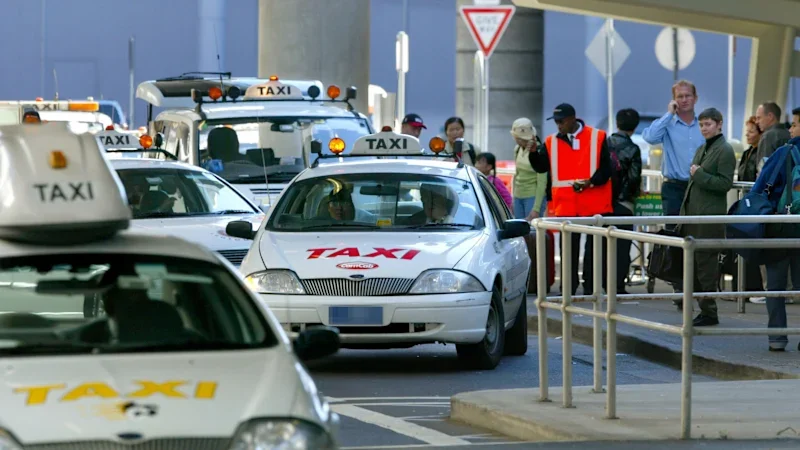
A “brazen” driver who was caught repeatedly operating illegal taxi rides and touting for airport passengers has been hit with $32,400 in fines, as authorities continue cracking down on a wave of rogue drivers that sprang up when rideshare apps were legalised.
The New South Wales local court convicted Sydney man, Omar Alfaouri, of multiple breaches of the laws that govern the taxi and rideshare industry, after it found he unlawfully solicited customers and provided passenger services when he was not authorised to do so.
The driver’s behaviour pre-dates the trial of a flat $60 fare for CBD-bound trips from Sydney Airport the state government introduced in November last year, the latest attempt to weed out a spate reports of drivers refusing to use their meters, demanding exorbitant up-front fares and refusing short trips entirely.
In December 2023, Alfaouri had been a registered taxi driver working for an authorised provider or network when he was first found to have approached passengers to secure them as customers, the NSW Point to Point Commissioner, the enforcing agency, said.
He touted for passengers at the airport again in September 2024, the court found.
From December 2024, the NSW government introduced a “two strikes and you’re out” policy, whereby drivers convicted of fare-related offences twice were disqualified from driving a taxi or rideshare.
Alfaouri appears to have continued operating taxi services despite disciplinary action after his first two offences.
Between March and August 2025, he was found to have touted or solicited passengers for rides a further five times.
Additionally, he was convicted of three offences related to providing taxi services when not authorised. This included one initial notice as well as two further instances, a pattern of “serious defiance” of prohibition notices which the acting Point to Point commissioner Kate Timbs described as “brazen and dangerous”.
“Passengers have a right to lawful and safe point to point transport services, particularly in busy places like Sydney Airport where visitors may be unfamiliar with local transport arrangements,” Timbs said.
“Illegal passenger touting and unauthorised services undermine the protections built into the regulated transport system and put passengers at risk. This result makes clear that this conduct will not be tolerated,” she said.
The court fined him $22,400 related to 10 offences, as well as $10,000 in costs related to the proceedings.
Alfaouri’s first infringement came roughly one year into the NSW government’s crackdown on non-compliant drivers, which began by launching a reporting hotline for customers to dob in offending cabbies.
Governments in NSW and Victoria deregulated their taxi industries in 2017 as laws were eased and broadened to include rideshare apps such as Uber. It effectively cut the cost of holding taxi license plates from more than $20,000 to just $160 and $56 a year respectively.
While cabs were still required to offer meters on rank and hail rides, critics say that deregulation so significantly broadened the pool of registered drivers that enforcement to ensure compliance suffered.
Additionally, industry leaders say the widespread adoption of apps such as Uber and public acceptance of inflated surge pricing at busy periods and around significant events, emboldened taxi drivers to refuse to turn on their meters, claim they didn’t work, demand fares that matched surge prices on apps, or leave their cars and tout for rides, as Alfaouri was found to have done.
In addition to introducing the hotline, the two strikes rule, deploying plain clothes compliance officers, hefty fines and trialling its $60 fare cap, the NSW government has also introduced a driver dashboard which allows taxi network employers to see any fare-related infringements and convictions recorded against a driver in the state.
NSW Taxi Council chief executive Nick Abrahim welcomed the convictions and court-ordered fines against Alfaouri, but said the industry was “hungry to lift standards to another level”.
Abrahim said that while the introduction of the dashboard helped, it crucially does not record complaints against a driver, which may have been lodged through the reporting hotline. This means that if a taxi network sacks a driver over repeated complaints which don’t escalate to convictions, they can approach a new network to join which will have no access to the complaint data.
“There’s nothing to stop a bad egg flying under the radar and the next network won’t have a clue,” Abrahim said.
Abrahim also warned that dodgy drivers were tampering with meters and payment terminals to overcharge passengers.
The Business Briefing newsletter delivers major stories, exclusive coverage and expert opinion. Sign up to get it every weekday morning*. *