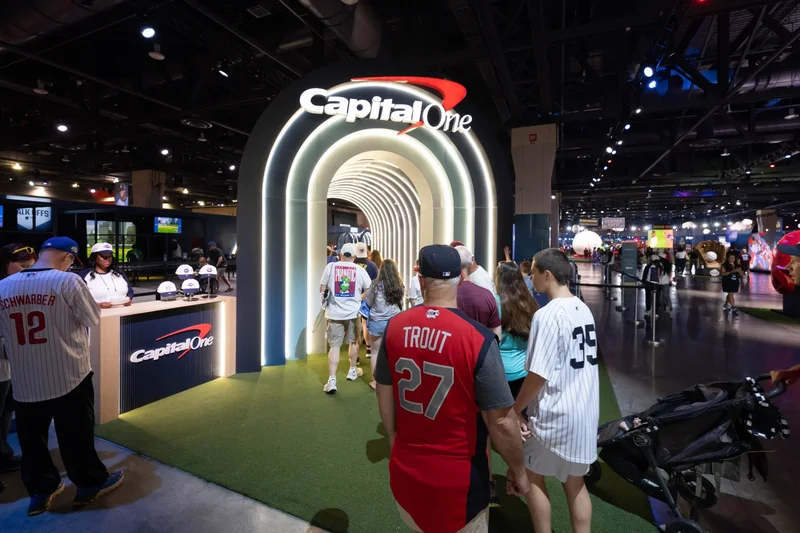
Good morning. Sports sponsorships have evolved far beyond logo placement. For companies like Capital One, this includes using exclusive experiences and cardholder perks to turn fans into long-term customers.
During Major League Baseball’s All-Star Week in Philadelphia, I spent the day at Capital One’s All-Star Village, where the company took over roughly 500,000 square feet at the Pennsylvania Convention Center with activations ranging from youth baseball drills to early access for Capital One cardholders and premium experiences for Venture X Business customers. The festival atmosphere—complete with food vendors, player tributes, and photo ops with mascots—helped draw 111,616 attendees over the four-day period, July 11–14, the event’s highest level since 2022, when it was held in Los Angeles, according to MLB.
Capital One (No. 63 on the Fortune 500) became MLB’s official bank and credit card partner in 2022. The company has positioned the sponsorship as a long-duration customer acquisition asset: tying card perks directly to MLB experiences and mapping fan journeys into customer lifetime value models. That’s the risk-reward calculus behind one of the sector’s biggest marketing bets—and what it reveals about the next phase of competition in consumer credit. I spoke with Capital One and MLB executives about the partnership. You can read more here.
The sponsorship strategy comes as Capital One integrates Discover Financial Services and reports stronger-than-expected financial results, giving investors a clearer view of how the company is deploying capital to drive long-term growth. For Q2, Capital One posted adjusted diluted EPS of $5.81, well above Wall Street expectations, while reported diluted EPS of $4.73 also topped estimates. Revenue came in at $15.85 billion, slightly above analyst forecasts, supported by solid top-line growth, strong credit performance, and lower provisions for credit losses.
Capital One completed its acquisition of Discover in May. About 50% of new Discover accounts and loans are now being booked on Capital One’s platform, CEO Richard Fairbank said on the July 21 earnings call. The company expects Discover to be fully on its tech stack for new originations by the end of the third quarter.
Sheryl Estrada
sheryl.estrada@fortune.com
Leaderboard
Alan Khalili was appointed CFO of Sidus Space, Inc. (Nasdaq: SIDU), a space and defense technology company, effective July 27. Khalili succeeds John Burke, who served as interim CFO. Khalili brings more than two decades of executive financial leadership experience. His career has ranged from investment banking and public accounting to co-founding a space-based global aviation-surveillance data platform and serving as a public-company CFO.
Mike Houli was appointed CFO of Mopec Group, a provider of pathology and anatomy equipment, technology, and consumable solutions. Houli brings nearly 20 years of finance leadership experience. Most recently, he served as SVP of finance at Parts Authority. Before that, he served as VP of finance at FreshEdge. Earlier in his career, Houli held roles at BorgWarner and General Electric.
Big Deal
Bank of America Institute finds that U.S. consumers are once again prioritizing value, with spending at discount apparel retailers and value grocers accelerating in early 2026, according to internal card data.
Higher-income households still account for a disproportionate share of overall retail spending, but lower-income households represent a larger share of spending at discount clothiers and value grocery stores and are gaining share in those segments. Lower-income families’ wages have kept pace with inflation better than before the pandemic, yet they are “trading down” the most—showing spending at discount apparel stores growing about five times faster than among higher-income households so far in 2026.
Going deeper
"Can Apple’s incoming CEO bring back the product design mojo of the Steve Jobs era?" is a Fortune feature article by Sebastian Herrera.
Herrera writes: "By the numbers, Tim Cook’s tenure has been enormously successful. Annual revenue has grown by more than $300 billion since he became CEO in 2011, and profits have more than quadrupled. Few companies, if any, top Apple at building elite hardware fast with a sturdy supply chain, and it remains a gold standard in consumer products. Cook inherited a company reliant on one or two big bets at a time and turned it into one of the world’s most operationally disciplined businesses. But the experts interviewed by Fortune argue it has come at a cost." Read more here.
Overheard
"Whoever controls the money controls the winners. You’ve got to soak up as much money as you can so there isn’t as much money available to other players.”
—Luke Rahbari, CEO of Equity Armor Investments, told Fortune about the increasingly competitive nature of raising and allocating capital for AI. Read more in the article, "Amazon and Microsoft are spending $400 billion on AI—and investors are low on patience."
Sign up here.