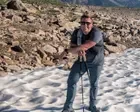
A Montana man walked 10 miles to safety with a trekking pole speared through his torso after a fall during a hiking expedition on the state’s highest mountain.
David Cifaldi slipped on rocks close to the summit of the 12,803ft (3,902 meters) Granite Peak during the hike on 20 July with two friends. He fell on one of his two poles, and “by the time I rolled over, I kind of knew something wasn’t right”, he told CBS news affiliate KVTQ.
The pole had pierced him in the side below his left arm, pushed out through his lower back, and only narrowly missed vital organs.
“Through my skin, I could feel the trekking pole,” he said. “I knew it wasn’t deep, and I knew I could take deep breaths.”
An emergency room nurse trained in wound care, Cifaldi said his medical background took over, and he and his friends made the decision to hike for six and a half hours along the route they had climbed, after alerting authorities using a satellite communicator.
“I think my nurse brain clicked on,” he said in a separate interview with Montana’s Local 12 news station.
“As soon as I was able to self-assess and establish that this was not life-threatening right now, I was pretty convinced I was going to get off that mountain under my own power.”
Cifaldi was taken to a local clinic after reaching the trailhead – then driven two hours by his friends to a hospital in Billings, where surgeons carefully removed the pole.
“I feel very lucky,” he said. “A couple inches the other way and this would be a different story.”
Cifaldi and his friends, Jesse Ross and Brad Reich, had set off at 3.30am to climb the mountain, which he said was a long-held ambition. They were about 1,000ft from the summit when the accident happened.
One of the friends walked behind Cifaldi to make sure he was steady on the rugged terrain back down while the other walked ahead to warn oncoming hikers.
“There’s families, and he … had us hike ahead and warn people so young kids didn’t have to see such a gnarly wound,” Ross told KVTQ. “Just so selfless.”
Ross expanded on the episode in an online fundraiser to pay for Cifaldi’s medical bills – and a new hiking vest.
“He self-assessed calmly: no bleeding, full feeling, no lightheadedness, nothing vital hit, and the pole stable in place,” he wrote.
“Given his condition, he made the call to self-rescue rather than wait for extraction – hiking 10 miles back to the trailhead with a trekking pole still through his body. [He] reached the trailhead entirely under his own power – never once complaining, staying in remarkably high spirits.”
When fully healed, Cifaldi said, the friends plan to attempt to reach the summit again.
Granite Peak’s peak is recorded in various places as between 12,799ft and 13,807ft. It was conquered in 1923, and only 17 climbers are known to have made it to the summit between then and 1953.
The mountain in the Beartooth range was the site of one of climbing’s greatest mysteries: the disappearance of Ernest Bruffey, 38, during a solo expedition in August 1959, the day an earthquake killed 28 people in Montana.
Human remains and a weathered boot believed to belong to Bruffey were found in 2000 by a group of six friends, one of whom had researched his disappearance.