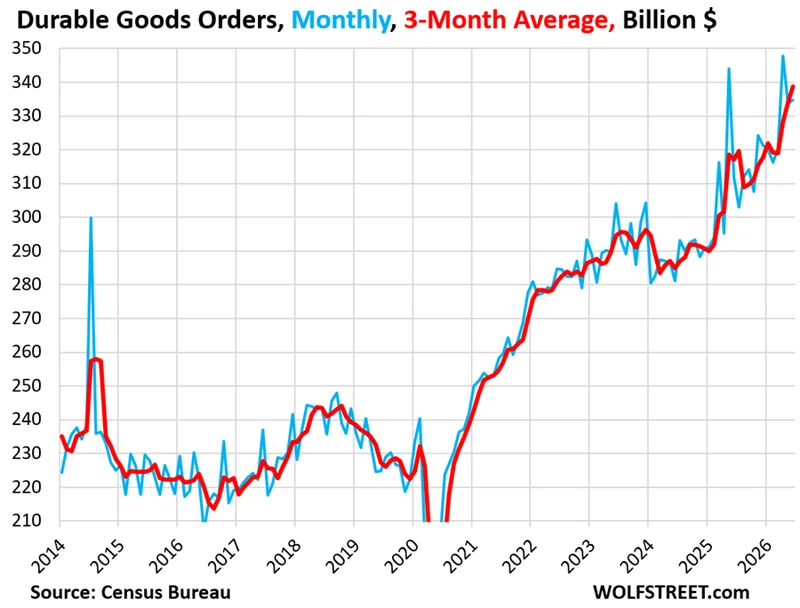
Orders for computer & electronic products; electrical equipment & components; machinery incl. power generation equipment; fabricated metals products; and core capital goods – all surged.
By Wolf Richter for WOLF STREET.
Total orders for durable goods received by manufacturers in the US, including aircraft and defense, ticked up by 0.3% seasonally adjusted in June from May (blue line). Year-over-year, not seasonally adjusted, total orders jumped by 8.9%, to $360 billion, according to data from the Census Bureau today.
The three-month average, seasonally adjusted, which irons out some of the month-to-month squiggles, spiked by 1.4% in June from May and was up by 6.9% year-over-year (red line).
But this includes orders for aircraft and defense. When Boeing receives an order for 113 jet aircraft in one month – as it did in June which will be reflected in durable goods orders over the next months – it pushes up durable goods orders by billions of dollars. But the following months, Boeing might not receive any big orders, which will push down durable goods orders. So in a moment, we’ll look at categories of products that are needed for data centers, and we can see the effects of the massive investment surge.
Where the AI data center investment boom shows up:
Orders for computer and electronic products spiked by 3.1% in June from May and by 16.7% year-over-year, to a record $31.1 billion. This includes orders for semiconductors at US-located semiconductor fabs:
Industries in computer and electronic products manufacturing (NAICS 334) consist of:
- Computer and Peripheral Equipment Manufacturing
- Communications Equipment Manufacturing
- Audio and Video Equipment Manufacturing
- Semiconductor and Other Electronic Component Manufacturing
- Navigational, Measuring, Electromedical, and Control Instruments Manufacturing
- Manufacturing and Reproducing Magnetic and Optical Media
Orders for electrical equipment, components, and appliances, which includes some of the electrical equipment needed in data centers, rose by 0.9% in June from May and by 6.7% year-over-year to $18.6 billion.
Industries in Electrical Equipment, Appliance, and Component Manufacturing (North American Industry Classification System, NAICS, code 335) consist of:
- Electric Lighting Equipment Manufacturing
- Electrical Equipment Manufacturing
- Other Electrical Equipment and Component Manufacturing
- Household Appliance Manufacturing
Orders for machinery, after a huge spike in May, was unchanged in June, and spiked by 14.4% year-over-year, to $43.7 billion. This includes power generation and transmission equipment to power data centers, HVAC equipment for data centers, etc.
Industries in Machinery Manufacturing (NAICS 333) consist of:
- Engine, Turbine, and Power Transmission Equipment Manufacturing
- Ventilation, Heating, Air-Conditioning, and Commercial Refrigeration Equipment Manufacturing
- Agriculture, Construction, and Mining Machinery Manufacturing
- Industrial Machinery Manufacturing
- Commercial and Service Industry Machinery Manufacturing
- Metalworking Machinery Manufacturing
- Other General Purpose Machinery Manufacturing
Orders for fabricated metal products dipped in June from May to $45.2 billion, but were up by 10.6% year-over-year.
Industries in the Fabricated Metal Product Manufacturing category (NAICS 332) use processes such as forging, stamping, bending, forming, machining, welding, and assembling metals into intermediate or end products (other than machinery, computers and electronics, and metal furniture).
Core capital goods (nondefense capital goods less aircraft) jumped by 0.8% month-to-month and by 12.5% year-over-year, to $85.1 billion.
This category includes some but not all of the above products, plus other products that are not included above, such as heavy trucks, railroad rolling stock, and ships.
“Orders” are an early indicator of future economic activity. It may take months before orders emerge from the backlog and become actual economic activity of production, sales, and investment.
This demand pushed up prices, and inflation played a role: The demand from the data center investment boom, especially for electronic products and machinery, was in part responsible for driving up prices of affected products.
The Producer Price Index (PPI) for “core” goods – a relevant inflation measure here – rose by 0.2% in June from May, after the spikes in the prior two months, and was up by 5.1% year-over-year (my analysis of PPI):
In case you missed it: AI May Not Cause Total Jobs Armageddon Afterall: Google Reports on How AI Is Being Used at Work
Enjoy reading WOLF STREET and want to support it? You can donate. I appreciate it immensely. Click on the mug to find out how: