Apple TV built its most beloved comedy on the strength of one idea: belief. Three years after Ted Lasso seemed to close the book for good, the show is back on August 5 with its biggest tonal swing yet, moving Coach Lasso from the men's Premier League pitch to a second-division women's football club. But the more interesting story right now isn't what happens on screen. It's what Apple has been doing off screen, and it may be the smartest marketing case study of the year.
Instead of leaning on nostalgia alone, Apple has built a rollout around two real-world engines: the explosive growth of women's soccer and the 2026 FIFA World Cup landing on home soil. Both moves reveal a studio that understands its show is no longer just a comedy people quote. It's a cultural asset that can be plugged directly into the sports calendar.
The women's soccer bet is not a subplot, it's a strategy
When Apple announced in January that Season 4 would center on Ted coaching Richmond's newly launched women's team, the framing mattered as much as the plot point itself. This wasn't billed as a spinoff gimmick. It was positioned as a continuation of a story Keeley Jones started pitching back in the Season 3 finale, giving the pivot narrative legitimacy rather than the whiff of a franchise scrambling for a new angle.
Apple then did something smarter than any billboard campaign could: it went to the real infrastructure of the women's game. A significant portion of Season 4 was filmed in and around Kansas City, including scenes shot inside CPKC Stadium, home of the NWSL's Kansas City Current and the first stadium in the world built specifically for a women's professional club. That's not a coincidence. It's a studio choosing a location that carries its own symbolism, a fictional women's club being born on screen inside the literal proof that women's soccer infrastructure has arrived in real life.
That symbolism became an activation on July 11, when Apple TV and the Kansas City Current co-hosted "Ted Lasso Night" at CPKC Stadium. Cast appearances, limited-edition merchandise, and giveaways fed directly into an international soccer watch party held on the same night, blending three audiences at once: existing Lasso fans, NWSL loyalists, and casual World Cup viewers who happened to be in the building. It's a rare marketing move that doesn't ask any of those groups to travel outside their own interest to find the others.
What's notable is what Apple has not done. There is no reported league-wide NWSL partnership, and nothing yet connecting the campaign to England's Women's Super League, despite the show being set in English football. The bet so far is hyper-local and symbolic rather than broad. Whether that widens before premiere, or whether real players from the women's game get folded into the show itself the way Thierry Henry and Pep Guardiola cameoed in men's-focused seasons, is the open question worth watching.
The World Cup did the heavy lifting Apple couldn't buy
If the women's soccer angle is about credibility, the World Cup angle is about reach. Apple timed Season 4's marketing to land directly inside the biggest surge of soccer attention the United States sees in a generation, the 2026 tournament co-hosted across the U.S., Mexico, and Canada.
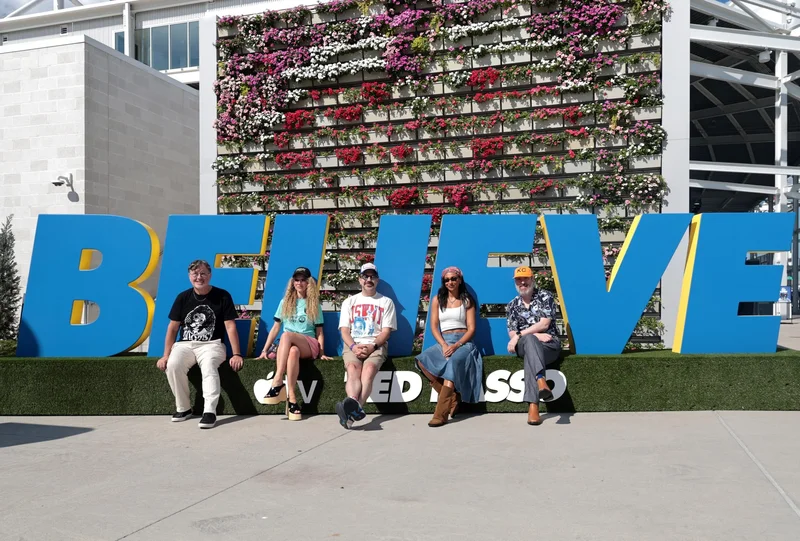
The centerpiece was a new ad built around the show's iconic Believe sign, following real fans holding up their own yellow-and-blue signs across stadiums, high school hallways, and hiking trails, scored to a stadium crowd singing "Take Me Home, Country Roads." It closes with Sudeikis breaking character just long enough to ask, "Do you believe in miracles?" The spot dropped weeks before the premiere, essentially using the World Cup's emotional momentum as free amplification for a show that hadn't aired a new episode in three years.
Apple also placed Ted Lasso inside Nike's flagship World Cup campaign, sharing frame space with Ronaldo, Mbappé, Haaland, Vinícius Jr., LeBron James, and Kim Kardashian. That's a fictional character sharing billing with the actual biggest names in the sport, a testament to how far the character has outgrown the show itself as a marketing asset.
Then there was Kansas City again. Sudeikis hosted a public watch party at CPKC Stadium for Argentina's World Cup quarterfinal against Switzerland, turning a genuine sporting moment into press coverage for Season 4 without spending a dollar on traditional advertising for that specific beat. Outlets covered it as World Cup news first and Lasso promotion second, which is exactly the kind of earned coverage paid media can't replicate.
None of this is entirely new. Apple ran a similar playbook in 2022, sending personalized, handwritten Believe billboards to every USMNT player's hometown ahead of the Qatar World Cup, a campaign good enough to win a D&AD Pencil. The 2026 version leans on the same visual signature, but with a wider frame, tying into two live cultural moments at once instead of one, and threading a real social conversation about women's sports investment into a comedy that built its identity on empathy.
Why this rollout matters beyond one show
What Apple is doing with Ted Lasso is a useful signal for anyone building entertainment marketing around sports right now. The old model treated a World Cup tie-in as a one-off stunt and a women's sports storyline as a risk to manage carefully. This rollout treats both as growth engines, tying a fictional property's credibility to real institutions (CPKC Stadium, the Kansas City Current, actual World Cup fandom) rather than manufacturing hype in a vacuum.
Whether Season 4 lands creatively is still an open question critics are already debating. But as a rollout, Apple has done something harder than make people laugh. It's made a three-year-old show feel like it showed up exactly on time.