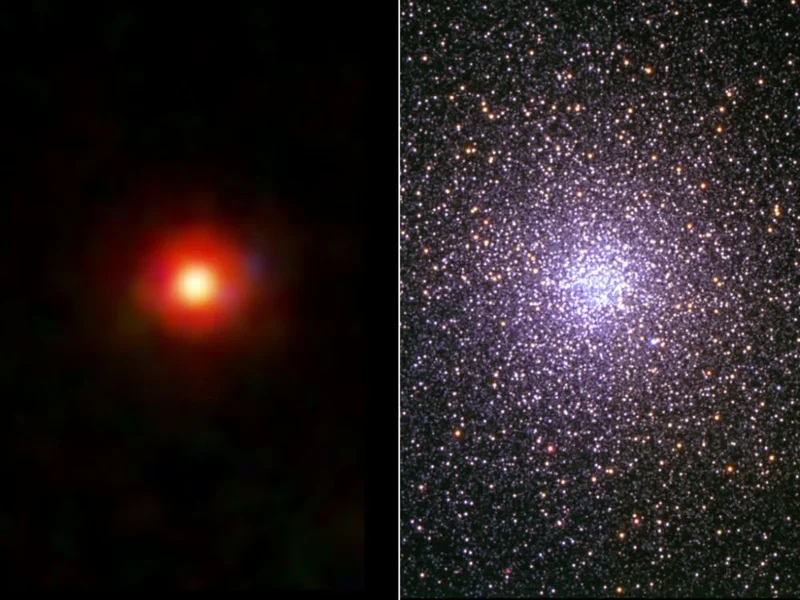
Nobody knows where the phrase "Kill two birds with one stone" originated. But the fact that itâor a phrase very similar to itâappears in multiple cultures throughout history shows that it has widespread utility. After all, who wouldn't like to solve two problems with one action?
The phrase applies to new research that links two astronomical mysteries to a single solution. One of the mysteries is globular clusters (GCs), those clumps of aged stars that hang around on the peripheries of galaxies like the Milky Way. The other is the JWST's notorious Little Red Dots (LRDs), extremely compact, glowing objects found in abundance by the space telescope in the early Universe.
The research is published in The Astrophysical Journal Letters and is titled "Little Red Dots as Globular Clusters in Formation." The lead author is John Chisholm, an astronomer at UT Austin.
In their research letter, the authors describe Little Red Dots (LRDs) as "enigmatic high-redshift discoveries." Their discovery was first reported in 2024 and they existed between about 13.2 and 12.2 billion years ago. They could be active galactic nuclei, supermassive primordial stars, primordial galaxies, or something else. "Here, we explore the possibility that these sources are globular clusters in formation," they write.
This image shows a handful of the Little Red Dots found by the JWST. Large numbers of LRDs emerged about 600 million years after the Big Bang, and then declined rapidly about 1.5 billion years after the Big Bang. Image Credit: NASA, ESA, CSA, STScI, D. Kocevski (Colby College)
Globular clusters aren't mysterious in the same way as LRDs are. We know they're collections of gravitationally bound stars, and a single GC can have several million members. Their stars tend to be older, and have lower metallicities. In some galaxies, the GCs are some of the oldest objects in the galaxy. Almost all galaxies have them, and our own galaxy has at least 150 of them in its galactic halo.
In this work, the researchers used modelling to ferret out a connection between LRDs and GCs.
Though LRDs and GCs look different from one another, study co-author Danielle Berg, an astronomer at UT Austin, reminds us that we're seeing the two in completely different time frames. GCs we can see in the local Universe, after they have likely aged for billions of years.
âWe usually see them after billions of years of evolution, at a time when their massive stars are gone, their gas has been cleared out, and dynamical processes have changed their masses and structures,â explained Berg. âThat makes it very hard to reconstruct the original conditions they formed in.â
The stellar population in a GC all formed at roughly the same time. They formed during a time of high star formation activity in the early Universe. That means they should have roughly the same metallicity and chemical composition. But that's not what astronomers find. Instead they find that some chemicals, like helium, nitrogen, sodium, and aluminum, are abundant. On the other hand, other chemicals like carbon, oxygen, and magnesium, are in short supply. This is a clue to the types of stars that were synthesizing the chemicals.
âThis specific pattern indicates nuclear fusion at very high temperatures, much higher than in the cores of even massive normal stars,â said UT Austinâs Mike Boylan-Kolchin, a co-author on the study. âA supermassive star is precisely the kind of environment that could produce this combination.â
A supermassive star (SMS) could be thousands of times more massive than the Sun, and hot enough to synthesize chemicals ike sodium and aluminum in abundance. A star this massive wouldn't have formed from a single collapse event like our Sun did. Instead, it would've formed over time through a series of stellar mergers. Inside a GC, a supermassive star like this would occupy the center, though not for very long. These stars would consume their supply of hydrogen rapidly.
âWhen they die, they would blow that material back out,â explained Berg, âseeding the next generation of stars with the chemical fingerprints we still see in globular clusters today.â
It's these supermassive stars that make ancient GCs look like LRDs, according to the researchers.
âIn our model,â added Chisholm, âthe supermassive star that helps make the object look like a Little Red Dot would live for only a short time. Once that star dies, the object may no longer look like a Little Red Dot, even if the cluster itself survives billions of years.â
Their main piece of evidence are the spectral profiles of LRDs and SMSs.
"LRDs are commonly defined by their V-shaped spectral morphology," the authors write. "An SMS combined with a star cluster can plausibly reproduce the observed V-shaped spectral profile."
This figure shows spectral profiles for a very bright LRD named A2744-45924 with a light blue line. The dark blue line shows an SMS, while the yellow line shows a star cluster. The red line shows an SMS combined with a star cluster, and that line is a strong match for the LRD. Image Credit: Chisholm et al. 2026. ApJL.
The researchers also determined the numbers of LRDs to see if it matches the number of GCs in the local Universe. This is derived from the mass function, which is basically the number density of objects as a function of mass. If LRDs are really GCs observed in the act of formation, then they should have evolved over time to have the mass function of modern GCs. The mechanisms would be stellar evolution and mass loss.
To compare the two, the researchers modelled what the mass function of LRDs would look like today to see if it matched that of GCs.
"Over the ensuing â¼13 Gyr, we follow the prescriptions developed to describe local globular clusters and assume the quenched cluster loses M* through stellar evolution and dynamical interactions such as tidal stripping and evaporation," the researchers explain.
The researchers then looked at the GC data for the Milky Way, Andromeda, and the Virgo Cluster. All three are very well-studied and the researchers used this data to determine the population of GCs within a range, including uncertainties.
"We estimate the total present-day number density of LRDs formed across all redshifts to be â0.3 Mpcâ3, similar within uncertainties to local globular clusters," the authors write.
Overall, their work shows that the mass of LRDs could've evolved into the mass of local GCs. Strengthening the connection between the two is the fact that the LRDs appeared in the Universe at the same point in time as GCs must have formed.
This figure shows how the Evolved Final Mass Function of LRDs matches that of the Milky Way's and the Virgo Cluster's population of GCs. Image Credit: Chisholm et al. 2026. ApJL.
While these results are intriguing, the researchers suggest caution. "While the scenario remains plausible, no definitive conclusion can be currently made and we outline several observations to stress test this hypothesis," they write.
âThereâs no single smoking gun at this point that says Little Red Dots are globular clusters, but it would explain a lot of diverse and surprising observations,â said Boylan-Kolchin.
âLittle Red Dots could be galaxies, they could involve black holes, or they could be something even more unexpected,â continued Chisholm. âOur work shows that forming globular clusters with supermassive stars should be part of that conversation.â
"If confirmed, LRDs offer a direct view of globular cluster formation and open a new window onto extreme stellar astrophysics characterized by intense radiation fields. Their high luminosities suggest that similar systems may be observable at even earlier epochs, potentially characterizing the first generations of stars," the authors conclude.