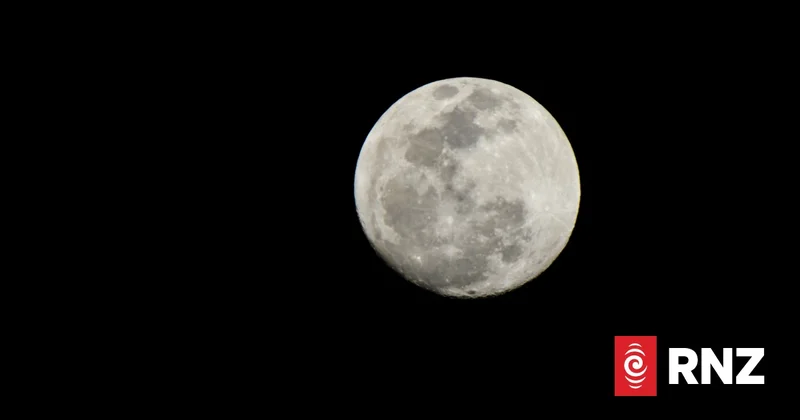
July's full moon is known around the world as the buck moon, but is there really anything special about it?
Te Whatu Stardome astronomer Kaitlyn Martin said astronomically, the moon was actually not very special but could be a "particularly pretty full moon" if the weather is clear.
It will be an official full moon just after 2am on 30 July but she said it will be most visible in the evening.
The buck moon got its name from North America, where the full moon marks the time when deers regrow their antlers in the summer season.
Martin said since it was winter in New Zealand, this phenomenon did not apply but it was similar to Maramataka - the Māori lunar calendar - which also acts as a guide to the environment.
In terms of how it will look, she said nothing too spectacular was expected but if the weather is clear, it could be a very visible full moon.
She said it was also expected to appear big at an earlier time between 6.15pm and 6.30pm.
As it is winter in the Southern Hemisphere, the moon won't be too low in the sky.
"This full moon will take quite a high arc over the sky from east to west. Not the highest it can get, but definitely quite high up."
Office of Astronomy Outreach International Astronomical Union national outreach coordinator Antony Gomez said while it was a full moon it shouldn't be mistaken for a supermoon, a much larger appearing moon.
He explained there are times when the moon is slightly further away and results in a slight variation in the size of the moon as it appears in the sky.
"That's solely determined by the way of the orbit of the moon around the Earth itself. I mean, there is formulas that determine when that happens but there's no kind of periodicity that says it's going to happen every July."
He said the buck moon was more of a seasonal marker for places like North America.
"Different cultures have different names for different times of year, and that's a way of indicating their seasons."
It was similar to the 'strawberry moon' which he said was linked to the Northern Hemisphere's harvest time.
"It's actually got nothing to do with the colour of the moon. It's more to do with the season of the time of year that strawberries are abundant in another country."
He said the next supermoon was set to be in November.
How to find the best photo spots
For those keen to get a photo of this month's full moon, Martin said it was best to be in a spot where the moon can be seen coming over the horizon.
"If you're sort of up high and can see the horizon line to the east, that will help you get a good view of it."
The weather does have to be ideal and MetServices' extended forecast for 29 July shows it may not be clear all over the country.
The North Island is mainly fine with isolated showers in the east set to clear up early. Areas of cloud and isolated showers are expected to develop in the north and south of the North Island later on.
The South Island is set to get some showers in the west which will turn into rain later and partly cloudy elsewhere.